In our aging society, healing joint problems is becoming increasingly important. To do this, cartilage damage must become repairable. But so far it has proven impossible to recreate the intricate internal structure of cartilage. Professor Jos Malda has now received an ERC Advanced grant of €2.5 million to crack that code.
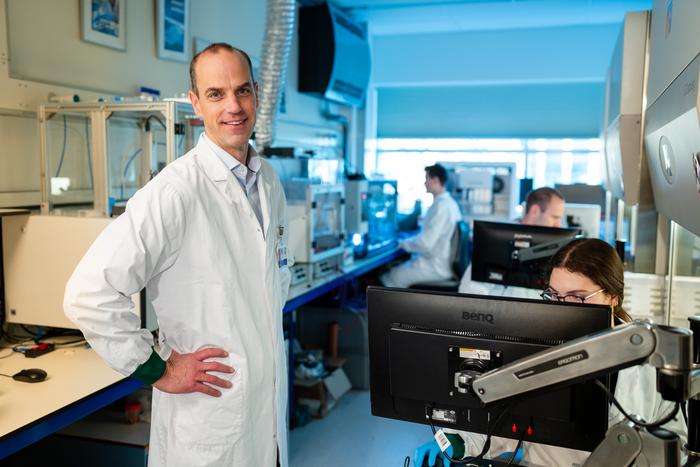
Credit: Regenerative Medicine Center Utrecht
Can Jos Malda crack the code of cartilage?
In our aging society, healing joint problems is becoming increasingly important. To do this, cartilage damage must become repairable. But so far it has proven impossible to recreate the intricate internal structure of cartilage. Professor Jos Malda has now received an ERC Advanced grant of €2.5 million to crack that code.
Bringing biology and technology together
Throughout his career, Jos Malda has been concerned with the interface between biology and technology. It took him from studying Bioprocess Engineering in Wageningen to a professorship of Biofabrication in Translational Regenerative Medicine in Utrecht. Here, at the Regenerative Medicine Center Utrecht, he has been focusing on printing and regenerating cells and tissues for years. Jos: ‘It started with cartilage, because it seemed relatively simple, without blood vessels and nerves. But it turns out to be very complicated, because it has a special structure.’
Cartilage is a challenging tissue due to its arched structure
Cartilage contains few cells, but lots of collagen in an arcuate structure. “These arches provide strength and can withstand a lot, just like similar shapes in old bridges or the famous buildings of Antoni Gaudí,” says Jos. Because cartilage has few cells, repair via the body’s own processes is difficult, and the solution mainly lies in being able to reshape the cartilage arches. ‘There are ways to repair cartilage, but they leave the collagen in a random orientation. This does not last as long and ensures that there is always a seam with the healthy tissue.’
A prestigious grant to understand cartilage
The 2.5 million euros that Jos Malda is now receiving from the European Research Council, the largest individual grant in Europe, is intended to find out once and for all how these cartilage arches arise, and how we can recreate it for regenerative treatments. ‘The great thing about this ERC Advanced grant is that it gives a lot of freedom. We have a thorough plan, but if the results show that we need to adjust our approach, then we can,” Jos beams.
Learning from models and animals
One of the first steps in the project will be to create a cartilage ‘organ-on-a-chip’ model. This is a small model in which pieces of cartilage can be studied in great detail. Jos: ‘We can make very small adjustments in such a model, for example in altering mechanical loading or by adding certain substances. How the tissue responds teaches us step by step what is important for the development of the cartilage.’
Another important phase is at the Faculty of Veterinary Medicine at Utrecht University. ‘I have been collecting cartilage from joints of various mammals for over fifteen years,’ Jos explains. ‘It started with horses and dogs, but after I had the opportunity to examine an elephant that died in a zoo, I started looking more broadly. Now I have broad selection in the drawer, from giraffes and kangaroos to orcas and sperm whales.”
Each animal is a puzzle piece
That collection of animals – all accidental deaths – now turns out to be a gold mine. ‘We can link the difference in cartilage to a different lifestyle. Animals that swim in the water experience a completely different load than walking land animals, and the joints and cartilage show this. Marine mammals, for example, lack those characteristic arches. This indicates that the forces that occur during walking may play a role in the development of the cartilage. This way we keep puzzling further towards the answer.’
The best conditions for arches
Jos links all the knowledge gained from research on other mammals and the models to his expertise in 3D bioprinting – printing living cells and tissues. ‘We can already do a lot with our bioprinters. But we will have to combine the technological side of printing arches with biological signals to ensure that such a print is ultimately successful and integrates well into the rest of the cartilage.’
A vision of a flexible joint
The ultimate goal of this knowledge is to create better treatments for humans and animals. “If we can recreate the cartilage better and have repairs properly integrated into the rest of the joint, the joints will remain healthy for longer,” Jos concludes. ‘A healthy musculoskeletal system is becoming increasingly important for healthy aging. Especially now that we are getting better at curing other conditions such as cardiovascular disease and cancer, and the elderly are living longer.’