Researchers from Lehigh University have developed a material that demonstrates the potential for drastically increasing the efficiency of solar panels.
Credit: Ekuma Lab / Lehigh University
Researchers from Lehigh University have developed a material that demonstrates the potential for drastically increasing the efficiency of solar panels.
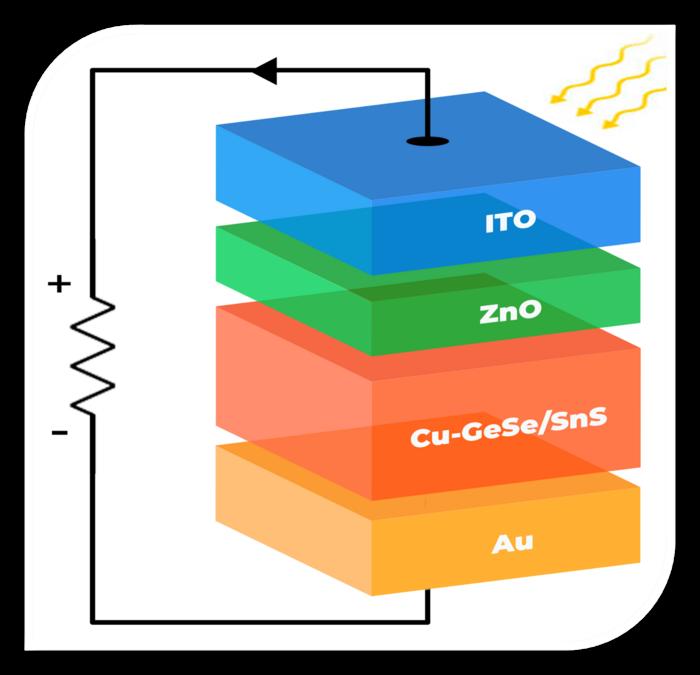
A prototype using the material as the active layer in a solar cell exhibits an average photovoltaic absorption of 80%, a high generation rate of photoexcited carriers, and an external quantum efficiency (EQE) up to an unprecedented 190%—a measure that far exceeds the theoretical Shockley-Queisser efficiency limit for silicon-based materials and pushes the field of quantum materials for photovoltaics to new heights.
“This work represents a significant leap forward in our understanding and development of sustainable energy solutions, highlighting innovative approaches that could redefine solar energy efficiency and accessibility in the near future,” said Chinedu Ekuma, professor of physics, who published a paper on the development of the material with Lehigh doctoral student Srihari Kastuar in the journal Science Advances.
The material’s efficiency leap is attributable largely to its distinctive “intermediate band states,” specific energy levels that are positioned within the material’s electronic structure in a way that makes them ideal for solar energy conversion.
These states have energy levels within the optimal subband gaps—energy ranges where the material can efficiently absorb sunlight and produce charge carriers—of around 0.78 and 1.26 electron volts.
In addition, the material performs especially well with high levels of absorption in the infrared and visible regions of the electromagnetic spectrum.
In traditional solar cells, the maximum EQE is 100%, representing the generation and collection of one electron for each photon absorbed from sunlight. However, some advanced materials and configurations developed over the past several years have demonstrated the capability of generating and collecting more than one electron from high-energy photons, representing an EQE of over 100%.
While such Multiple Exciton Generation (MEG) materials are yet to be broadly commercialized, they hold the potential to greatly increase the efficiency of solar power systems. In the Lehigh-developed material, the intermediate band states enable the capture of photon energy that is lost by traditional solar cells, including through reflection and the production of heat.
The researchers developed the novel material by taking advantage of “van der Waals gaps,” atomically small gaps between layered two-dimensional materials. These gaps can confine molecules or ions, and materials scientists commonly use them to insert, or “intercalate,” other elements to tune material properties.
To develop their novel material, the Lehigh researchers inserted atoms of zerovalent copper between layers of a two-dimensional material made of germanium selenide (GeSe) and tin sulfide (SnS).
Ekuma, an expert in computational condensed matter physics, developed the prototype as a proof of concept after extensive computer modeling of the system demonstrated theoretical promise.
“Its rapid response and enhanced efficiency strongly indicate the potential of Cu-intercalated GeSe/SnS as a quantum material for use in advanced photovoltaic applications, offering an avenue for efficiency improvements in solar energy conversion,” he said. “It’s a promising candidate for the development of next-generation, high-efficient solar cells, which will play a crucial role in addressing global energy needs.”
Although integrating the newly designed quantum material into current solar energy systems will need further research and development, Ekuma points out that the experimental technique used to create these materials is already highly advanced. Scientists have, over time, mastered a method that precisely inserts atoms, ions, and molecules into materials.
The research was funded in part by a grant from the U.S. Department of Energy.
Journal
Science Advances
DOI
10.1126/sciadv.adl6752
Article Title
Chemically Tuned Intermediate Band States in Atomically Thin CuxGeSe/SnS Quantum Material for Photovoltaic Applications
Article Publication Date
10-Apr-2024