Researchers have introduced an innovative underwater vest equipped with an antioxidant MXene hydrogel for the sensitive recognition of fish locomotion. This novel device aims to deepen our understanding of aquatic life by enabling precise monitoring of fish behavior in their natural habitats.
Traditional techniques for observing fish behavior, largely dependent on vision-based systems, face substantial limitations, such as a confined range of observation and a limited duration of operation underwater. In response to these challenges, the research team has pioneered a wearable electronic device that adeptly captures disturbances in the water flow caused by the movements of fish. This innovation is realized through a “smart vest” designed for fish, utilizing an advanced MXene hydrogel known for its remarkable sensitivity to changes in water pressure. The device features a pair of pseudocapacitive pressure-sensing units, offering a robust and noninvasive approach for the in-depth study of aquatic behaviors. These findings were detailed in an article (DOI: 10.1038/s41378-024-00675-8) released on March 22, 2024, in Microsystems & Nanoengineering.
This vest is designed to precisely capture the subtle nuances of fish movement, offering a window into their natural behaviors without interference. The heart of the vest’s technology is its innovative hydrogel electrodes, which ingeniously combine MXene nanosheets with holey-reduced graphene oxide, further enhanced by ionic liquids. This blend not only boosts the electrodes’ sensitivity to minute movements but also ensures their longevity in aquatic environments, overcoming traditional barriers of underwater research tools. The breakthrough lies in the vest’s ability to detect the flow field disturbances created by fish as they navigate their watery realms. Whether a fish turns, speeds up, or dips, the vest’s pseudocapacitive pressure-sensing units register these actions with unparalleled precision.
Dr. Jiafei Hu, the lead researcher from the National University of Defense Technology, highlighted the breakthrough nature of their wearable device, stating, “This wearable device significantly advances aquatic research. It transcends the constraints of traditional systems and paves the way for comprehensive studies on fish behavior and their ecological interactions.”
The introduction of the underwater vest signifies a major advancement in research methodologies, enabling precise, real-time insights into fish behaviors and their environmental dynamics. Its implications for environmental conservation, aquatic ecosystem studies, and the development of sophisticated monitoring technologies are profound and far-reaching.
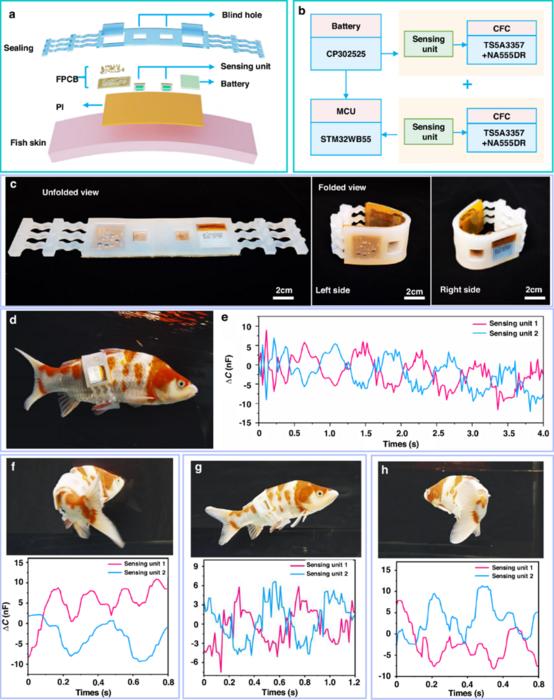
Credit: Microsystems & Nanoengineering
Researchers have introduced an innovative underwater vest equipped with an antioxidant MXene hydrogel for the sensitive recognition of fish locomotion. This novel device aims to deepen our understanding of aquatic life by enabling precise monitoring of fish behavior in their natural habitats.
Traditional techniques for observing fish behavior, largely dependent on vision-based systems, face substantial limitations, such as a confined range of observation and a limited duration of operation underwater. In response to these challenges, the research team has pioneered a wearable electronic device that adeptly captures disturbances in the water flow caused by the movements of fish. This innovation is realized through a “smart vest” designed for fish, utilizing an advanced MXene hydrogel known for its remarkable sensitivity to changes in water pressure. The device features a pair of pseudocapacitive pressure-sensing units, offering a robust and noninvasive approach for the in-depth study of aquatic behaviors. These findings were detailed in an article (DOI: 10.1038/s41378-024-00675-8) released on March 22, 2024, in Microsystems & Nanoengineering.
This vest is designed to precisely capture the subtle nuances of fish movement, offering a window into their natural behaviors without interference. The heart of the vest’s technology is its innovative hydrogel electrodes, which ingeniously combine MXene nanosheets with holey-reduced graphene oxide, further enhanced by ionic liquids. This blend not only boosts the electrodes’ sensitivity to minute movements but also ensures their longevity in aquatic environments, overcoming traditional barriers of underwater research tools. The breakthrough lies in the vest’s ability to detect the flow field disturbances created by fish as they navigate their watery realms. Whether a fish turns, speeds up, or dips, the vest’s pseudocapacitive pressure-sensing units register these actions with unparalleled precision.
Dr. Jiafei Hu, the lead researcher from the National University of Defense Technology, highlighted the breakthrough nature of their wearable device, stating, “This wearable device significantly advances aquatic research. It transcends the constraints of traditional systems and paves the way for comprehensive studies on fish behavior and their ecological interactions.”
The introduction of the underwater vest signifies a major advancement in research methodologies, enabling precise, real-time insights into fish behaviors and their environmental dynamics. Its implications for environmental conservation, aquatic ecosystem studies, and the development of sophisticated monitoring technologies are profound and far-reaching.
###
References
DOI
10.1038/s41378-024-00675-8
Original Source URL
https://doi.org/10.1038/s41378-024-00675-8
Funding information
This work was supported by the National Natural Science Foundation of China (no. 62304259).
About Microsystems & Nanoengineering
Microsystems & Nanoengineering is an online-only, open access international journal devoted to publishing original research results and reviews on all aspects of Micro and Nano Electro Mechanical Systems from fundamental to applied research. The journal is published by Springer Nature in partnership with the Aerospace Information Research Institute, Chinese Academy of Sciences, supported by the State Key Laboratory of Transducer Technology.
Journal
Microsystems & Nanoengineering
DOI
10.1038/s41378-024-00675-8
Subject of Research
Not applicable
Article Title
An underwater vest containing an antioxidant MXene hydrogel for sensitive recognition of fish locomotion
Article Publication Date
22-Mar-2024
COI Statement
The authors declare that they have no competing interests.