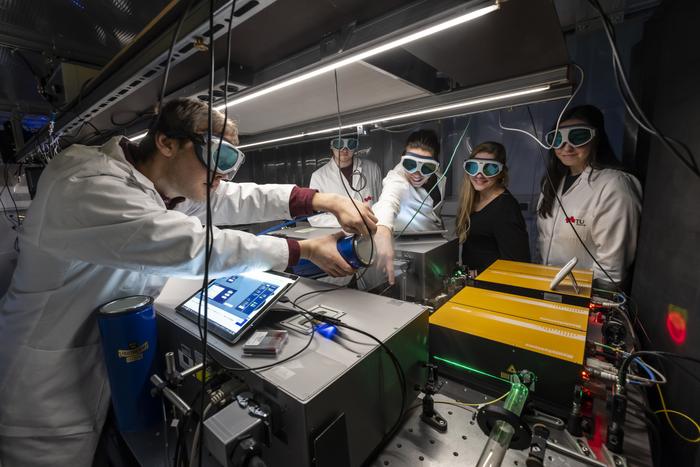
Sunlight has a major influence on chemical processes. Its high-energy UV radiation in particular is strongly absorbed by all materials and triggers photochemical reactions of the substances present in the air. A well-known example is the formation of ground-level ozone when UV light hits nitrogen oxides. A research team led by Birgitta Schultze-Bernhardt from the Institute of Experimental Physics at Graz University of Technology (TU Graz) is now utilising this high reaction potential for a new method of environmental monitoring. They have developed the world’s first broadband UV dual-comb spectrometer with which air pollutants can be continually measured and their reaction with the environment can be observed in real time. A paper on the development has been recently published in the journal Optica.
Dual-comb spectrometers have been around for almost 20 years. Here, a source emits light in a broad wavelength range, which, when arranged according to its optical frequencies, is reminiscent of the teeth of a comb. If this light penetrates a gaseous material sample, the molecules it contains absorb some of the light. The altered light wavelengths allow conclusions to be drawn about the ingredients and optical properties of the analysed gas.
Laser light pulses cause gas molecules to rotate and vibrate
The special feature of the spectrometer developed by Birgitta Schultze-Bernhardt is that a laser system emits double light pulses in the ultraviolet spectrum. When this UV light meets gas molecules, it excites the molecules electronically and also causes them to rotate and vibrate – so-called rovibronic transitions – which are unique to each gaseous substance. In addition, the broadband UV dual-comb spectrometer combines three properties that conventional spectrometers have so far only been able to offer in part: (1) a large bandwidth of the emitted UV light, which means that a great deal of information about the optical properties of the gas samples can be collected with a single measurement; (2) a high spectral resolution, which in future will also enable the investigation of complex gas mixtures such as our Earth’s atmosphere; and (3) short measurement times when analysing the gas samples. “This makes our spectrometer suitable for sensitive measurements by which changes in gas concentrations and the course of chemical reactions can be observed very precisely,” explains Lukas Fürst, PhD student in the Coherent Sensing working group and first author of the publication.
Developed and tested using formaldehyde as an example
The researchers developed and tested their spectrometer using formaldehyde. The air pollutant is produced when fossil fuels and wood are burned, as well as indoors through vapours from adhesives used in furniture. “With our new spectrometer, formaldehyde emissions in the textile or wood processing industries as well as in cities with increased smog levels can be monitored in real time, thus improving the protection of personnel and the environment,” explains Birgitta Schultze-Bernhardt. The application of the spectrometer can also be transferred to other air pollutants such as nitrogen oxides and ozone and other climate-relevant trace gases. The research team hopes that this will provide new findings about their effects in the atmosphere. Based on this, new strategies for improving air quality could be derived.
This research area is anchored in the Field of Expertise “Advanced Materials Science“, one of five strategic foci of TU Graz. The research project was funded as part of an ERC Starting Grant (Horizon 2020, project number 947288) and an Austrian Science Fund START award (project number Y1254).
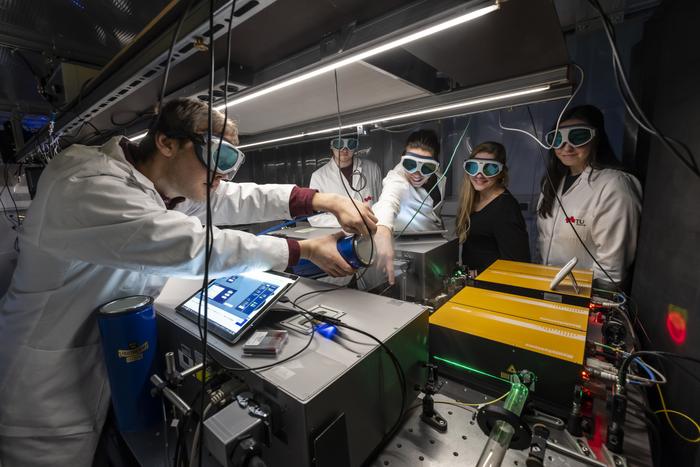
Credit: Lunghammer – NAWI Graz
Sunlight has a major influence on chemical processes. Its high-energy UV radiation in particular is strongly absorbed by all materials and triggers photochemical reactions of the substances present in the air. A well-known example is the formation of ground-level ozone when UV light hits nitrogen oxides. A research team led by Birgitta Schultze-Bernhardt from the Institute of Experimental Physics at Graz University of Technology (TU Graz) is now utilising this high reaction potential for a new method of environmental monitoring. They have developed the world’s first broadband UV dual-comb spectrometer with which air pollutants can be continually measured and their reaction with the environment can be observed in real time. A paper on the development has been recently published in the journal Optica.
Dual-comb spectrometers have been around for almost 20 years. Here, a source emits light in a broad wavelength range, which, when arranged according to its optical frequencies, is reminiscent of the teeth of a comb. If this light penetrates a gaseous material sample, the molecules it contains absorb some of the light. The altered light wavelengths allow conclusions to be drawn about the ingredients and optical properties of the analysed gas.
Laser light pulses cause gas molecules to rotate and vibrate
The special feature of the spectrometer developed by Birgitta Schultze-Bernhardt is that a laser system emits double light pulses in the ultraviolet spectrum. When this UV light meets gas molecules, it excites the molecules electronically and also causes them to rotate and vibrate – so-called rovibronic transitions – which are unique to each gaseous substance. In addition, the broadband UV dual-comb spectrometer combines three properties that conventional spectrometers have so far only been able to offer in part: (1) a large bandwidth of the emitted UV light, which means that a great deal of information about the optical properties of the gas samples can be collected with a single measurement; (2) a high spectral resolution, which in future will also enable the investigation of complex gas mixtures such as our Earth’s atmosphere; and (3) short measurement times when analysing the gas samples. “This makes our spectrometer suitable for sensitive measurements by which changes in gas concentrations and the course of chemical reactions can be observed very precisely,” explains Lukas Fürst, PhD student in the Coherent Sensing working group and first author of the publication.
Developed and tested using formaldehyde as an example
The researchers developed and tested their spectrometer using formaldehyde. The air pollutant is produced when fossil fuels and wood are burned, as well as indoors through vapours from adhesives used in furniture. “With our new spectrometer, formaldehyde emissions in the textile or wood processing industries as well as in cities with increased smog levels can be monitored in real time, thus improving the protection of personnel and the environment,” explains Birgitta Schultze-Bernhardt. The application of the spectrometer can also be transferred to other air pollutants such as nitrogen oxides and ozone and other climate-relevant trace gases. The research team hopes that this will provide new findings about their effects in the atmosphere. Based on this, new strategies for improving air quality could be derived.
This research area is anchored in the Field of Expertise “Advanced Materials Science“, one of five strategic foci of TU Graz. The research project was funded as part of an ERC Starting Grant (Horizon 2020, project number 947288) and an Austrian Science Fund START award (project number Y1254).
Journal
Optica
DOI
10.1364/OPTICA.516783
Method of Research
Experimental study
Subject of Research
Not applicable
Article Title
Broadband near-ultraviolet dual comb spectroscopy
Article Publication Date
3-Apr-2024