• HOME
  • NEWS
  • EXPLORE
    • CAREER
      • Companies
      • Jobs
    • EVENTS
    • iGEM
      • News
      • Team
    • PHOTOS
    • VIDEO
    • WIKI
  • BLOG
  • COMMUNITY
    • FACEBOOK
    • INSTAGRAM
    • TWITTER
Saturday, February 7, 2026
BIOENGINEER.ORG
No Result
View All Result
  • Login
  • HOME
  • NEWS
  • EXPLORE
    • CAREER
      • Companies
      • Jobs
        • Lecturer
        • PhD Studentship
        • Postdoc
        • Research Assistant
    • EVENTS
    • iGEM
      • News
      • Team
    • PHOTOS
    • VIDEO
    • WIKI
  • BLOG
  • COMMUNITY
    • FACEBOOK
    • INSTAGRAM
    • TWITTER
  • HOME
  • NEWS
  • EXPLORE
    • CAREER
      • Companies
      • Jobs
        • Lecturer
        • PhD Studentship
        • Postdoc
        • Research Assistant
    • EVENTS
    • iGEM
      • News
      • Team
    • PHOTOS
    • VIDEO
    • WIKI
  • BLOG
  • COMMUNITY
    • FACEBOOK
    • INSTAGRAM
    • TWITTER
No Result
View All Result
Bioengineer.org
No Result
View All Result
Home NEWS Science News Chemistry

Ocean waves propel PFAS back to land

Bioengineer by Bioengineer
April 5, 2024
in Chemistry
Reading Time: 3 mins read
0
Royal Research Ship (RSS) Discovery
Share on FacebookShare on TwitterShare on LinkedinShare on RedditShare on Telegram

A new study by researchers at the Department of Environmental Science, Stockholm University, published in Science Advances, reveals that PFAS re-emit into the air from crashing ocean waves at levels comparable to or greater than other sources, establishing a cyclical transport process for these “forever chemicals” between land and sea.
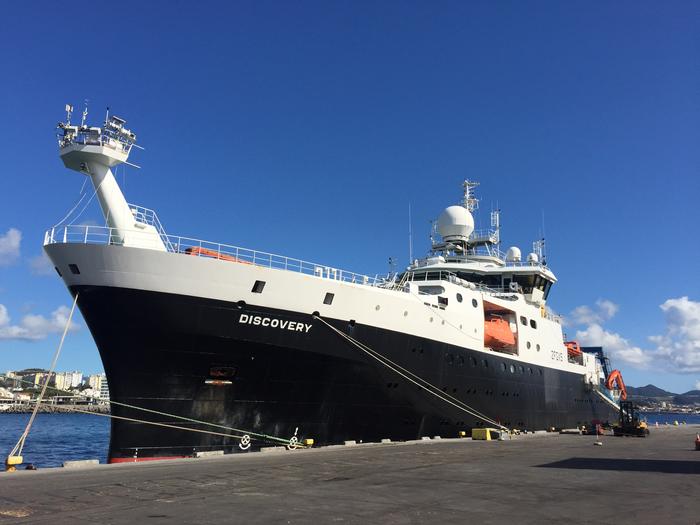
Royal Research Ship (RSS) Discovery

Credit: Bo Sha, Department of Enviromental Science, Stockholm University

A new study by researchers at the Department of Environmental Science, Stockholm University, published in Science Advances, reveals that PFAS re-emit into the air from crashing ocean waves at levels comparable to or greater than other sources, establishing a cyclical transport process for these “forever chemicals” between land and sea.

“The common belief is that per- and polyfluoroalkyl substances, PFAS, drain from the land into the oceans where they stay to be diluted into the deep oceans over the timescale of decades,” said Ian Cousins, Professor at the Department of Environmental Science and co-author of the study. “But we’ve now demonstrated in multiple studies that there’s a boomerang effect, and some of the toxic PFAS are re-emitted to air, transported long distances and then deposited back onto land.”

Field experiments across the Atlantic Ocean conducted by co-authors Bo Sha, Post-doc at the Department of Environmental Science and Jana Johansson, former Researcher at the Department of Environmental Science, currently at Linköping University, showed PFAS concentrations in air particles surpassing seawater concentrations by over 100,000 times. Subsequent global modeling estimated the re-emission, atmospheric transport, and deposition of PFAS to land.

“Jana (Johansson) and I worked intensively for two months on a ship conducting multiple field experiments with our custom-built sea spray simulator,” explained Bo Sha, the main author of the study. “While our results are scientifically impactful, they are disconcerting, creating a lot of interest among scientists, regulators, and the public.”

PFAS impacting health in coastal regions

PFAS, characterized by their extreme persistence leading to their colloquial designation as “forever chemicals, ”are associated with a variety of serious health conditions, including cancer, fertility issues, and compromised immune system function.

“In Denmark, scientists have compiled compelling evidence indicating that the sea serves as the primary source of PFAS along their west coast,” explained Matthew Salter, Researcher at the Department of Environmental Science and co-author of the study. “This aligns with our expectations, as our study predicts that coastal regions bear the greatest impact.”

The research was funded by the Swedish Research Council, FORMAS, the INTEGRATE project, and was part of the Atlantic Meridional Transect programme funded by the UK Natural Environment Research Council.


Journal

Science Advances

DOI

10.1126/sciadv.adl1026

Method of Research

Experimental study

Subject of Research

Not applicable

Article Title

Constraining global transport of perfluoroalkyl acids on sea spray aerosol using field measurements

Article Publication Date

5-Apr-2024

Share12Tweet8Share2ShareShareShare2

Related Posts

blank

Breakthrough in Environmental Cleanup: Scientists Develop Solar-Activated Biochar for Faster Remediation

February 7, 2026
blank

Cutting Costs: Making Hydrogen Fuel Cells More Affordable

February 6, 2026

Scientists Develop Hand-Held “Levitating” Time Crystals

February 6, 2026

Observing a Key Green-Energy Catalyst Dissolve Atom by Atom

February 6, 2026

POPULAR NEWS

  • Robotic Ureteral Reconstruction: A Novel Approach

    Robotic Ureteral Reconstruction: A Novel Approach

    82 shares
    Share 33 Tweet 21
  • Digital Privacy: Health Data Control in Incarceration

    63 shares
    Share 25 Tweet 16
  • Study Reveals Lipid Accumulation in ME/CFS Cells

    57 shares
    Share 23 Tweet 14
  • Breakthrough in RNA Research Accelerates Medical Innovations Timeline

    53 shares
    Share 21 Tweet 13

About

We bring you the latest biotechnology news from best research centers and universities around the world. Check our website.

Follow us

Recent News

Evaluating Pediatric Emergency Care Quality in Ethiopia

TPMT Expression Predictions Linked to Azathioprine Side Effects

Improving Dementia Care with Enhanced Activity Kits

Subscribe to Blog via Email

Success! An email was just sent to confirm your subscription. Please find the email now and click 'Confirm' to start subscribing.

Join 73 other subscribers
  • Contact Us

Bioengineer.org © Copyright 2023 All Rights Reserved.

Welcome Back!

Login to your account below

Forgotten Password?

Retrieve your password

Please enter your username or email address to reset your password.

Log In
No Result
View All Result
  • Homepages
    • Home Page 1
    • Home Page 2
  • News
  • National
  • Business
  • Health
  • Lifestyle
  • Science

Bioengineer.org © Copyright 2023 All Rights Reserved.