To better understand COVID-19’s spread during the pandemic, public health officials expanded wastewater surveillance. These efforts track SARS-CoV-2 levels and health risks among most people, but they miss people who live without shelter, a population particularly vulnerable to severe infection. To fill this information gap, researchers reporting in ACS’ Environmental Science & Technology Letters tested flood-control waterways near unsheltered encampments, finding similar transmission patterns as in the broader community and identifying previously unseen viral mutations.
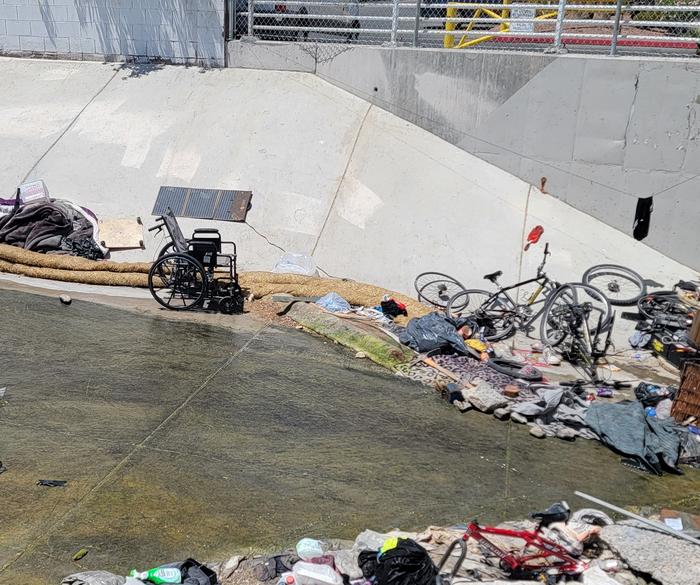
Credit: Edwin Oh
To better understand COVID-19’s spread during the pandemic, public health officials expanded wastewater surveillance. These efforts track SARS-CoV-2 levels and health risks among most people, but they miss people who live without shelter, a population particularly vulnerable to severe infection. To fill this information gap, researchers reporting in ACS’ Environmental Science & Technology Letters tested flood-control waterways near unsheltered encampments, finding similar transmission patterns as in the broader community and identifying previously unseen viral mutations.
In recent years, testing untreated wastewater for SARS-CoV-2 incidence and dominant viral variants, as well as other pathogens, has been vital to helping public health officials determine infectious disease transmission in local communities. Yet, this monitoring only captures information on viruses shed from human feces and urine in buildings that are connected to local sewage infrastructure. Beyond the pandemic’s impact on human health, it also exacerbated socioeconomic difficulties and increased the number of people experiencing homelessness and living in open-air encampments without access to indoor bathrooms. To understand the prevalence of COVID-19 among people who live unsheltered, Edwin Oh and colleagues tested for SARS-CoV-2 in waterways near encampments outside Las Vegas from December 2021 through July 2022.
Using quantitative polymerase chain reaction, the researchers identified SARS-CoV-2 RNA in more than 25% of the samples tested from two flood-control channels. The highest detection frequency over the study period aligned with Las Vegas’ first wave of omicron variant infections, as confirmed through parallel testing at a local wastewater treatment plant. The researchers say these results suggest a similar level of transmission was occurring within the unsheltered community as it was among the general population. Then the researchers conducted whole genome sequencing to identify the SARS-CoV-2 variants in the waterways. These samples largely contained the same variants identified in the broader community. Deeper computational analysis of the viral sequences identified three novel viral spike protein mutations in some waterway samples, but the researchers have not yet examined what impact these mutations might have on viral function or clinical outcomes. Regardless, the ability to detect and identify SARS-CoV-2 in environmental water samples could help improve public health measures for a community that is often underrepresented in current surveillance methods. The researchers also say monitoring waterways could warn health officials of unexpected variants circulating in the community.
The authors acknowledge funding from the National Institutes of Health, the Nevada Governor’s Office of Economic Development, the Centers for Disease Control and Prevention, and the Water Resources Research Institute of the United States Geological Survey.
The paper’s abstract will be available on April 3 at 8 a.m. Eastern time here: http://pubs.acs.org/doi/abs/10.1021/acs.estlett.3c00938
###
The American Chemical Society (ACS) is a nonprofit organization chartered by the U.S. Congress. ACS’ mission is to advance the broader chemistry enterprise and its practitioners for the benefit of Earth and all its people. The Society is a global leader in promoting excellence in science education and providing access to chemistry-related information and research through its multiple research solutions, peer-reviewed journals, scientific conferences, eBooks and weekly news periodical Chemical & Engineering News. ACS journals are among the most cited, most trusted and most read within the scientific literature; however, ACS itself does not conduct chemical research. As a leader in scientific information solutions, its CAS division partners with global innovators to accelerate breakthroughs by curating, connecting and analyzing the world’s scientific knowledge. ACS’ main offices are in Washington, D.C., and Columbus, Ohio.
To automatically receive news releases from the American Chemical Society, contact [email protected].
Note: ACS does not conduct research, but publishes and publicizes peer-reviewed scientific studies.
Follow us: X, formerly Twitter | Facebook | LinkedIn | Instagram
Journal
Environmental Science & Technology Letters
DOI
10.1021/acs.estlett.3c00938
Article Title
Environmental Surveillance of Flood Control Infrastructure Impacted by Unsheltered Individuals Leads to the Detection of SARS-CoV‑2 and Novel Mutations in the Spike Gene
Article Publication Date
3-Apr-2024