An overlooked and long-neglected type of forest has vast capacity to rebound, enhancing species diversity and resilience to climate change, according to an international team of forest scientists.
Credit: Paul Rogers
An overlooked and long-neglected type of forest has vast capacity to rebound, enhancing species diversity and resilience to climate change, according to an international team of forest scientists.
According to new research, published today in the peer-reviewed science journal PLOS ONE, there is ample habitat for the Eurasian aspen, and these environments will continue to be suitable for this “keystone species” as the global climate warms.
“The Eurasian aspen, and aspen species globally, are home to vast populations of other dependent plants and animals,” said the study’s lead author, Antonin Kusbach, an applied ecologist at Mendel University in Brno, Czechia, also known as the Czech Republic, where the team’s research was conducted. “Additionally, aspen systems regenerate and colonize new areas quickly, so these types of forests are ideally adaptive to increased forest disturbances like fire, diseases, insect infestations, and windstorms, that are widely anticipated under climate warming scenarios.”
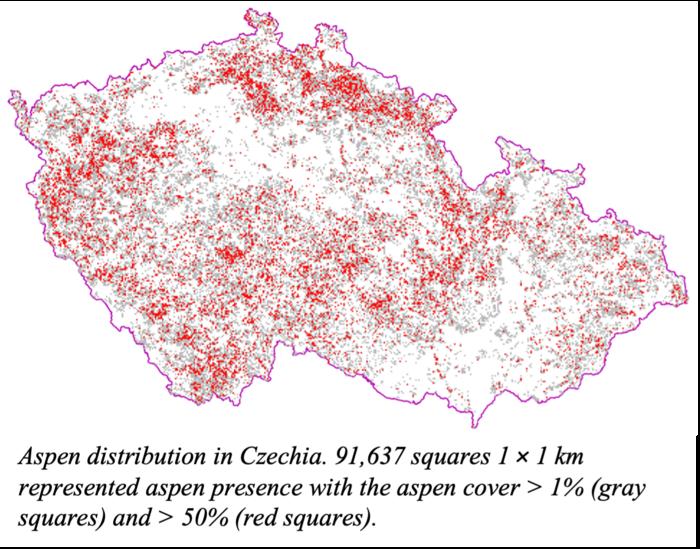
The scientists conducted a survey of more than four million forest locations using field measurements, remote sensing technology, and sophisticated analytical techniques to better understand historic and potential aspen habitat, termed the “realized niche,” across all of Czechia’s forest terrain, which are similar in make-up to forests throughout central Europe. Aspen forests were once far more widespread across these regions, but commercial forestry, usually favoring monotypic stands of desired conifer species, have altered these habitats.
It doesn’t have to remain that way.
“A course correction in European forest management could help reestablish these amazing forests,” said co-author Paul Rogers, of the Western Aspen Alliance, Ecology Center, and Department of Environment and Society at Utah State University. “Within every acre of aspen forest that returns, plant and animal diversity will flourish.”
The Eurasian aspen, Populus tremula, is one of six species of aspen in the Populus genus, which collectively stretch across much of the Northern hemisphere. Jointly, these species harbor outsized biodiversity relative to surrounding forests. Eurasian aspen spans the breadth of Europe and Asia. The quaking aspen, Populus tremuloides, is the most widely distributed tree in North America, where it is also known as a keystone species, facilitating elevated biodiversity even as climates change.
“It’s sometimes said that you could walk from coast to coast in North America and never leave the shade of an aspen tree,” Rogers said. “That might not be literally true, but it speaks to the flexibility and adaptability of these forests. Now, we are coming to better understand the great potential aspen have to thrive across Europe, as well.”
While re-establishing aspen within the tens of millions of hectares of potential habitat across Europe would be a patently difficult endeavor, it may take little more than a “nudge” to get the process started.
“My personal field observations indicate that after large Norway spruce removal following bark beetle outbreaks, aspen have naturally found their way into the central European forests,” Kusbach said. “So, this might be thought of as a solution that has been hiding in plain sight.”
Journal
PLoS ONE
Method of Research
Data/statistical analysis
Subject of Research
Not applicable
Article Title
Eurasian aspen (Populus tremula L.): Central Europe’s keystone species ‘hiding in plain sight’
Article Publication Date
27-Mar-2024