• HOME
  • NEWS
  • EXPLORE
    • CAREER
      • Companies
      • Jobs
    • EVENTS
    • iGEM
      • News
      • Team
    • PHOTOS
    • VIDEO
    • WIKI
  • BLOG
  • COMMUNITY
    • FACEBOOK
    • INSTAGRAM
    • TWITTER
Saturday, February 7, 2026
BIOENGINEER.ORG
No Result
View All Result
  • Login
  • HOME
  • NEWS
  • EXPLORE
    • CAREER
      • Companies
      • Jobs
        • Lecturer
        • PhD Studentship
        • Postdoc
        • Research Assistant
    • EVENTS
    • iGEM
      • News
      • Team
    • PHOTOS
    • VIDEO
    • WIKI
  • BLOG
  • COMMUNITY
    • FACEBOOK
    • INSTAGRAM
    • TWITTER
  • HOME
  • NEWS
  • EXPLORE
    • CAREER
      • Companies
      • Jobs
        • Lecturer
        • PhD Studentship
        • Postdoc
        • Research Assistant
    • EVENTS
    • iGEM
      • News
      • Team
    • PHOTOS
    • VIDEO
    • WIKI
  • BLOG
  • COMMUNITY
    • FACEBOOK
    • INSTAGRAM
    • TWITTER
No Result
View All Result
Bioengineer.org
No Result
View All Result
Home NEWS Science News

Research opens door to smaller, cheaper, more agile communications tech

Bioengineer by Bioengineer
February 16, 2017
in Science News
Reading Time: 2 mins read
0
Share on FacebookShare on TwitterShare on LinkedinShare on RedditShare on Telegram
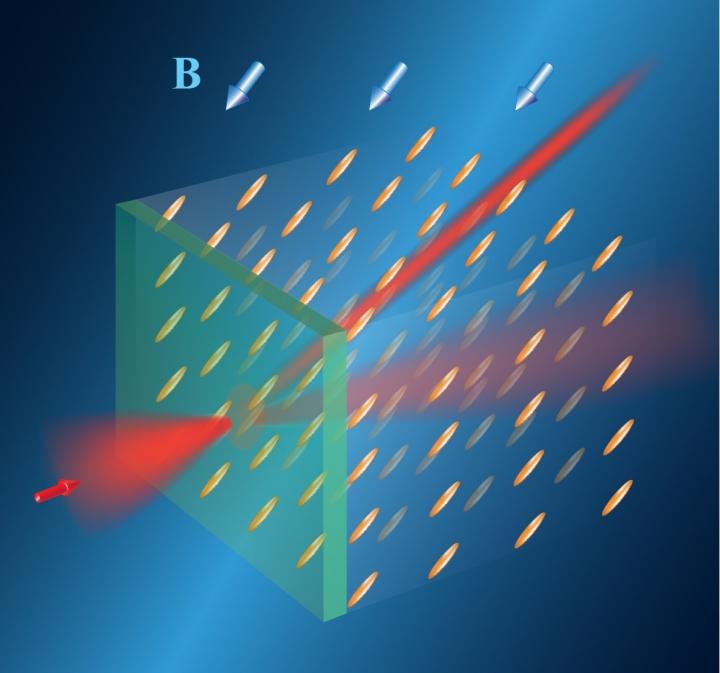
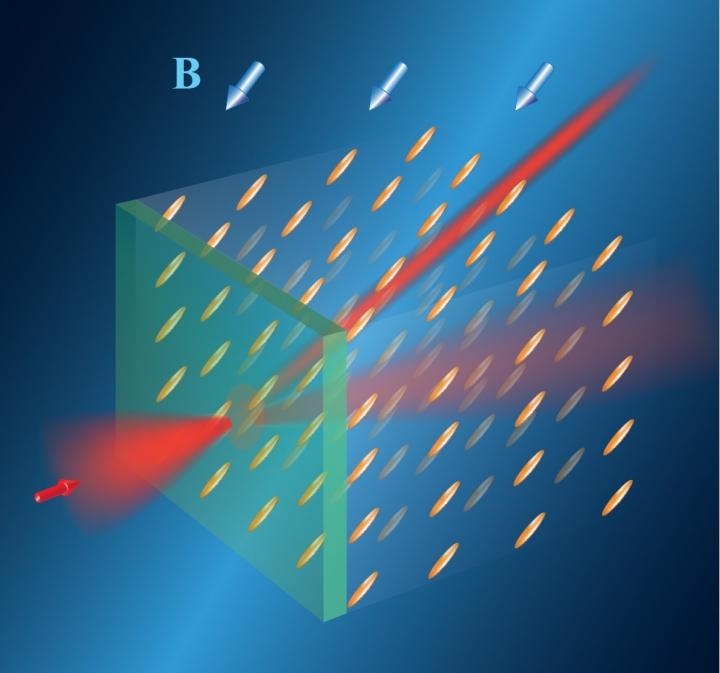
IMAGE

Credit: ANU

Research led by The Australian National University (ANU) on the use of magnets to steer light has opened the door to new communications systems which could be smaller, cheaper and more agile than fibre optics.

Group leader Professor Wieslaw Krolikowski from the ANU Research School of Physics and Engineering (RSPE) said the team's breakthrough would be crucial for developing tiny components to process huge amounts of data.

"This technology is also expected to be applicable in sensors, data storage and liquid crystal displays," said Professor Krolikowski.

Today's communication technologies aim to maximise data transmission rates and require the ability to precisely direct information channels. These technologies use electronic components for signal processing such as switching, which is not as fast as light-based technology including fibre optics.

Professor Krolikowski said the team used a magnetic field to stimulate liquid crystals and steer light beams carrying data, which enables an innovative approach to data processing and switching.

"Our discovery could lead to communications technology that could power a new generation of efficient devices such as compact and fast optical switches, routers and modulators," he said.

Co-researcher Dr Vladlen Shvedov from RSPE said the team's innovation, based on liquid crystals with properties modified by light, promised a much more agile system than fibre optics.

"This touch-free magneto-optical system is so flexible that you can remotely transfer the tiny optical signal in any desired direction in real time," Dr Shvedov said.

Co-researcher Dr Yana Izdebskaya from RSPE said while the innovation was in the early stages, it was highly promising for future communications technology.

"In the liquid crystal the light creates a temporary channel to guide itself along, called a soliton, which is about one tenth the diameter of a human hair. That's about 25 times thinner than fibre optics," Dr Izdebskaya said.

"Developing efficient strategies to achieve the robust control and steering of solitons is one of the major challenges in light-based technologies."

Dr Izdebskaya said controlling solitons in liquid crystals had only been achieved by applying voltage from inflexible electrodes.

"Such systems have been restricted by the configuration of electrodes in a thin liquid crystal layer. Our new approach doesn't have this limitation and opens a way to full 3D manipulations of light signals carried by solitons," Dr Izdebskaya said.

###

The research is published in Nature Communications: http://www.nature.com/articles/ncomms14452

For media assistance, contact Will Wright from the ANU Media Team on +612 6125 7979, +61 478 337 740 or [email protected]

Media Contact

Will Wright
[email protected]
61-261-257-979
@ANUmedia

http://www.anu.edu.au/media

############

Story Source: Materials provided by Scienmag

Share12Tweet8Share2ShareShareShare2

Related Posts

Evaluating Pediatric Emergency Care Quality in Ethiopia

February 7, 2026

TPMT Expression Predictions Linked to Azathioprine Side Effects

February 7, 2026

Improving Dementia Care with Enhanced Activity Kits

February 7, 2026

Decoding Prostate Cancer Origins via snFLARE-seq, mxFRIZNGRND

February 7, 2026
Please login to join discussion

POPULAR NEWS

  • Robotic Ureteral Reconstruction: A Novel Approach

    Robotic Ureteral Reconstruction: A Novel Approach

    82 shares
    Share 33 Tweet 21
  • Digital Privacy: Health Data Control in Incarceration

    63 shares
    Share 25 Tweet 16
  • Study Reveals Lipid Accumulation in ME/CFS Cells

    57 shares
    Share 23 Tweet 14
  • Breakthrough in RNA Research Accelerates Medical Innovations Timeline

    53 shares
    Share 21 Tweet 13

About

We bring you the latest biotechnology news from best research centers and universities around the world. Check our website.

Follow us

Recent News

Evaluating Pediatric Emergency Care Quality in Ethiopia

TPMT Expression Predictions Linked to Azathioprine Side Effects

Improving Dementia Care with Enhanced Activity Kits

Subscribe to Blog via Email

Success! An email was just sent to confirm your subscription. Please find the email now and click 'Confirm' to start subscribing.

Join 73 other subscribers
  • Contact Us

Bioengineer.org © Copyright 2023 All Rights Reserved.

Welcome Back!

Login to your account below

Forgotten Password?

Retrieve your password

Please enter your username or email address to reset your password.

Log In
No Result
View All Result
  • Homepages
    • Home Page 1
    • Home Page 2
  • News
  • National
  • Business
  • Health
  • Lifestyle
  • Science

Bioengineer.org © Copyright 2023 All Rights Reserved.