Researchers at the Keck School of Medicine, University of Southern California, have discovered that a protein called Piezo1 prevents a type of immune cell in the lung from becoming hyperactivated by allergens. The study, to be published March 26 in the Journal of Experimental Medicine (JEM), suggests that switching on Piezo1 could represent a new therapeutic approach to reducing lung inflammation and treating allergic asthma.
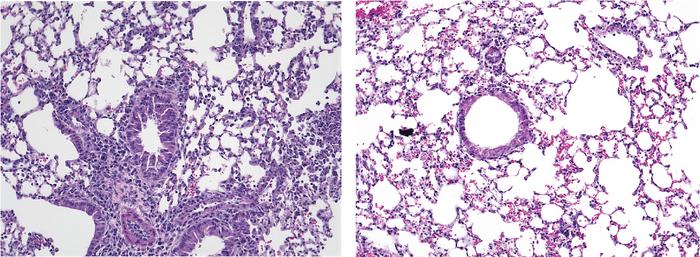
Credit: ©2024 Hurrell et al. Originally published in Journal of Experimental Medicine. https://doi.org/10.1084/jem.20231835
Researchers at the Keck School of Medicine, University of Southern California, have discovered that a protein called Piezo1 prevents a type of immune cell in the lung from becoming hyperactivated by allergens. The study, to be published March 26 in the Journal of Experimental Medicine (JEM), suggests that switching on Piezo1 could represent a new therapeutic approach to reducing lung inflammation and treating allergic asthma.
Type 2 innate lymphoid cells (also known as ILC2s) are a type of immune cell that resides in the lungs, skin, and other tissues of the body. ILC2s in the lungs become activated in the presence of allergens and produce proinflammatory signals that drive the recruitment of other immune cells into the lungs. Unchecked, this can result in excessive inflammation and a tightening of the airways, making it difficult for asthma patients to properly breathe.
“Given the importance of ILC2s in allergic asthma, there is an urgent need to develop novel mechanism-based approaches to target these critical drivers of inflammation in the lungs,” says Omid Akbari, Professor of Immunology and Professor of Medicine at USC’s Keck School of Medicine.
Akbari and colleagues discovered that, when they are activated by an allergen, ILC2s start to produce a protein called Piezo1 that can limit their activity. Piezo1 forms channels in the outer membranes of cells that open in response to mechanical changes in the cell’s environment, allowing calcium to enter the cell and change its activity.
Akbari’s team found that, in the absence of Piezo1, mouse ILC2s became more active than normal in response to allergenic signals, and the animals developed increased airway inflammation. In contrast, treatment with a drug called Yoda1 that switches on Piezo1 channels reduced the activity of ILC2s, decreased airway inflammation, and alleviated the symptoms of allergen-exposed mice. The group’s observations suggest a significant role for Piezo1 channels in ILC2 metabolism, as treatment with Yoda1 reduced ILC2 mitochondrial function and rewired the cells’ energy source.
Finally, the researchers determined that human ILC2s also produce Piezo1, and so they tested the effects of Yoda1 on mice whose ILC2s had been replaced with human immune cells.
“Remarkably, treatment of these humanized mice with Yoda1 reduced airway hyperreactivity and lung inflammation, suggesting that Yoda1 may be used as a therapeutic tool to modulate ILC2 function and alleviate the symptoms associated with ILC2-dependent airway inflammation in humans,” Akbari says. “Future studies are therefore warranted to delineate the role of Piezo1 channels in human patients with asthma and develop Piezo1-driven therapeutics for the treatment of allergic asthma pathogenesis.”
Hurrell et al. 2024. J. Exp. Med. https://rupress.org/jem/article-lookup/doi/10.1084/jem.20231835?PR
# # #
About Journal of Experimental Medicine
Journal of Experimental Medicine (JEM) publishes peer-reviewed research on immunology, cancer biology, stem cell biology, microbial pathogenesis, vascular biology, and neurobiology. All editorial decisions on research manuscripts are made through collaborative consultation between professional scientific editors and the academic editorial board. Established in 1896, JEM is published by Rockefeller University Press, a department of The Rockefeller University in New York. For more information, visit jem.org.
Visit our Newsroom, and sign up for a weekly preview of articles to be published. Embargoed media alerts are for journalists only.
Follow JEM on Twitter at @JExpMed and @RockUPress.
Journal
Journal of Experimental Medicine
DOI
10.1084/jem.20231835
Method of Research
Experimental study
Subject of Research
Animals
Article Title
Piezo1 channels restrain ILC2s and regulate the development of airway hyperreactivity
Article Publication Date
26-Mar-2024