Osaka, Japan – Organic electronics is a field that has garnered significant interest in academic and industrial circles due to its potential applications in OLEDs and organic solar cells, offering advantages such as lightweight design, flexibility, and cost-efficiency. These devices are made by depositing a thin film of organic molecules onto a substrate that acts as an electrode, and function by controlling the transfer of electrons between the thin film and the substrate. Therefore, understanding electron behavior at the interface between the substrate and the thin film, coupled with the electronic properties of the organic thin film, is crucial for the further advancement of organic electronics. Moreover, the simultaneous observation of photocarrier electrons and intramolecular photoexcitation would offer more insights into thin films of organic molecules.
Credit: Masahiro Shibuta, Osaka Metropolitan University
Osaka, Japan – Organic electronics is a field that has garnered significant interest in academic and industrial circles due to its potential applications in OLEDs and organic solar cells, offering advantages such as lightweight design, flexibility, and cost-efficiency. These devices are made by depositing a thin film of organic molecules onto a substrate that acts as an electrode, and function by controlling the transfer of electrons between the thin film and the substrate. Therefore, understanding electron behavior at the interface between the substrate and the thin film, coupled with the electronic properties of the organic thin film, is crucial for the further advancement of organic electronics. Moreover, the simultaneous observation of photocarrier electrons and intramolecular photoexcitation would offer more insights into thin films of organic molecules.
Although the static electronic states of thin films of organic molecules have been studied in detail using a technique called photoelectron spectroscopy, the accurate detection of the dynamic behavior of electrons attempting to express their functions in devices has been challenging, hindering progress.
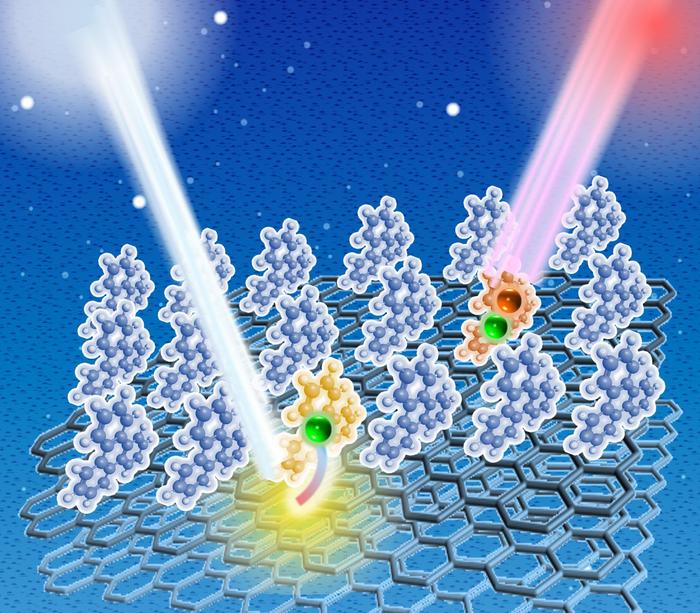
A research group led by Associate Professor Masahiro Shibuta of the Graduate School of Engineering at Osaka Metropolitan University observed the electronic behavior and surface structure of a thin film of triphenylene (TP) molecules deposited on a graphite substrate using two-photon photoemission (2PPE) spectroscopy, scanning tunneling microscopy and low-energy electron diffraction. The results showed that the TP molecules exhibit a special structure in which they are adsorbed in a standing-up configuration onto the substrate. Both electrons were injected from the substrate into the TP molecules upon light irradiation, and the electrons photo-excited in the molecular thin film were successfully observed simultaneously in a single sample. Additionally, strong photoluminescence was also observed on a thin film with only one layer of molecules in a special structure where the molecules were adsorbed diagonally on the substrate, as in the case of the TP molecules. It is expected that these results will contribute to the development of new luminescent materials and to the further development of functional organic electronic devices.
“2PPE spectroscopy is still a novel method for evaluating electronic states, but it suffers from the fact that the electronic states are sometimes well observed and sometimes not, despite the time-consuming nature of the well-optimized measurement,” Professor Shibuta said. “Our findings highlighted that the visibility of the electronic state is closely related to the adsorption mode of the molecule on the substrate and its electronic properties. In other words: Not only the type of molecules but also the way they are arranged must be properly controlled to create a device that can fully showcase their functions. I am delighted that our research is providing insights into the development of functional material for practical applications.”
The results were published in The Journal of Physical Chemistry C.
###
About OMU
Osaka Metropolitan University is the third largest public university in Japan, formed by the merger of Osaka City University and Osaka Prefecture University in 2022. OMU upholds the “Convergence of Knowledge” through 11 undergraduate schools, a college, and 15 graduate schools. For more research news, visit https://www.omu.ac.jp/en/ and follow us on X @OsakaMetUniv_en, Instagram, or Facebook.
Journal
The Journal of Physical Chemistry C
DOI
10.1021/acs.jpcc.3c07596
Method of Research
Experimental study
Subject of Research
Not applicable
Article Title
Probing of Photocarrier Electrons and Excitons at an Organic Monolayer Film Studied by Two-Photon Photoemission Spectroscopy
Article Publication Date
24-Jan-2024
COI Statement
The authors declare no competing financial interest.