Acoustic recordings of a colony of little auks reveal their nocturnal activities and offer valuable monitoring means for avian biology in the Arctic.
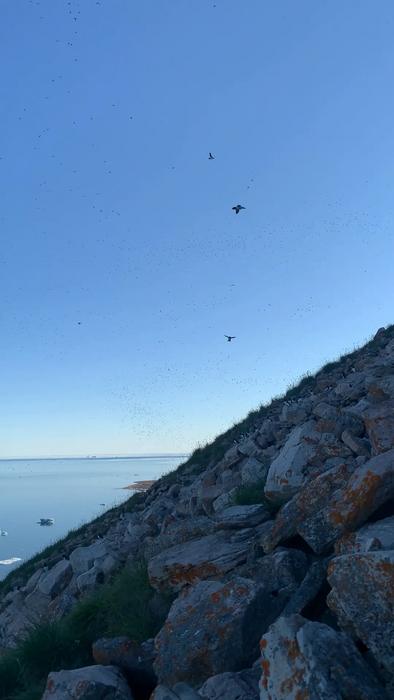
Credit: Monica Ogawa
Acoustic recordings of a colony of little auks reveal their nocturnal activities and offer valuable monitoring means for avian biology in the Arctic.
A collaborative study conducted by researchers from the Arctic Research Center at Hokkaido University and the Department of Ecoscience at Aarhus University, Denmark, delves into the captivating activities of the most abundant seabird in the North Atlantic (little auk, Alle alle). The study sheds light on birds’ daily rhythmic behavior under the endless daylight of the Arctic summer. Led by Associate Professor Evgeny A. Podolskiy, Hokkaido University, the findings were published in the journal Communications Biology.
In the remote wilderness of Northwest Greenland, the research team employed passive acoustic and imaging technologies to uncover the hidden rhythms of little auk colonies. Every summer, approximately 60 million birds come to this region to breed and forage, and while their vocalization is a familiar summer soundscape for the local inhabitants, little is known to science about their daily routines and calling habits. The study revealed a “nocturnal” surge in vocalization activity, contrary to expectations of mid-latitude inhabitants familiar with a dawn chorus. Due to a lower number of birds in the afternoon, the calling and wing-flapping rates decreased. The study improves our understanding of avian behavior in continuous daylight environments.
“These findings provide a fascinating glimpse into the intricate rhythms of Arctic life, and remind us that bird counts depend on the time of day,” says Podolskiy. “Under the perpetual daylight, little auks exhibit an acoustic pattern that mirrors their behavioral cycles—such as attendance, feeding, and fledging—offering valuable insights into their ecological dynamics.”
“The little auk, also known as the dovekie, emerges as a sentinel species in monitoring Arctic environmental shifts,” says Dr. Anders Mosbech, co-author from Aarhus University. “Understanding their behavioral dynamics is paramount for effective conservation and ecosystem management in the face of rapid environmental transformations.”
“The significance of this study extends beyond mere curiosity, emphasizing the crucial role of passive acoustic monitoring in studying wildlife behavior in remote and difficult-to-access regions,” adds Podolskiy.
The study advocates for the continued use of acoustic monitoring as a non-invasive and efficient method for studying bird colonies in the Arctic. Traditional methods of field observation could be less practical due to their laborious nature and the remoteness of seabird breeding colonies. “By combining audio data with other monitoring techniques, such as time-lapse cameras or radar systems, and engaging local communities, we can enhance conservation efforts for important seabird populations while also promoting sustainability,” explains Monica Ogawa, co-author of the study and a Ph.D. candidate at the Graduate School of Environmental Science, Hokkaido University.
The research team plans to continue their investigations into the acoustic ecology of Arctic seabirds, leveraging interdisciplinary collaborations to delve deeper into the avian biology and environmental changes affecting it. Through their efforts, the researchers hope to expand our understanding of the complex web of interactions that sustain life in one of the most extreme environments on Earth.
Journal
Communications Biology
DOI
10.1038/s42003-024-05954-8
Method of Research
Observational study
Subject of Research
Animals
Article Title
Acoustic monitoring reveals a diel rhythm of an arctic seabird colony (little auk, Alle alle)
Article Publication Date
15-Mar-2024