• HOME
  • NEWS
  • EXPLORE
    • CAREER
      • Companies
      • Jobs
    • EVENTS
    • iGEM
      • News
      • Team
    • PHOTOS
    • VIDEO
    • WIKI
  • BLOG
  • COMMUNITY
    • FACEBOOK
    • INSTAGRAM
    • TWITTER
Saturday, February 7, 2026
BIOENGINEER.ORG
No Result
View All Result
  • Login
  • HOME
  • NEWS
  • EXPLORE
    • CAREER
      • Companies
      • Jobs
        • Lecturer
        • PhD Studentship
        • Postdoc
        • Research Assistant
    • EVENTS
    • iGEM
      • News
      • Team
    • PHOTOS
    • VIDEO
    • WIKI
  • BLOG
  • COMMUNITY
    • FACEBOOK
    • INSTAGRAM
    • TWITTER
  • HOME
  • NEWS
  • EXPLORE
    • CAREER
      • Companies
      • Jobs
        • Lecturer
        • PhD Studentship
        • Postdoc
        • Research Assistant
    • EVENTS
    • iGEM
      • News
      • Team
    • PHOTOS
    • VIDEO
    • WIKI
  • BLOG
  • COMMUNITY
    • FACEBOOK
    • INSTAGRAM
    • TWITTER
No Result
View All Result
Bioengineer.org
No Result
View All Result
Home NEWS Science News

90 percent of fish used for fishmeal are prime fish

Bioengineer by Bioengineer
February 15, 2017
in Science News
Reading Time: 2 mins read
0
Share on FacebookShare on TwitterShare on LinkedinShare on RedditShare on Telegram
IMAGE

Credit: Valentina Ruiz Leotaud

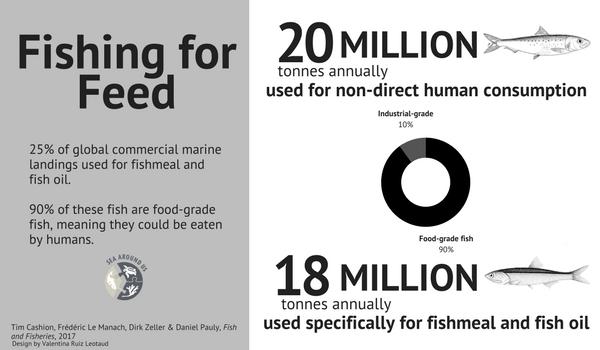
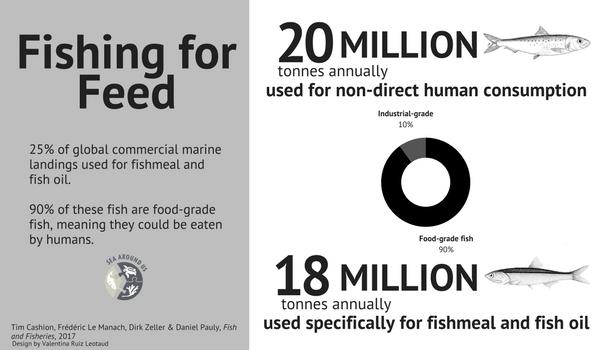
Every year for the past 60 years, an average of 20 million tonnes of fish caught in the global ocean have not been used to nourish people.

A new study emerging from the Sea Around Us project at the University of British Columbia's Institute for the Oceans and Fisheries reveals that from 1950 to 2010, 27 per cent of commercial marine landings were diverted to uses other than direct human consumption.

This trend has not changed in recent years and it poses serious questions regarding food security, as most of the diverted fish are classified as food-grade or prime food-grade.

Out of the grand total, 18 million tonnes of fish have been being used specifically in the production of fishmeal and fish oil, which are commonly fed to aquaculture and livestock species.

According to Tim Cashion, a researcher at the Sea Around Us and lead author of the study "Most fish destined for fishmeal production are food-grade fish" published in Fish and Fisheries, the use of prime fish resources to artificially feed farmed fish, pigs and chicken is a cause of concern as fish are an important source of nutrients and animal protein for 2.9 billion people across the world.

Furthermore, fish used to feed other fish are often sourced in the waters of developing countries, which puts pressure on their fish stocks and reduces locals' access to fresh seafood. In general, these food-insecure communities are also denied access to final aquaculture products because most of those products are exported to developed countries.

On top of this, Cashion and his co-authors, Daniel Pauly, Dirk Zeller, and Frederic LeManach, also found that there is an increase in the variety of fish being used for non-direct human consumption. This trend is mostly fueled by the growth of fed aquaculture in Southeast Asia and China and the depletion of overfished stocks of former target species.

The analysis is based on information extracted from the Sea Around Us global database, specifically the reconstructed commercial landings data (industrial and artisanal) by taxon for each fishing country for each year from 1950-2010.

###

To schedule an interview with the author, please contact Valentina Ruiz Leotaud [email protected]

About the Sea Around Us

The Sea Around Us is a research initiative at the University of British Columbia's Institute for the Oceans and Fisheries. The program is led by Daniel Pauly and Dirk Zeller and it focuses on assessing the impact of fisheries on the marine ecosystems of the world.

The Sea Around Us provides data and analyses through View Data and articles in peer-reviewed journals. The project regularly updates its products at the scale of countries' Exclusive Economic Zones, Large Marine Ecosystems, the High Seas and other spatial scales, and as global maps and summaries.

Media Contact

Valentina Ruiz Leotaud
[email protected]
604-827-3164
@UBCnews

http://www.ubc.ca

############

Story Source: Materials provided by Scienmag

Share12Tweet8Share2ShareShareShare2

Related Posts

Evaluating Pediatric Emergency Care Quality in Ethiopia

February 7, 2026

TPMT Expression Predictions Linked to Azathioprine Side Effects

February 7, 2026

Improving Dementia Care with Enhanced Activity Kits

February 7, 2026

Decoding Prostate Cancer Origins via snFLARE-seq, mxFRIZNGRND

February 7, 2026
Please login to join discussion

POPULAR NEWS

  • Robotic Ureteral Reconstruction: A Novel Approach

    Robotic Ureteral Reconstruction: A Novel Approach

    82 shares
    Share 33 Tweet 21
  • Digital Privacy: Health Data Control in Incarceration

    63 shares
    Share 25 Tweet 16
  • Study Reveals Lipid Accumulation in ME/CFS Cells

    57 shares
    Share 23 Tweet 14
  • Breakthrough in RNA Research Accelerates Medical Innovations Timeline

    53 shares
    Share 21 Tweet 13

About

We bring you the latest biotechnology news from best research centers and universities around the world. Check our website.

Follow us

Recent News

Evaluating Pediatric Emergency Care Quality in Ethiopia

TPMT Expression Predictions Linked to Azathioprine Side Effects

Improving Dementia Care with Enhanced Activity Kits

Subscribe to Blog via Email

Success! An email was just sent to confirm your subscription. Please find the email now and click 'Confirm' to start subscribing.

Join 73 other subscribers
  • Contact Us

Bioengineer.org © Copyright 2023 All Rights Reserved.

Welcome Back!

Login to your account below

Forgotten Password?

Retrieve your password

Please enter your username or email address to reset your password.

Log In
No Result
View All Result
  • Homepages
    • Home Page 1
    • Home Page 2
  • News
  • National
  • Business
  • Health
  • Lifestyle
  • Science

Bioengineer.org © Copyright 2023 All Rights Reserved.