WASHINGTON, March 12, 2024 – Sometimes, seeing clearly requires complete black. For astronomy and precision optics, coating devices in black paint can cut down on stray light, enhancing images and boosting performance. For the most advanced telescopes and optical systems, every little bit matters, so their manufacturers seek out the blackest blacks to coat them.
Credit: Jin et al.
WASHINGTON, March 12, 2024 – Sometimes, seeing clearly requires complete black. For astronomy and precision optics, coating devices in black paint can cut down on stray light, enhancing images and boosting performance. For the most advanced telescopes and optical systems, every little bit matters, so their manufacturers seek out the blackest blacks to coat them.
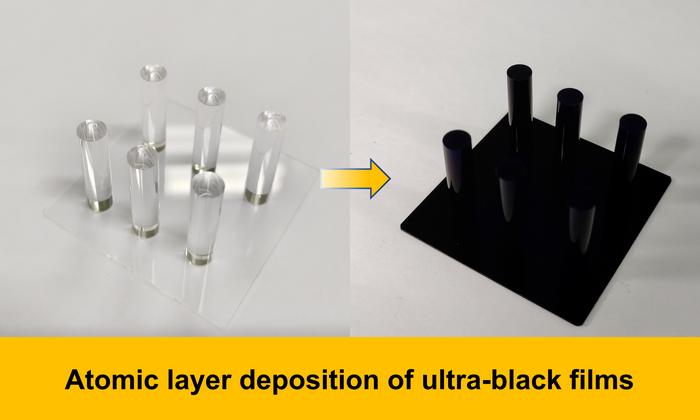
In the Journal of Vacuum Science & Technology A, by AIP Publishing, researchers from the University of Shanghai for Science and Technology and the Chinese Academy of Sciences developed an ultrablack thin-film coating for aerospace-grade magnesium alloys. Their coating absorbs 99.3% of light while being durable enough to survive in harsh conditions.
For telescopes operating in the vacuum of space, or optical equipment in extreme environments, existing coatings are often insufficient.
“Existing black coatings like vertically aligned carbon nanotubes or black silicon are limited by fragility,” said author Yunzhen Cao. “It is also difficult for many other coating methods to apply coatings inside a tube or on other complicated structures. This is important for their application in optical devices as they often have significant curvature or intricate shapes.”
To solve these problems, the researchers turned to atomic layer deposition (ALD). With this vacuum-based manufacturing technique, the target is placed in a vacuum chamber and sequentially exposed to specific types of gas, which adhere to the object’s surface in thin layers.
“One big advantage of the ALD method lies in its excellent step-coverage ability, which means we can obtain uniform film coverage on very complex surfaces, such as cylinders, pillars, and trenches,” said Cao.
To make their ultrablack coating, the team used alternating layers of aluminum-doped titanium carbide (TiAlC) and silicon nitride (SiO2). The two materials work together to prevent nearly all light from reflecting off the coated surface.
“TiAlC acted as an absorbing layer, and SiO2 was employed to create an anti-reflection structure,” said Cao. “As a result, nearly all of the incident light is trapped in the multilayer film, achieving efficient light absorption.”
In tests, the team found an average absorption of 99.3% across a wide range of light wavelengths, from violet light at 400 nanometers all the way to near infrared at 1,000 nanometers. Using a special barrier layer, they even applied their coating to magnesium alloys, which are often used in aerospace applications but are easily corroded.
“What’s more, the film shows superb stability in adverse environments, and is tough enough to withstand friction, heat, damp conditions, and extreme temperature changes,” said Cao.
The authors hope their coating will be used to enhance space telescopes and optical hardware operating in the most extreme conditions and are working to further improve its performance.
“Now that the film can absorb over 99.3% of incoming visible light, we’re hoping to expand its light absorption range even further to include ultraviolet and infrared regions,” said Cao.
###
The article “Robust ultra-black film deposited on large-curvature magnesium alloy by atomic layer deposition” is authored by Jianfei Jin, Lin Lv, Lu Yan, Ying Li, and Yunzhen Cao. It will appear in Journal of Vacuum Science & Technology A on March 12, 2024 (DOI: 10.1116/6.0003305). After that date, it can be accessed at https://doi.org/10.1116/6.0003305.
ABOUT THE JOURNAL
Journal of Vacuum Science & Technology A, an AVS journal published by AIP Publishing, features reports of original research, letters, and review articles on interfaces and surfaces of materials, thin films, and plasmas. JVST A publishes reports that advance the fundamental understanding of interfaces and surfaces at a fundamental level and that use this understanding to advance the state of the art in various technological applications. See https://avs.scitation.org/journal/jva.
ABOUT AVS
AVS is an interdisciplinary, professional society with some 4,500 members worldwide. Founded in 1953, AVS hosts local and international meetings, publishes five journals, serves members through awards, training and career services programs, and supports networking among academic, industrial, government, and consulting professionals. Its members come from across the fields of chemistry, physics, biology, mathematics, engineering, and business and share a common interest in basic science, technology development and commercialization related to materials, interfaces, and processing. https://www.avs.org.
###
Journal
Journal of Vacuum Science & Technology A Vacuum Surfaces and Films
DOI
10.1116/6.0003305
Article Title
Robust ultra-black film deposited on large-curvature magnesium alloy by atomic layer deposition
Article Publication Date
12-Mar-2024