Researchers have developed a new method for triggering and imaging seizures in epilepsy patients, offering physicians the ability to collect real-time data to tailor epilepsy surgery. In contrast to previous practice, where physicians from neurology and nuclear medicine had to wait for hours to days in hopes of capturing the onset of a seizure, the new method is convenient, spares resources, and is clinically feasible. This research was published in the March issue of The Journal of Nuclear Medicine.
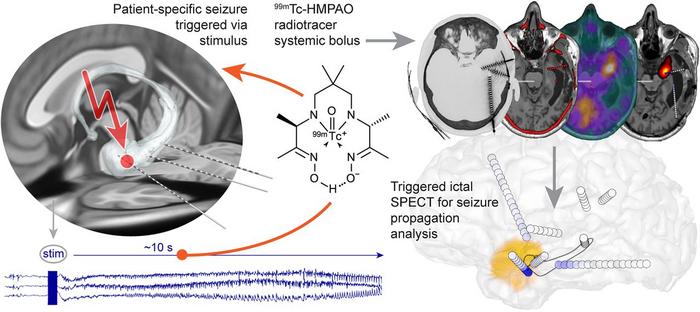
Credit: Image created by Dr. S Barlatey, MD, PhD and Dr. C Mignardot, PhD.
Researchers have developed a new method for triggering and imaging seizures in epilepsy patients, offering physicians the ability to collect real-time data to tailor epilepsy surgery. In contrast to previous practice, where physicians from neurology and nuclear medicine had to wait for hours to days in hopes of capturing the onset of a seizure, the new method is convenient, spares resources, and is clinically feasible. This research was published in the March issue of The Journal of Nuclear Medicine.
People with epilepsy and seizures who do not respond to medication are often helped by brain surgery. The goal of the surgical procedure is to remove the epileptic brain tissue and spare the healthy brain tissue to control seizures but avoid neurological deficits. “Precisely delineating the epileptic brain tissue is essential for successful surgeries, and obtaining timely images of seizures may help formulate surgical plans with increased precision” said Sabry L. Barlatey, MD, PhD, resident in the Department of Neurosurgery at University Hospital of Bern in Bern, Switzerland.
The ictal SPECT method has been used since the 1990s as the sole neuro-imaging technique able to capture an image of an epileptic seizure propagating in the brain. However, due to the growing cost and time constraints in health care, most epilepsy centers abandoned this potentially informative technique.
“In this study, instead of waiting for spontaneous occurrences, we imaged planned seizures that were triggered with targeted electrical stimulation to the brain. To our knowledge, this simple idea had never been tested before,” noted Maxime O. Baud, MD, PhD, professor of neurology in the Department of Neurology at the University Hospital of Bern.
Three adult participants with left temporal epilepsy were included in the case study. Authors identified and used stereotactic electroencephalography (sEEG) leads in targeted cerebral areas to trigger patient-typical seizures. The radiotracer 99mTc-HMPAO was administered within 12 seconds of ictal onset and SPECT images were acquired within 40 minutes.
Seizures were successfully triggered in each participant, replicating the patient-typical seizure semiology and electrographic pattern on sEEG without any adverse events. Each triggered seizure was patient-specific, and the imaged early seizure propagation was unique. In the first two cases, ictal SPECT offered complementary information to sEEG and revealed early involvement of brain areas lacking electrode coverage. In the third case, sEEG and ictal SPECT provided overlapping information.
“The finding of this study is of practical nature, as it greatly facilitates the acquisition of the ictal SPECT,” noted Thomas Pyka, MD, Privatdozent in the Department of Nuclear Medicine at the University Hospital of Bern. “This may help obtain images of greater quality and could contribute to the refinement of resection planning, improving seizure and cognitive outcomes in epilepsy surgery.”
This study was made available online in January 2024.
The authors of “Triggered Seizures for Ictal SPECT Imaging: A Case Series and Feasibility Study” include Sabry L. Barlatey, Andreas Nowacki, Werner J. Z’Graggen, and Claudio Pollo, Department of Neurosurgery, University Hospital of Bern, Bern, Switzerland; Camille G. Mignardot, Cecilia Friedrichs-Maeder, Kaspar Schindler, and Maxime O. Baud, Sleep-Wake-Epilepsy Center and NeuroTec, Center for Experimental Neurology, Department of Neurology, University Hospital of Bern, Bern, Switzerland; Roland Wiest, Support Center for Advanced Neuroimaging, University Institute of Diagnostic and Interventional Neuroradiology, University Hospital of Bern, Bern, Switzerland; Matthias Haenggi, Department of Intensive Care Medicine, University Hospital of Bern, Bern, Switzerland; and Axel Rominger and Thomas Pyka, Department of Nuclear Medicine, University Hospital of Bern, Bern, Switzerland.
Visit the JNM website for the latest research, and follow our new Twitter and Facebook pages @JournalofNucMed or follow us on LinkedIn.
###
Please visit the SNMMI Media Center for more information about molecular imaging and precision imaging. To schedule an interview with the researchers, please contact Rebecca Maxey at (703) 652-6772 or [email protected].
About JNM and the Society of Nuclear Medicine and Molecular Imaging
The Journal of Nuclear Medicine (JNM) is the world’s leading nuclear medicine, molecular imaging and theranostics journal, accessed more than 16 million times each year by practitioners around the globe, providing them with the information they need to advance this rapidly expanding field. Current and past issues of The Journal of Nuclear Medicine can be found online at http://jnm.snmjournals.org.
JNM is published by the Society of Nuclear Medicine and Molecular Imaging (SNMMI), an international scientific and medical organization dedicated to advancing nuclear medicine and molecular imaging—precision medicine that allows diagnosis and treatment to be tailored to individual patients in order to achieve the best possible outcomes. For more information, visit www.snmmi.org.
Journal
Journal of Nuclear Medicine
DOI
10.2967/jnumed.123.266515
Article Title
Triggered Seizures for Ictal SPECT Imaging: A Case Series and Feasibility Study
Article Publication Date
1-Mar-2024
COI Statement
Maxime Baud holds shares with Epios, Ltd., a medical device company based in Geneva.