The ‘ultrasound-photoacoustic dual-modal imaging system’ combines molecular imaging contrast with ultrasound imaging, and it can visualize molecular and structural information inside the body in real-time without any ionizing radiation. This advantage gives it the potential to enhance medical diagnosis by providing diverse physiological and histological information, ensuring greater accuracy and safety for patients. However, optical and ultrasound pathway integration always reduces the system’s performance in conventional ultrasound transducers. Therefore, a novel transducer that can achieve simple and seamless integration is crucial for practical application.
Credit: POSTECH
The ‘ultrasound-photoacoustic dual-modal imaging system’ combines molecular imaging contrast with ultrasound imaging, and it can visualize molecular and structural information inside the body in real-time without any ionizing radiation. This advantage gives it the potential to enhance medical diagnosis by providing diverse physiological and histological information, ensuring greater accuracy and safety for patients. However, optical and ultrasound pathway integration always reduces the system’s performance in conventional ultrasound transducers. Therefore, a novel transducer that can achieve simple and seamless integration is crucial for practical application.
Professor Chulhong Kim (Department of Electrical Engineering, the Department of Convergence IT Engineering, the Department of Mechanical Engineering, and the School of Convergence Science and Technology), Dr. Seonghee Cho (Department of Electrical Engineering), and Ph.D. candidate Minsu Kim (Department of Convergence IT Engineering) at Pohang University of Science and Technology (POSTECH), addressed challenges inherent in conventional ultrasound-photoacoustic systems by developing a novel transparent ultrasonic transducer (TUT) showcasing high performance. Their research findings have been published in the ‘Nature Communications.’
An ultrasound transducer transmits or receives ultrasound. Conventional ultrasound transducers are typically made using multiple opaque layers to maximize acoustic performance, and they cannot be seamlessly integrated into light pathways. This fundamental limitation always diminishes the performance of both optical and ultrasound systems. While many recent research projects actively explore the use of transparent materials in TUTs to address this issue, achieving transparency and best acoustic performance across all transducer layers continues to be a problem.
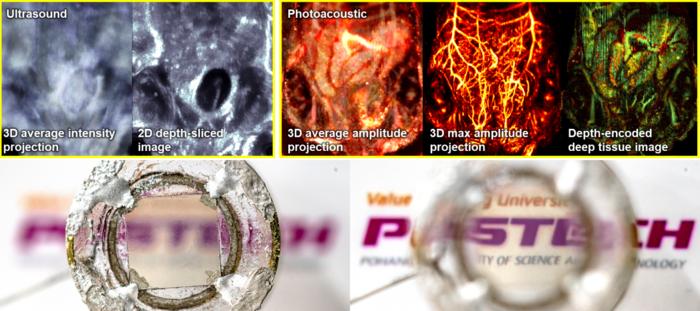
This research demonstrates a transparent material using a silicon dioxide (SiO2)-epoxy composite and applies it to a novel TUT. The novel TUT exhibits exceptional optical transparency (>80%) and maintains the same bandwidth (±30% at the center frequency) as conventional opaque ultrasound transducers.
Using the novel TUT in the ultrasound-photoacoustic dual-modal system resulted in depth-to-resolution ratios, surpassing 500 for ultrasound imaging and 370 for photoacoustic imaging. These ratios are three to six times higher than those of traditional photoacoustic single systems. Notably, this research breaks the conventional limit of a depth-to-resolution ratio 200 in photoacoustic research, achieving 370.
This imaging system also easily conducted intricate structural and functional imaging of live animals and humans.
POSTECH Professor Chulhong Kim expressed his optimism, stating, “The application of this technology extends across various medical devices, encompassing tasks like using light stimulation for cell manipulation, employing laser surgery for tumor removal, and employing ultrasound for the examination of residual tissue.” He added, ”Our aspiration is that this research will be beneficial in diverse fields including those employing ultrasound and optical sensors such as mobile devices and robotics.”
The research was conducted with support from the Mid-Career Researcher Program, the Sejong Fellowship Program, the Governmental Medical Device R&D Program, the BK21, the BRIDGE project, and the Program for Key Research Institutes for Universities of the National Research Foundation of Korea.
Journal
Nature Communications
DOI
10.1038/s41467-024-45273-4
Article Title
An ultrasensitive and broadband transparent ultrasound transducer for ultrasound and photoacoustic imaging in-vivo
Article Publication Date
16-Feb-2024