“[…] our findings underscore the imperative for additional markers to gauge the physiological impact of senolytic treatments […]”
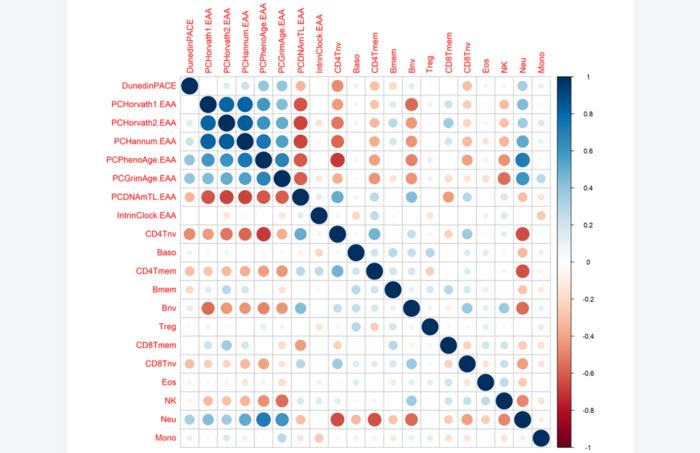
Credit: 2024 Lee et al.
“[…] our findings underscore the imperative for additional markers to gauge the physiological impact of senolytic treatments […]”
BUFFALO, NY- March 6, 2024 – A new research paper was published in Aging (listed by MEDLINE/PubMed as “Aging (Albany NY)” and “Aging-US” by Web of Science) Volume 16, Issue 4, entitled, “Exploring the effects of Dasatinib, Quercetin, and Fisetin on DNA methylation clocks: a longitudinal study on senolytic interventions.”
Senolytics, small molecules targeting cellular senescence, have emerged as potential therapeutics to enhance health span. However, their impact on epigenetic age remains unstudied. In this new study, researchers Edwin Lee, Natàlia Carreras-Gallo, Leilani Lopez, Logan Turner, Aaron Lin, Tavis L. Mendez, Hannah Went, Alan Tomusiak, Eric Verdin, Michael Corley, Lishomwa Ndhlovu, Ryan Smith, and Varun B. Dwaraka from the Institute For Hormonal Balance, TruDiagnostic, Buck Institute for Research on Aging, and Cornell University aimed to assess the effects of senolytic treatments on DNA methylation (DNAm), epigenetic age, and immune cell subsets.
“[…] this study aims to comprehensively assess the impact of senolytic drugs on epigenetic aging through two longitudinal studies to address our research objective. The initial investigation focuses on a combination treatment of Dasatinib and Quercetin, while the subsequent phase incorporates Fisetin into the treatment regimen.”
In a Phase I pilot study, 19 participants received Dasatinib and Quercetin (DQ) for 6 months, with DNAm measured at baseline, 3 months, and 6 months. Significant increases in epigenetic age acceleration were observed in first-generation epigenetic clocks and mitotic clocks at 3 and 6 months, along with a notable decrease in telomere length. However, no significant differences were observed in second and third-generation clocks.
Building upon these findings, a subsequent investigation evaluated the combination of DQ with Fisetin (DQF), a well-known antioxidant and antiaging senolytic molecule. After one year, 19 participants (including 10 from the initial study) received DQF for 6 months, with DNAm assessed at baseline and 6 months. Remarkably, the addition of Fisetin to the treatment resulted in non-significant increases in epigenetic age acceleration, suggesting a potential mitigating effect of Fisetin on the impact of DQ on epigenetic aging.
“Furthermore, our analyses unveiled notable differences in immune cell proportions between the DQ and DQF treatment groups, providing a biological basis for the divergent patterns observed in the evolution of epigenetic clocks. These findings warrant further research to validate and comprehensively understand the implications of these combined interventions.”
Read the full paper: DOI: https://doi.org/10.18632/aging.205581
Corresponding Author: Varun B. Dwaraka
Corresponding Email: [email protected]
Keywords: senolytics, longitudinal studies, epigentic clocks, aging, immune system
Click here to sign up for free Altmetric alerts about this article.
About Aging:
Launched in 2009, Aging publishes papers of general interest and biological significance in all fields of aging research and age-related diseases, including cancer—and now, with a special focus on COVID-19 vulnerability as an age-dependent syndrome. Topics in Aging go beyond traditional gerontology, including, but not limited to, cellular and molecular biology, human age-related diseases, pathology in model organisms, signal transduction pathways (e.g., p53, sirtuins, and PI-3K/AKT/mTOR, among others), and approaches to modulating these signaling pathways.
Please visit our website at www.Aging-US.com and connect with us:
- X, formerly Twitter
- YouTube
- Spotify, and available wherever you listen to podcasts
Click here to subscribe to Aging publication updates.
For media inquiries, please contact [email protected].
Aging (Aging-US) Journal Office
6666 E. Quaker Str., Suite 1B
Orchard Park, NY 14127
Phone: 1-800-922-0957, option 1
###
Journal
Aging-US
DOI
10.18632/aging.205581
Method of Research
Experimental study
Subject of Research
People
Article Title
Exploring the effects of Dasatinib, Quercetin, and Fisetin on DNA methylation clocks: a longitudinal study on senolytic interventions
Article Publication Date
22-Feb-2024