• HOME
  • NEWS
  • EXPLORE
    • CAREER
      • Companies
      • Jobs
    • EVENTS
    • iGEM
      • News
      • Team
    • PHOTOS
    • VIDEO
    • WIKI
  • BLOG
  • COMMUNITY
    • FACEBOOK
    • INSTAGRAM
    • TWITTER
Saturday, June 6, 2026
BIOENGINEER.ORG
No Result
View All Result
  • Login
  • HOME
  • NEWS
  • EXPLORE
    • CAREER
      • Companies
      • Jobs
        • Lecturer
        • PhD Studentship
        • Postdoc
        • Research Assistant
    • EVENTS
    • iGEM
      • News
      • Team
    • PHOTOS
    • VIDEO
    • WIKI
  • BLOG
  • COMMUNITY
    • FACEBOOK
    • INSTAGRAM
    • TWITTER
  • HOME
  • NEWS
  • EXPLORE
    • CAREER
      • Companies
      • Jobs
        • Lecturer
        • PhD Studentship
        • Postdoc
        • Research Assistant
    • EVENTS
    • iGEM
      • News
      • Team
    • PHOTOS
    • VIDEO
    • WIKI
  • BLOG
  • COMMUNITY
    • FACEBOOK
    • INSTAGRAM
    • TWITTER
No Result
View All Result
Bioengineer.org
No Result
View All Result
Home NEWS Science News Biology

Scientists train a bank of AI models to identify patterns of brain activity that signal memory formation

Bioengineer by Bioengineer
March 5, 2024
in Biology
Reading Time: 2 mins read
0
AdrianRubio-AndreaNavasOlive-LisetMdelaPrida
Share on FacebookShare on TwitterShare on LinkedinShare on RedditShare on Telegram

The study of brain oscillations has advanced our understanding of brain function. Ripples are a type of fast oscillations underlying the organization of memories. They are affected in neurological disorders such as epilepsy and Alzheimer’s. For this reason, they are considered an electroencephalographic (EEG) biomarker. However, ripples exhibit various waveforms and properties that can be missed by standard spectral methods.
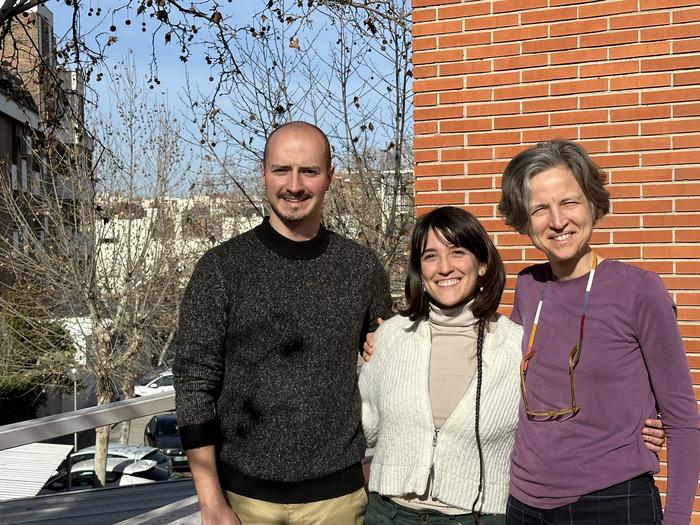
AdrianRubio-AndreaNavasOlive-LisetMdelaPrida

Credit: CSIC

The study of brain oscillations has advanced our understanding of brain function. Ripples are a type of fast oscillations underlying the organization of memories. They are affected in neurological disorders such as epilepsy and Alzheimer’s. For this reason, they are considered an electroencephalographic (EEG) biomarker. However, ripples exhibit various waveforms and properties that can be missed by standard spectral methods.

Recently, the neuroscience community called for the need to better automate, harmonize, and improve the detection of ripples across a range of tasks and species. In the study, the authors used recordings obtained in laboratory mice to train a toolbox of machine learning models. “We have tested the ability of these models using data from non-human primates that were collected at Vanderbilt University (Nashville, USA) by Saman Abbaspoor and lab leader Kari Hoffman as part of the Brain Initiative.  We found that it is possible to use rodent EEG data to train AI algorithms that can be applied to data from primates and possibly human, provided the same type of recording techniques are used.”, De la Prida explains.

The model toolbox emerged as a result of a hackathon, which resulted in a short list for the best detection models. These architectures were then harmonized and optimized by the authors who now provide all codes and data openly to the research community. Models include some of the best-known supervised learning architectures, such as support vector machines, decision trees, and convolutional neural networks. “We have identified more than one hundred possible models from the different architectures that are now available for application or retraining by other researchers.”, commented Andrea Navas Olivé and Adrián Rubio, who are first authors of the work.

 “This bank of AI models will provide new applications in the field of neurotechnologies and can be useful for detection and analysis of high-frequency oscillations in pathologies such as epilepsy, where they are considered clinical markers” concludes De la Prida, who is part of the CSIC’s AI-HUB connection aimed at advancing the use of AI and its applications.


Journal

Communications Biology

DOI

10.1038/s42003-024-05871-w

Method of Research

Experimental study

Subject of Research

Animals

Article Title

A machine learning toolbox for the analysis of sharp-wave ripples reveals common waveform features across species

Article Publication Date

4-Mar-2024
Share12Tweet8Share2ShareShareShare2

Related Posts

New Study Reveals the Role of Insects in Our Ancestors’ Diet — Biology

New Study Reveals the Role of Insects in Our Ancestors’ Diet

June 5, 2026
RNA-Protein Self-Replication Systems Show Path Toward Evolutionary Extinction — Biology

RNA-Protein Self-Replication Systems Show Path Toward Evolutionary Extinction

June 5, 2026

Active Helitron Transposon Family Discovered in Wheat

June 5, 2026

How the Body Produces Reliable Antibodies Amidst Biological Chaos

June 5, 2026

POPULAR NEWS

  • ESMO 2025: mRNA COVID Vaccines Enhance Efficacy of Cancer Immunotherapy

    322 shares
    Share 129 Tweet 81
  • Multi-Hospital Study Reveals Long Covid Burden Is Twice as High as Current Estimates

    89 shares
    Share 35 Tweet 22
  • Saying Goodbye to PGY-6: Pediatric Fellowship Realities

    78 shares
    Share 31 Tweet 20
  • Common Food Preservatives Associated with Elevated Blood Pressure and Increased Heart Disease Risk

    57 shares
    Share 23 Tweet 14

About

We bring you the latest biotechnology news from best research centers and universities around the world. Check our website.

Follow us

Recent News

Optometrists’ Role in Preventing Older Adults’ Falls

AI-Powered CNN Enhances Wildfire Spread Predictions

TIA-1 Boosts FUNDC1 to Prevent Cell Aging

Subscribe to Blog via Email

Enter your email address to subscribe to this blog and receive notifications of new posts by email.

Join 82 other subscribers
  • Contact Us

Bioengineer.org © Copyright 2023 All Rights Reserved.

Welcome Back!

Login to your account below

Forgotten Password?

Retrieve your password

Please enter your username or email address to reset your password.

Log In
No Result
View All Result
  • Homepages
    • Home Page 1
    • Home Page 2
  • News
  • National
  • Business
  • Health
  • Lifestyle
  • Science

Bioengineer.org © Copyright 2023 All Rights Reserved.