Rice University researchers have developed a rapid, accurate test for diagnosing malaria that is significantly faster and easier to use than traditional tests. The advancement has the potential to improve patient outcomes, especially in rural regions with limited health care resources.
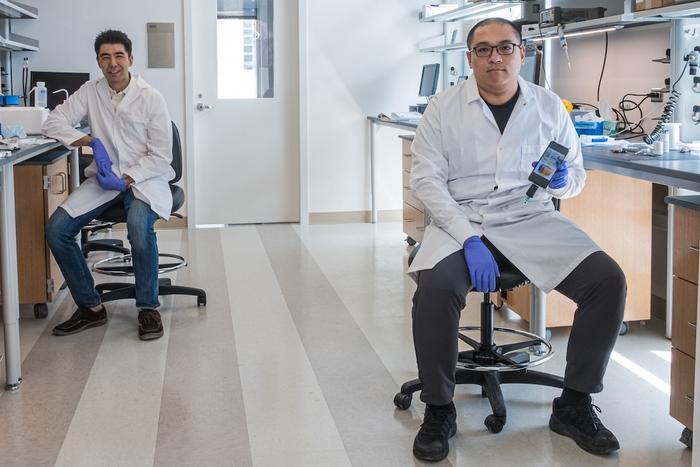
Credit: Rice University.
Rice University researchers have developed a rapid, accurate test for diagnosing malaria that is significantly faster and easier to use than traditional tests. The advancement has the potential to improve patient outcomes, especially in rural regions with limited health care resources.
Malaria remains a significant global health challenge with an estimated 247 million cases and more than 600,000 deaths annually, the majority of which occur in sub-Saharan Africa. The most severe form, cerebral malaria, has a high mortality rate, particularly in children under 5 years of age.
Current rapid diagnostic tests (RDTs) for malaria provide only a binary result — positive or negative — often missing asymptomatic infections and lacking the sensitivity needed to detect severe cases early. Molecular assays, while more sensitive, are expensive, time-consuming and require specialized equipment and trained personnel, making them impractical for widespread use in resource-limited settings.
To address these challenges, a team led by mechanical engineer Peter Lillehoj of Rice’s Brown School of Engineering, created a microfluidic point-of-care (mPOC) immunoassay for quantifying a malaria parasite biomarker, Plasmodium falciparum histidine-rich protein 2 (PfHRP2), in whole blood.
The device features two diagnostic modes for detecting PfHRP2 at low and high concentrations, making it useful for various diagnostic applications, including the detection of asymptomatic infection and the prediction of disease outcomes. Test results are available in just 15 minutes and can be accessed on a smartphone app, developed by the research team.
The work is published in the journal Biosensors and Bioelectronics.
“The mPOC immunoassay was designed to be simple, accurate and field-deployable, making it suitable for use in rural and remote health centers in sub-Saharan Africa,” said Lillehoj, associate professor of mechanical engineering. “Unlike traditional tests, this device does not require plasma separation, pipetting, complicated sample processing or long incubations, making it easy to use even by minimally trained health care providers.”
In testing conducted in Malawi, the mPOC immunoassay demonstrated similar accuracy to a commercial PfHRP2 enzyme-linked immunosorbent assay (ELISA) test, while being 12 times faster and simpler to use. The ability to quickly and accurately diagnose malaria, particularly cerebral malaria, at the point of care could lead to early identification and treatment of severe cases, according to Lillehoj.
“In areas with limited access to health care facilities, our test could be a game-changer,” he said. “It can help health care providers quickly identify and treat severe cases, potentially saving lives. By enabling early detection and appropriate management of malaria cases, we can reduce the burden of the disease and improve patient outcomes in Africa and beyond.”
Joining Lillehoj on the study were former doctoral student and lead author Jiran Li; Alexuse M. Saidi, Kamuzu University of Health Sciences, Malawi; and Karl Seydal, Michigan State University.
This work was supported by the National Institutes of Health (R01AI113257).
Journal
Biosensors and Bioelectronics
Method of Research
Experimental study
Subject of Research
Not applicable
Article Title
Rapid diagnosis and prognosis of malaria infection using a microfluidic point-of-care immunoassay
Article Publication Date
2-Feb-2024