There’s enough water frozen in Greenland and Antarctic glaciers that if they melted, global seas would rise by many feet. What will happen to these glaciers over the coming decades is the biggest unknown in the future of rising seas, partly because glacier fracture physics is not yet fully understood.
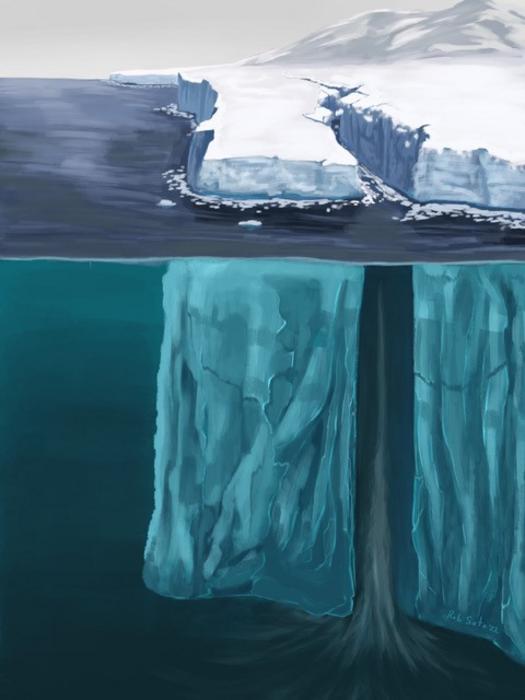
Credit: Rob Soto
There’s enough water frozen in Greenland and Antarctic glaciers that if they melted, global seas would rise by many feet. What will happen to these glaciers over the coming decades is the biggest unknown in the future of rising seas, partly because glacier fracture physics is not yet fully understood.
A critical question is how warmer oceans might cause glaciers to break apart more quickly. University of Washington researchers have demonstrated the fastest-known large-scale breakage along an Antarctic ice shelf. The study, recently published in AGU Advances, shows that a 6.5-mile (10.5 kilometer) crack formed in 2012 on Pine Island Glacier — a retreating ice shelf that holds back the larger West Antarctic ice sheet — in about 5 and a half minutes. That means the rift opened at about 115 feet (35 meters) per second, or about 80 miles per hour.
“This is to our knowledge the fastest rift-opening event that’s ever been observed,” said lead author Stephanie Olinger, who did the work as part of her doctoral research at the UW and Harvard University, and is now a postdoctoral researcher at Stanford University. “This shows that under certain circumstances, an ice shelf can shatter. It tells us we need to look out for this type of behavior in the future, and it informs how we might go about describing these fractures in large-scale ice sheet models.”
A rift is a crack that passes all the way through the roughly 1,000 feet (300 meters) of floating ice for a typical Antarctic ice shelf. These cracks are the precursor to ice shelf calving, in which large chunks of ice break off a glacier and fall into the sea. Such events happen often at Pine Island Glacier — the iceberg observed in the study has long since separated from the continent.
“Ice shelves exert a really important stabilizing influence on the rest of the Antarctic ice sheet. If an ice shelf breaks up, the glacier ice behind really speeds up,” Olinger said. “This rifting process is essentially how Antarctic ice shelves calve large icebergs.”
In other parts of Antarctica, rifts often develop over months or years. But it can happen more quickly in a fast-evolving landscape like Pine Island Glacier, where researchers believe the West Antarctic Ice Sheet has already passed a tipping point on its collapse into the ocean.
Satellite images provide ongoing observations. But orbiting satellites pass by each point on Earth only every three days. What happens during those three days is harder to pin down, especially in the dangerous landscape of a fragile Antarctic ice shelf.
For the new study, the researchers combined tools to understand the rift’s formation. They used seismic data recorded by instruments placed on the ice shelf by other researchers in 2012 with radar observations from satellites.
Glacier ice acts like a solid on short timescales, but it’s more like a viscous liquid on long timescales.
“Is rift formation more like glass breaking or like Silly Putty being pulled apart? That was the question,” Olinger said. “Our calculations for this event show that it’s a lot more like glass breaking.”
If the ice were a simple brittle material, it should have shattered even faster, Olinger said. Further investigation pointed to the role of seawater. Seawater in the rifts holds the space open against the inward forces of the glacier. And since seawater has viscosity, surface tension and mass, it can’t just instantly fill the void. Instead, the pace at which seawater fills the opening crack helps slow the rift’s spread.
“Before we can improve the performance of large-scale ice sheet models and projections of future sea-level rise, we have to have a good, physics-based understanding of the many different processes that influence ice shelf stability,” Olinger said.
The research was funded by the National Science Foundation. Co-authors are Brad Lipovsky and Marine Denolle, both UW faculty members in Earth and space sciences who began advising the work while at Harvard University.
###
For more information, contact Olinger at [email protected].
Journal
AGU Advances
DOI
10.1029/2023AV001023
Method of Research
Observational study
Subject of Research
Not applicable
Article Title
Ocean Coupling Limits Rupture Velocity of Fastest Observed Ice Shelf Rift Propagation Event
Article Publication Date
5-Feb-2024