Black carbon is the most dangerous air pollutant you’ve never heard of. Its two main sources, diesel exhaust and wood smoke from wildfires and household heating, produce ultrafine air particles that are up to 25 times more of a health hazard per unit compared to other types of particulate matter. Despite its danger, black carbon is understudied due to a lack of monitoring equipment. Regulatory-standard sensors are wildly expensive to deploy and maintain, resulting in sparse coverage in regions infamous for poor air quality, such as the greater Salt Lake City metropolitan area in Utah.
Credit: AethLabs
Black carbon is the most dangerous air pollutant you’ve never heard of. Its two main sources, diesel exhaust and wood smoke from wildfires and household heating, produce ultrafine air particles that are up to 25 times more of a health hazard per unit compared to other types of particulate matter. Despite its danger, black carbon is understudied due to a lack of monitoring equipment. Regulatory-standard sensors are wildly expensive to deploy and maintain, resulting in sparse coverage in regions infamous for poor air quality, such as the greater Salt Lake City metropolitan area in Utah.
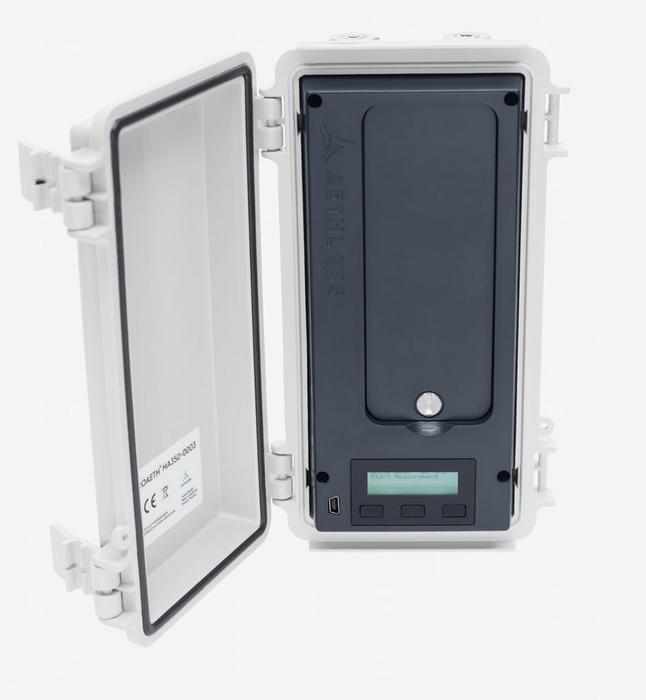
A University of Utah-led study found that the AethLabs microAeth MA350, a portable, more affordable sensor, recorded black carbon concentrations as accurately as the Aerosol Magee Scientific AE33, the most widely used instrument for monitoring black carbon in real time. Researchers placed the portable technology next to an existing regulatory sensor at the Bountiful Utah Division of Air Quality site from Aug. 30, 2021-Aug. 8, 2022. The AethLabs technology recorded nearly identical quantities of black carbon at the daily, monthly and seasonal timescales. The authors also showed that the microAeth could distinguish between wildfire and traffic sources as well as the AE33 at longer timescales.
Because black carbon stays close to the source, equipment must be localized to yield accurate readings. The microAethsensor’s portability would allow monitoring at remote or inaccessible stationary sites, as well as for mobile use.
“Having a better idea of black carbon exposure across different areas is an environmental justice issue,” said Daniel Mendoza, research assistant professor of atmospheric sciences at the University of Utah and lead author of the study. “The Salt Lake Valley’s westside has some of the region’s worst air quality partly because it’s closest to pollution sources, but we lack the ability to measure black carbon concentrations accurately. Democratizing data with reliable and robust sensors is an important first step to safeguarding all communities from hazardous air pollution.”
The study was published on Feb. 1, 2024, in the journal Sensors.
In the dark
Black carbon pollutants are a type of fine particulate matter (PM2.5), a class of air particles small enough to be inhaled into the lungs and absorbed into the bloodstream. Black carbon is true soot, produced when hydrocarbons do not fully burn, and has been shown to migrate into the heart, brain, fetal tissue, and other biological systems.
“The combination of increasing wildfires driven by anthropogenic climate change and steady population growth along the Wasatch Front in coming decades will result in new pollution challenges that Utah will have to face,” said Erik Crosman, assistant professor of environmental sciences at West Texas A&M University and a co-author of the study.“The portable MA350 ‘micro’ aethalometer could be utilized in building a better spatial observational network of accurate but lower cost black carbon sensors across the region.”
Though research suggests exposure to black carbon is 10 to 25 times more hazardous to respiratory and cardiovascular health than other PM2.5, long-term health outcomes are largely unknown. An accurate observation network is the first step to establishing disease risk and creating effective public health policies. This study, funded by the Salt Lake City Corporation, aims to help regions with poor air quality establish a baseline of black carbon distribution.
“It’s crucial that we target our measurements to identify the largest and most relevant black carbon sources,” said Drew Hill, a study coauthor who leads data science and applied research work at AethLabs. “We’ve added a feature rooted in physical principles to provide real-time estimates of the amount of measured black carbon produced by fossil fuel burning versus wood burning to allow researchers and policy makers to triangulate such sources.”
Having established the portable sensor’s accuracy and regional relevance, the researchers are measuring black carbon levels around the Salt Lake Valley, including testing concentrations present inside school buildings.
“First, you need to get readings. In some neighborhoods you could look at air quality concentrations, then look at the cancer or other disease rate in that neighborhood,” said Mendoza, who is also an adjunct assistant professor in the Division of Pulmonary Medicine at University of Utah Health. “Getting measurements with a high degree of accuracy, now we can really think about health and policy avenues to really protect everyone’s lung health.”
Jeffrey Blair of AethLabs also contributed to the study, titled, “A long-term comparison between the AethLabs MA350 and Aerosol Magee Scientific AE22 Black Carbon Monitors in the Greater Salt Lake City Metropolitan Area.” Sensors 2024, 24(3), 965; https://doi.org/10.3390/s24030965.
Journal
Sensors
DOI
10.3390/s24030965
Article Title
A long-term comparison between the AethLabs MA350 and Aerosol Magee Scientific AE22 Black Carbon Monitors in the Greater Salt Lake City Metropolitan Area
Article Publication Date
1-Feb-2024