There is no doubt that water is significant. Without it, life would never have begun, let alone continue today – not to mention its role in the environment itself, with oceans covering over 70% of Earth.
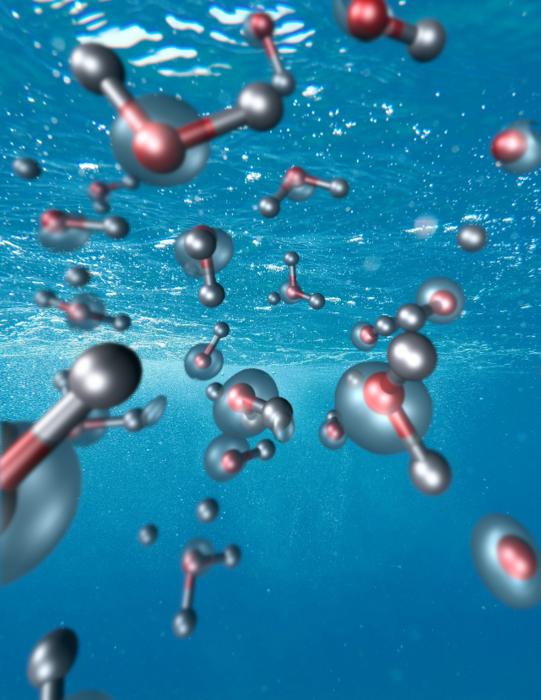
Credit: Krystian Tambur (background)/Alexey Tal (water molecules)
There is no doubt that water is significant. Without it, life would never have begun, let alone continue today – not to mention its role in the environment itself, with oceans covering over 70% of Earth.
But despite its ubiquity, liquid water features some electronic intricacies that have long puzzled scientists in chemistry, physics, and technology. For example, the electron affinity, i.e. the energy stabilization undergone by a free electron when captured by water, has remained poorly characterized from an experimental point of view.
Even today’s most accurate electronic structure theory has been unable to clarify the picture, which means that important physical quantities like the energy at which electrons from external sources can be injected in liquid water remain elusive. These properties are crucial for understanding the behavior of electrons in water and could play a role in biological systems, environmental cycles, and technological applications like solar energy conversion.
In a recent study, EPFL researchers Alexey Tal, Thomas Bischoff, and Alfredo Pasquarello have made significant strides in deciphering the puzzle. Their study, published in PNAS, addresses water’s electronic structure using computational methods that go beyond today’s most advanced approaches.
The researchers studied water using a method based on “many-body perturbation theory”. This is a complex mathematical framework used to study the interactions of multiple particles within a system, like electrons in a solid or a molecule, exploring how these particles affect each other’s behavior, not in isolation but as part of a larger, interacting group. Put relatively simply, many-body perturbation theory is a way to calculate and predict the properties of a many-particle system by taking into account all the complex interactions between its components.
But the physicists tweaked the theory with “vertex corrections”: modifications in many-body perturbation theory that account for the complex interactions between particles beyond the simplest approximations. Vertex corrections refine the theory by taking into account how these interactions affect the energy levels of particles, e.g. their response to external fields or their self-energy. In short, vertex corrections lead to more accurate predictions of physical properties in a many-particle system.
Modeling water’s electronic properties
Modeling liquid water is particularly challenging. A water molecule contains one oxygen atom and two hydrogen atoms, and both their thermal motion and the quantum nature of their nuclei play a key role. Accounting for these aspects, the researchers accurately determined water’s electronic properties, such as its ionization potential, electron affinity, and band gap. These findings are essential for understanding how water interacts with light and other substances at the electronic level.
“Our study of water’s energy levels reconciles high-level theory with experiment,” says Alfredo Pasquarello. Alexey Tal further stresses the importance of the new methodology: “Thanks to the advanced description of the electronic structure, we were also able to produce an accurate absorption spectrum.”
The findings have additional implications. The theoretical developments applied by the EPFL team lay the foundations for a new universally applicable standard to achieve accurate electronic structures of materials. This provides a highly predictive tool that could potentially revolutionize our fundamental understanding of electronic properties in condensed matter science, with applications in the search of materials properties with specific electronic functionalities.
Reference
Alexey Tal, Thomas Bischoff, Alfredo Pasquarello. Absolute energy levels of liquid water from many-body perturbation theory with effective vertex corrections. PNAS 26 February 2024. DOI: 10.1073/pnas.2311472121
Journal
Proceedings of the National Academy of Sciences
DOI
10.1073/pnas.2311472121
Article Title
Absolute energy levels of liquid water from many-body perturbation theory with effective vertex corrections.
Article Publication Date
26-Feb-2024