Striped marlin are some of the fastest animals on the planet and one of the ocean’s top predators. When hunting in groups, individual marlin will take turns attacking schools of prey fish one at a time. Now a new study reported in the journal Current Biology on February 5 helps to explain how they might coordinate this turn-taking style of attack on their prey to avoid injuring each other. The key, according to the new work, is rapid color changes.
Credit: Alicia Burns
Striped marlin are some of the fastest animals on the planet and one of the ocean’s top predators. When hunting in groups, individual marlin will take turns attacking schools of prey fish one at a time. Now a new study reported in the journal Current Biology on February 5 helps to explain how they might coordinate this turn-taking style of attack on their prey to avoid injuring each other. The key, according to the new work, is rapid color changes.
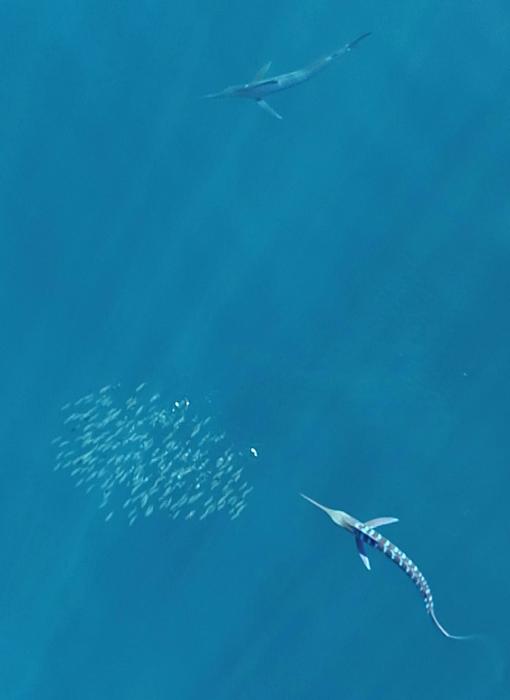
“We documented for the first time rapid color change in a group-hunting predator, the striped marlin, as groups of marlin hunted schools of sardines,” says Alicia Burns of Humboldt University in Berlin, Germany. “We found that the attacking marlin ‘lit up’ and became much brighter than its groupmates as it made its attack before rapidly returning to its ‘non-bright’ coloration after its attack ended.”
Burns and her colleagues, including Jens Krause, explained that the use of drones in their research has given them a new perspective of how marlins move and hunt. As they examined the video footage they’d captured via drone, they noticed something unexpected: the stripes on individual marlins got obviously brighter as a fish moved in for an attack. As they swam away, those stripes dimmed again. Were the fish changing colors to communicate with one another?
To explore this question in the new study, the researchers analyzed 12 high-resolution video clips, each containing two separate attacks on a school of sardines by two different marlin. They also quantified the contrast of the stripes on the two attacking marlins compared to a randomly chosen marlin that wasn’t attacking. Their analysis confirms that the predatory fish rapidly change color, suggesting that the color change might serve as a reliable signal of an individual’s motivation to go in for an attack.
“Color change in predators is rare, but especially so in group-hunting predators,” Burns said. “Although it is known that marlin can change color, this is the first time it’s been linked to hunting or any social behavior.”
The discovery suggests that marlins have more complicated communication channels than had been suspected. The researchers propose that the color changes might even serve a dual purpose of confusing their prey.
They now hope to explore this idea, alongside other questions. For example, they want to find out whether marlins use their color-changing abilities in other contexts. They’re curious to know whether they still change color when hunting solo and how the changes affect their prey. They are also looking into similar color changes in other predatory species of fish.
“We already have footage of hunting behavior of sailfish and mahi mahi where we have seen even more pronounced and more variable color change than in the marlin,” Burns says.
####
Current Biology, Burns et al. “Rapid colour change in a group-hunting pelagic predator when attacking schooling prey” https://www.cell.com/current-biology/fulltext/S0960-9822(23)01740-2
Current Biology (@CurrentBiology), published by Cell Press, is a bimonthly journal that features papers across all areas of biology. Current Biology strives to foster communication across fields of biology, both by publishing important findings of general interest and through highly accessible front matter for non-specialists. Visit http://www.cell.com/current-biology. To receive Cell Press media alerts, contact [email protected].
Journal
Current Biology
DOI
10.1016/j.cub.2023.12.040
Method of Research
Observational study
Subject of Research
Animals
Article Title
Rapid colour change in a group-hunting pelagic predator when attacking schooling prey
Article Publication Date
26-Feb-2024