Kale fans can rest easy knowing pesticides used to grow the hearty greens are unlikely to end up in their salads or smoothies, a new chemical analysis of the superfood suggests.
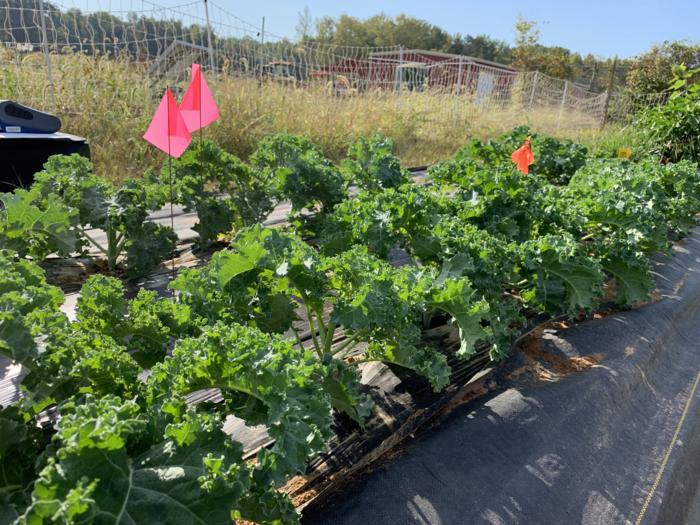
Credit: Keeve Nachman/Johns Hopkins University
Kale fans can rest easy knowing pesticides used to grow the hearty greens are unlikely to end up in their salads or smoothies, a new chemical analysis of the superfood suggests.
Conducting novel tests that provide the most complete picture to date of a crop’s chemical makeup, the Johns Hopkins–led team found several pesticides and compounds in Maryland-farmed kale—but no cause for alarm.
“We do see minute traces of pesticides in the kale, but the levels we found are so much lower than the amounts that would be concerning,” said lead author Carsten Prasse, a Johns Hopkins University assistant professor of environmental health and engineering who studies chemical contaminants. “We took great care to examine exposures to even the most vulnerable among us, including pregnant females and infants, and found no evidence of concern in our samples.”
The findings, newly published in the journal Environmental Sciences & Technology, will help researchers and regulators identify health risks associated with eating other farm-raised fruits and vegetables.
Prasse’s team screened kale from six small farms in Maryland—two urban farms in Baltimore and four rural farms outside the city. The farms used either conventional pesticides or certified organic ones.
The team found six pesticides and related compounds in the kale, including traces of pesticides not used by the farms. The kale also contained herbicides and remnants of DEET, a potent insect repellent famous for melting holes in synthetic fabrics, though not in quantities that would harm anyone according to Environmental Protection Agency standards.
Although the researchers were focused on pesticides, they also wanted to know what else could be in the kale.
They used specialized analytical chemistry techniques capable of screening for many thousands of different chemicals in a single sample. They found evidence the kale could contain as many as 87 other compounds, some with links to negative health effects, though further work is needed to determine whether they pose health risks.
The presence of the compounds themselves is not necessarily cause for alarm, the researchers said. The potential health danger is more about how much, how long, and how often a person is exposed to them.
“If we want to assess the potential risks associated with eating a certain food, we need to cast a wider net to identify and assess chemicals even when we can’t anticipate what they are or where they would be coming from,” said co-author Keeve Nachman, an associate professor of environmental health and engineering. “Using these novel methods for screening contaminants, we were able to look beyond the usual suspects for chemicals we might not have found otherwise.”
Fruits and vegetables can absorb or take up chemicals from many sources in our environment. Ground water used for irrigation can carry substances from surrounding areas, air pollution can settle on the surface of growing crops, and soils can house pesticides and other chemicals for years, the researchers said. As a result, crops can inadvertently be exposed to unknown substances or banned chemicals, the researchers said.
“We dug out all the local soil in our raised beds at home and replaced it with organic soil,” Prasse said. “Because, as it turns out, it’s often the chemicals coming in from the surrounding environment that we should be paying attention to.”
The study is part of a larger effort to better understand how farming practices affect the quality of food. The researchers plan to test farm-raised tomatoes, corn, and other vegetables.
Authors include Johns Hopkins assistant scientists Sara Lupolt and Brent Kim, program officer Raychel Santo, master’s student Qinfan Lyu, and former PhD student Christopher L. Brueck; Georgia Tech PhD student Xiaoyue Xin; and EPA chemist Antony J. Williams.
This work was made possible by cooperative agreement 58-8040-8-021 between the U.S. Department of Agriculture Agricultural Research Service and Johns Hopkins University, NSF DGE1746891, and EPA grant R840247.
Journal
Environmental Science & Technology
DOI
10.1021/acs.est.3c09106
Article Title
(Non)targeted Chemical Analysis and Risk Assessment of Organic Contaminants in Darkibor Kale Grown at Rural and Urban Farms
Article Publication Date
13-Feb-2024