

• HOME
  • NEWS
  • EXPLORE
    • CAREER
      • Companies
      • Jobs
    • EVENTS
    • iGEM
      • News
      • Team
    • PHOTOS
    • VIDEO
    • WIKI
  • BLOG
  • COMMUNITY
    • FACEBOOK
    • INSTAGRAM
    • TWITTER
Wednesday, April 1, 2026
BIOENGINEER.ORG
No Result
View All Result
  • Login
  • HOME
  • NEWS
  • EXPLORE
    • CAREER
      • Companies
      • Jobs
        • Lecturer
        • PhD Studentship
        • Postdoc
        • Research Assistant
    • EVENTS
    • iGEM
      • News
      • Team
    • PHOTOS
    • VIDEO
    • WIKI
  • BLOG
  • COMMUNITY
    • FACEBOOK
    • INSTAGRAM
    • TWITTER
  • HOME
  • NEWS
  • EXPLORE
    • CAREER
      • Companies
      • Jobs
        • Lecturer
        • PhD Studentship
        • Postdoc
        • Research Assistant
    • EVENTS
    • iGEM
      • News
      • Team
    • PHOTOS
    • VIDEO
    • WIKI
  • BLOG
  • COMMUNITY
    • FACEBOOK
    • INSTAGRAM
    • TWITTER
No Result
View All Result
Bioengineer.org
No Result
View All Result
Home NEWS Science News Biology

How ancient sea creatures can inform soft robotics

Bioengineer by Bioengineer
February 10, 2024
in Biology
Reading Time: 2 mins read
0
How Ancient Sea Creatures can Inform Soft Robotics
Share on FacebookShare on TwitterShare on LinkedinShare on RedditShare on Telegram

ROCKVILLE, MD – Soft robotics is the study of creating robots from soft materials, which has the advantage of flexibility and safety in human interactions. These robots are well-suited for applications ranging from medical devices to enhancing efficiency in various tasks. Additionally, using different forms of robotic movement may also serve us well in exploring the ocean or space, or doing certain jobs in those environments.
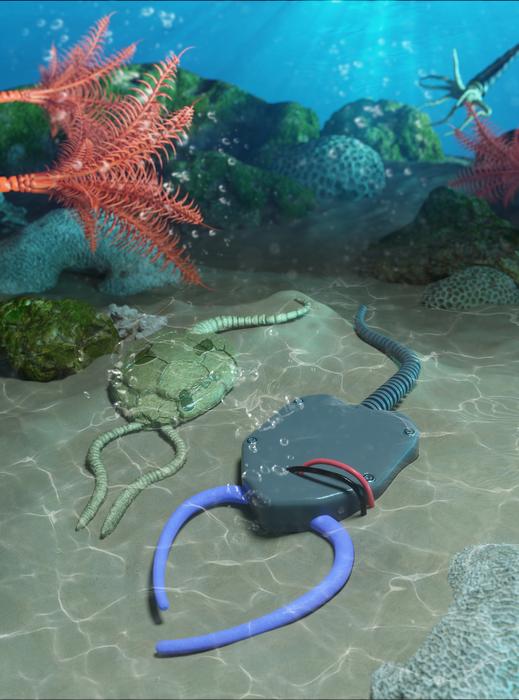
How Ancient Sea Creatures can Inform Soft Robotics

Credit: Image courtesy of Richard Desatnik.

ROCKVILLE, MD – Soft robotics is the study of creating robots from soft materials, which has the advantage of flexibility and safety in human interactions. These robots are well-suited for applications ranging from medical devices to enhancing efficiency in various tasks. Additionally, using different forms of robotic movement may also serve us well in exploring the ocean or space, or doing certain jobs in those environments.

To broaden our understanding of locomotion, Richard Desatnik, who works in the labs of Philip LeDuc and Carmel Majidi at Carnegie Mellon University and collaborates with paleontologists from Europe, turns to the past. The team creates robots with the movement of ancient animals such as pleurocystitids, a sea creature that lived around 500 million years ago. Desatnik will present their findings from the process of building a soft robot based on pleurocystitids at the 68th Biophysical Society Annual Meeting, to be held February 10 – 14, 2024 in Philadelphia, Pennsylvania.

“We’ve learned a lot from modern creatures, but that’s only 1% of the animals that have existed during our planet’s history, and we want to see if there is something we can learn from the other 99% of creatures that once roamed the earth,” Desatnik said. He added, “there are animals that were very successful for millions of years and the reason they died out wasn’t from a lack of success from their biology—there may have been a massive environmental change or extinction event.”

Desatnik and colleagues started off with fossils of pleurocystitids, which are related to present-day sea stars and sea urchins but that had a muscular stem—a kind of tail—to move. They used CT scans to get a better idea of the 3D shape. Computer simulations suggested the ways it may have propelled itself through the water. Based on these data, they built a soft robot that mimics the prehistoric creature.

Their work suggests that a sweeping motion of the stem could have helped these animals glide along the ocean floor. They also found that a longer stem—which the fossil record suggests pleurocystitids developed over generations—could have made them faster without requiring much more energy.

These underwater soft robots may help in the future, “whether it’s geologic surveying, or fixing all the machinery that we have underwater,” Desatnik points out.

The researchers’ approach of using extinct animals to inform soft robotic design, which they call paleobionics, has the potential to further our understanding of evolution, biomechanics, and soft robot movements.



Share12Tweet8Share2ShareShareShare2

Related Posts

Chikungunya Virus Lingers in Joint Macrophages, Causes Chronic Disease

Chikungunya Virus Lingers in Joint Macrophages, Causes Chronic Disease

April 1, 2026
Unveiling How Two Genes Collaborate to Shape Dental and Facial Features

Unveiling How Two Genes Collaborate to Shape Dental and Facial Features

April 1, 2026

Do Your Genes Influence How Lifestyle Choices Affect Aging?

April 1, 2026

Combining Single-Cell Multiomics Unlocks Precise Identification of Rare Cell Types and States

March 31, 2026

POPULAR NEWS

  • blank

    Revolutionary AI Model Enhances Precision in Detecting Food Contamination

    96 shares
    Share 38 Tweet 24
  • Imagine a Social Media Feed That Challenges Your Views Instead of Reinforcing Them

    1006 shares
    Share 398 Tweet 249
  • Promising Outcomes from First Clinical Trials of Gene Regulation in Epilepsy

    51 shares
    Share 20 Tweet 13
  • Popular Anti-Aging Compound Linked to Damage in Corpus Callosum, Study Finds

    43 shares
    Share 17 Tweet 11

About

We bring you the latest biotechnology news from best research centers and universities around the world. Check our website.

Follow us

Recent News

Dorsoventral Hippocampus Reactivates After Aversive Sleep

ALDH1L2 Controls ROS and Pancreatic Cell Changes

Tim-3 Agonist Limits ILC2, Eases Airway Reactivity

Subscribe to Blog via Email

Enter your email address to subscribe to this blog and receive notifications of new posts by email.

Join 78 other subscribers
  • Contact Us

Bioengineer.org © Copyright 2023 All Rights Reserved.

Welcome Back!

Login to your account below

Forgotten Password?

Retrieve your password

Please enter your username or email address to reset your password.

Log In
No Result
View All Result
  • Homepages
    • Home Page 1
    • Home Page 2
  • News
  • National
  • Business
  • Health
  • Lifestyle
  • Science

Bioengineer.org © Copyright 2023 All Rights Reserved.