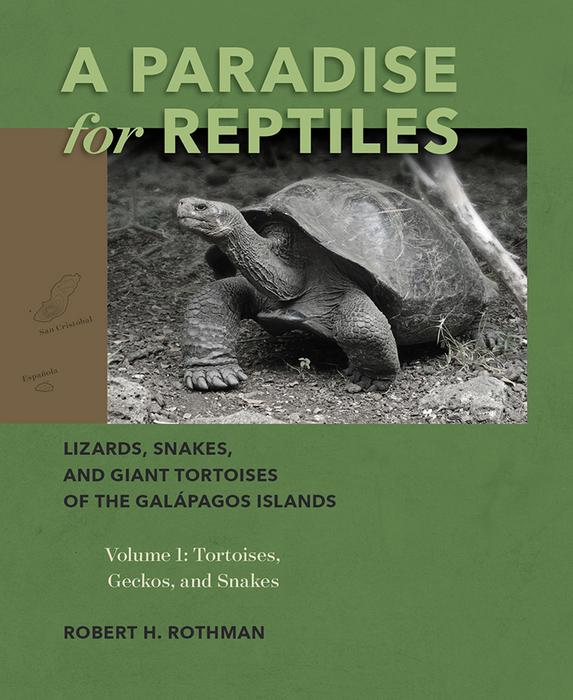
Natural scientist and author Robert Rothman takes readers on a reptillian tour of the Galápagos Islands in his new book, A Paradise for Reptiles: Lizards, Snakes, and Giant Tortoises of the Galápagos Islands Vol. 1: Tortoises, Geckos, and Snakes, published by RIT Press.
Credit: RIT Press
Natural scientist and author Robert Rothman takes readers on a reptillian tour of the Galápagos Islands in his new book, A Paradise for Reptiles: Lizards, Snakes, and Giant Tortoises of the Galápagos Islands Vol. 1: Tortoises, Geckos, and Snakes, published by RIT Press.
For more than 30 years, Rothman has led hundreds of Rochester Institute of Technology students on tours to the Galápagos Islands to observe the wildlife and landscape that inspired Charles Darwin’s theory of evolution by natural selection. Rothman’s A Paradise for Reptiles, an homage to the 19th century scientist, is an accessibly written guide for anyone interested in Darwin, the Galápagos, and reptiles in general.
“It’s the only real synthesis of research that’s been done on those reptiles,” said Rothman, RIT emeritus professor, whose photography illustrates the book. “What I’ve tried to do is, while being scientifically rigorous, make it accessible to anyone who is interested in the Galápagos.”
The story of Galápagos reptiles is tied to the unique geography of the archipelago, and Rothman’s account begins with the geologic processes that formed the chain of volcanic islands. Plants and wildlife reached the islands from South America, adapted to the different habitats, and evolved independently.
An understanding of the habitat leads to a comprehensive review of the giant tortoise, the beloved ambassador of the Galápagos. At one time 18 different types of Galápagos tortoises lived on the islands. That number has dropped, and scientists have used recent DNA analysis to discover hybrid tortoises related to two extinct species.
Buccaneers, mariners, and scientists over hunted giant tortoises for centuries. Now, conservation and repatriation efforts are trying to preserve them, Rothman said. Lonesome George, the last Pinta Island tortoise, held celebrity status at the Charles Darwin Research Station and became a mascot shared by the Galápagos National Park Directorate. Efforts to breed Lonesome George were unsuccessful and the species disappeared with his death in 2012.
“Lonesome George was the symbol of the extreme fragility of the Galápagos Islands and a reminder of the need for vigilance and conservation,” Rothman said. “He is an icon for the finality of extinction.”
A Paradise for Reptiles also includes two shorter sections discussing Galápagos geckos and racer snakes. The Galápagos geckos’ nocturnal existence contributes to their large absence from the scientific literature, Rothman said. Darwin collected related gecko specimens while visiting nearby Patagonia, but none from the archipelago.
Visitors today rarely see Galápagos geckos because their nocturnal activity conflicts with tourist hours on the islands. Tourists must leave the island by 6 p.m., Rothman said. People staying in hotels on the major islands typically see a different type of gecko.
“The geckos come out in force in the evening, but it is the introduced species that are generally seen,” Rothman said.
Rothman concludes his book with findings from the few research studies about the elusive racer snakes. Although Darwin returned from the Galápagos with snake specimens, these reptiles remain obscure.
“Snakes are the least studied and least understood reptile in the Galápagos,” Rothman said.
The archipelago encapsulates Rothman’s lifelong interest in vertebrate paleontology, evolution, and the history of science, as well as Darwin’s discoveries. As an RIT professor of biology and genetics, he taught one of the university’s longest running study abroad programs to the Galápagos Islands.
“When you visit a place once, the way you see it is the way you think it is,” Rothman writes. “However, by returning so many times, I have seen the Galápagos in its many moods.”
To purchase a copy of A Paradise for Reptiles: Lizards, Snakes, and Giant Tortoises of the Galápagos Islands Vol. 1: Tortoises, Geckos, and Snakes, contact RIT Press.
Rothman’s second volume on Galápagos reptiles will publish later this year with a focus on marine and land iguanas and lava lizards.