Tea Maho and Robert R. Reisz
University of Toronto Mississauga
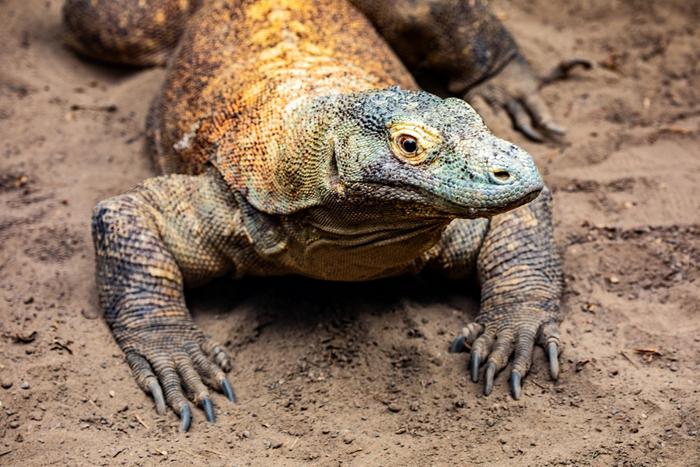
Credit: Toronto Zoo
Tea Maho and Robert R. Reisz
University of Toronto Mississauga
Kilat, the largest living lizard at the Toronto Metro Zoo, like other members of his species (Varanus komodoensis), truly deserves to be called the Komodo Dragon! Its impressive size and the way it looks at you and tracks your every move makes you realize that it is an apex predator, not unlike a ferocious theropod dinosaur. So, it is not surprising when you look around at his enclosure to find that there are shed teeth sparkling on the ground, a common find when hunting for Mesozoic theropod dinosaurs. This startling phenomenon led us to study the teeth and feeding behaviour of this fascinating predator. The Toronto Zoo Team generously collected many shed teeth and allowed us to undertake this study, and skulls in the skeletal collection of the Royal Ontario Museum were also made available to us.
Previous studies have focused on the unique feeding behaviour of the Komodo Dragon but have not related this to its unique dental morphology, development, and replacement. We, therefore, examined the dentition and jaws of adults and juveniles with a combination of histological analysis and computed tomography (CT). We discovered that the adult Komodo teeth were surprisingly similar to those of theropod dinosaurs, with the strongly recurved teeth of adults having serrated cutting edges that were strengthened by dentine cores. “We were very excited by this discovery because it makes the Komodo an ideal living model organism for studies of the life history and feeding strategies of the extinct theropod dinosaurs” said PhD student Tea Maho, lead author of the paper published in PLoS One.
The Komodo Dragon, like most other reptiles, including the extinct theropod dinosaurs, replaces its teeth continuously throughout its life. The histology, a common technique for studying the microstructure of teeth, and x-ray CT of their heads showed that the Komodo dragon maintains up to five replacement teeth per tooth position in their jaws. “Having this many teeth within the jaw at a given time is a unique feature among predatory reptiles, and only seen In the Komodo” noted Dr. Robert Reisz, coauthor of the research paper. Most other known reptiles have one or at most two replacement teeth in the jaw, and this includes most theropod dinosaurs. Perhaps the most surprising discovery was that the Komodo started to make new teeth in each tooth position every 40 days. This is why there were so many shed teeth in the Komodo Dragon enclosure, and this is how new teeth very rapidly replace the old functional teeth. Other reptiles, including most theropod dinosaurs, usually took three months to make a replacement tooth, sometimes as long as a year. “So, if in the wild a tooth breaks during prey capture or defleshing, no problem, a new one would replace the broken tooth very quickly” explained Tea Maho.
Since we had skulls and teeth of both adults and juveniles of the Komodo, we were also able to discover an interesting correlation between their teeth and their feeding behaviour. Hatchlings and juvenile Komodos have more delicate teeth, not suited for the typical defleshing behaviour of the adults, and spend most of their time in the trees, avoiding the adults and feeding mainly on insects and small vertebrates. As they grow to adult size, their teeth change dramatically in shape, and they eventually descend from the trees to become apex predators, able to attack and kill anything in their domain.
Finally, we also noticed that the front teeth of the Komodo adults are either very small or completely missing. This unusual dental morphology correlates well with their tongue-flicking behaviour, using the slender, forked snake-like tongue for foraging for prey without having to open their mouth.
Journal
PLoS ONE
DOI
10.1371/journal.pone.0295002
Subject of Research
Animals
Article Title
Exceptionally rapid tooth development and ontogenetic changes in the feeding apparatus of the Komodo dragon
Article Publication Date
7-Feb-2024