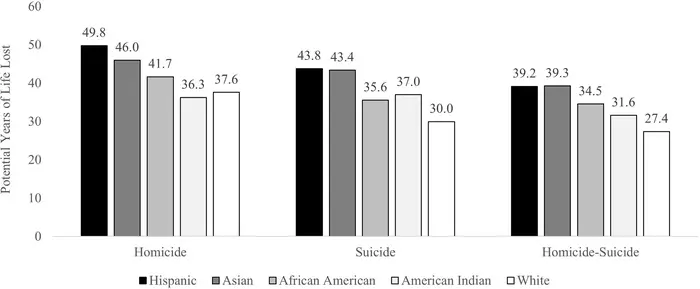
In the US, people of color who are killed by violence or die by suicide lose more potential years of life than white victims, according to a new study, which also explored factors that may contribute to these disparities. Gregory Zimmerman of Northeastern University in Boston, US, and colleagues present these findings in the open-access journal PLOS ONE on February 7, 2024.
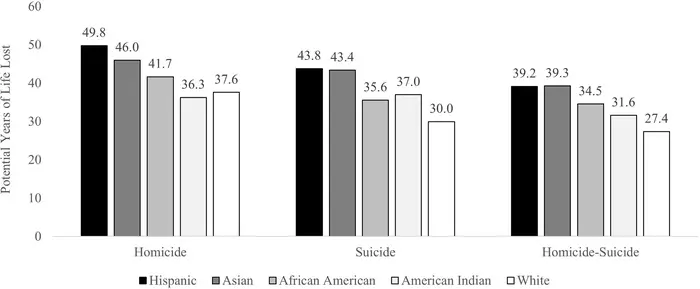
Credit: Zimmerman et al., 2024, PLOS ONE, CC-BY 4.0 (https://creativecommons.org/licenses/by/4.0/)
In the US, people of color who are killed by violence or die by suicide lose more potential years of life than white victims, according to a new study, which also explored factors that may contribute to these disparities. Gregory Zimmerman of Northeastern University in Boston, US, and colleagues present these findings in the open-access journal PLOS ONE on February 7, 2024.
Mounting evidence suggests that, among victims of violence in the US, the average number of potential years of life lost—how much longer the victim would have lived if they survived—is greater for people of color than for white people.
To deepen understanding, Zimmerman and colleagues analyzed data from the National Violent Death Reporting System (NVDRS). The data included a total of 98,617 homicide victims, 230,527 suicide decedents, and 3,962 homicide-suicide perpetrators who died between 2003 and 2019.
In line with prior research, they found that victims who were Hispanic, African American, Asian or Pacific Islander, or American Indian or Alaska Native tended to die at significantly younger ages than white victims.
Next, the researchers used information from the NVDRS and the US Census Bureau’s American Community Survey to explore if these disparities could be statistically explained by known differences in exposure among the different racial and ethnic groups to factors associated with higher risk of violence.
They found that several such factors—including individual differences, socio-familial factors, and characteristics and context of the violent incident—did indeed statistically account for some of the disparities. These factors included educational attainment, mental health problems, access to firearms, medical problems, and financial challenges.
The researchers say their findings suggest that the observed disparities can be addressed, and they identify several directions for such efforts; for instance, by providing communities of color with resources to boost educational opportunities, improve access to childcare, and address intimate partner violence.
The researchers also note the need for further research, as the NVDRS data only captured US deaths and did so incompletely. Furthermore, the study did not account for other factors that could help explain the observed disparities, such as cultural factors and access to quality medical and mental healthcare.
The authors add: “Findings indicated that non-white homicide victims, suicide decedents, and homicide-suicide perpetrators died significantly younger than their white counterparts. Homicide and suicide exact a high societal cost, and the burden of that cost is disproportionately high among persons of color.”
#####
In your coverage please use this URL to provide access to the freely available article in PLOS ONE: https://journals.plos.org/plosone/article?id=10.1371/journal.pone.0297346
Citation: Zimmerman GM, Fridel EE, Trovato D (2024) Disproportionate burden of violence: Explaining racial and ethnic disparities in potential years of life lost among homicide victims, suicide decedents, and homicide-suicide perpetrators. PLoS ONE 19(2): e0297346. https://doi.org/10.1371/journal.pone.0297346
Author Countries: USA
Funding: The authors received no specific funding for this work.
Journal
PLoS ONE
DOI
10.1371/journal.pone.0297346
Method of Research
Observational study
Subject of Research
People
Article Title
Disproportionate burden of violence: Explaining racial and ethnic disparities in potential years of life lost among homicide victims, suicide decedents, and homicide-suicide perpetrators
Article Publication Date
7-Feb-2024
COI Statement
The authors have declared that no competing interests exist.