Hamilton, ON, Feb. 6, 2024 – Think of it as recycling on the nanoscale: a tantalizing electrochemical process that can harvest carbon before it becomes air pollution and restructure it into the components of everyday products.
Credit: Jessie Park, McMaster University
Hamilton, ON, Feb. 6, 2024 – Think of it as recycling on the nanoscale: a tantalizing electrochemical process that can harvest carbon before it becomes air pollution and restructure it into the components of everyday products.
The drive to capture airborne carbon dioxide from industrial waste and make it into fuel and plastics is gaining momentum after a team of researchers based at McMaster University, working with computational chemistry experts at Copenhagen’s Danish Technical University, uncovered precisely how the process works and where it bogs down.
The researchers set out to resolve why synthetic materials that have been shown to catalyze and convert carbon dioxide break down too quickly for the process to be practical at an industrial level.
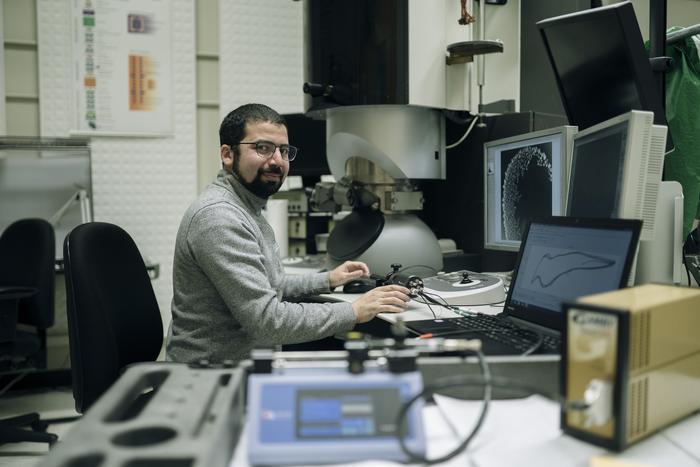
Using extremely powerful magnification equipment at the Canadian Centre for Electron Microscopy (CCEM), which is based on McMaster’s campus, the researchers were able to capture the chemical reaction at nanoscale – billionths of a metre – allowing them to study both the conversion process and understand how the catalyst breaks down under operating conditions.
Lead author Ahmed Abdellah spent years developing the techniques that made it possible to observe the process, using an electrochemical reactor small enough to work under the electron microscopes at the centre.
“It’s exciting for us that this is the first time anyone has been able to look at both the shapes of these structures and their crystal structures, to see how they evolve at the nanoscale,” says Abdellah, a former PhD student in the chemical engineering lab of Drew Higgins and now a postdoctoral fellow at the CCEM.
Higgins, a corresponding author of the paper, newly published in the journal Nature Communications, hopes the new information will facilitate the global effort to reduce carbon pollution by drawing carbon dioxide away from waste streams and instead recycling it to create useful products that would otherwise be produced from fossil fuels.
“What we have found is that catalysts that can convert carbon dioxide into fuels and chemicals restructure quite rapidly under operating conditions. Their structures change and their properties change, right before our very eyes” Higgins says. “That dictates how efficient they are at converting carbon dioxide and how long they last. The catalysts eventually degrade and stop working and we want to know why they do that and how they do that so that we can develop strategies to improve their operational lifetimes.”
Abdellah, Higgins and their colleagues are hopeful they and other researchers around the world can use the research results described in the new paper to make the reactive materials last longer and catalyze the process more efficiently, to allow the lab-based process to be scaled up for commercial use.
Industries such as cement manufacturing, brewing and distilling, as well as chemical refineries produce high volumes of readily retrievable carbon dioxide, Higgins explains, making them likely first targets for rolling out the technology once it is improved to the point where it is commercially viable.
Other less concentrated forms of CO2 in industrial waste would come next.
Though it’s a longshot today, Higgins says it’s possible the same technology could become efficient and stable enough to pull carbon dioxide from ambient air as “feedstock” for fuel and useful chemicals.
“We’re still a little ways off, but progress has been very rapid in this field of research and development in the last five years or so,” Higgins says. “Ten years ago, people weren’t thinking about this kind of conversion, but now we’re starting to see promise. Efficiency and durability, though, just aren’t high enough yet. Once these bottlenecks are removed, this idea can really take off.”
Photos of Ahmed Abdellah and Drew Higgins are available here. https://photos.app.goo.gl/wjp8333wHmpXAp8a7
To arrange an interview with Drew Higgins, please contact him at [email protected]
For more information, please contact:
Wade Hemsworth
McMaster Media Relations
[email protected]
Michelle Donovan
McMaster Media Relations
[email protected]
Journal
Nature Communications
DOI
10.1038/s41467-024-45096-3
Method of Research
Experimental study
Subject of Research
Not applicable
Article Title
Impact of palladium/palladium hydride conversion on electrochemical CO2 reduction via in-situ transmission electron microscopy and diffraction
Article Publication Date
31-Jan-2024
COI Statement
The authors declare no competing interests.