• HOME
  • NEWS
  • EXPLORE
    • CAREER
      • Companies
      • Jobs
    • EVENTS
    • iGEM
      • News
      • Team
    • PHOTOS
    • VIDEO
    • WIKI
  • BLOG
  • COMMUNITY
    • FACEBOOK
    • INSTAGRAM
    • TWITTER
Sunday, February 8, 2026
BIOENGINEER.ORG
No Result
View All Result
  • Login
  • HOME
  • NEWS
  • EXPLORE
    • CAREER
      • Companies
      • Jobs
        • Lecturer
        • PhD Studentship
        • Postdoc
        • Research Assistant
    • EVENTS
    • iGEM
      • News
      • Team
    • PHOTOS
    • VIDEO
    • WIKI
  • BLOG
  • COMMUNITY
    • FACEBOOK
    • INSTAGRAM
    • TWITTER
  • HOME
  • NEWS
  • EXPLORE
    • CAREER
      • Companies
      • Jobs
        • Lecturer
        • PhD Studentship
        • Postdoc
        • Research Assistant
    • EVENTS
    • iGEM
      • News
      • Team
    • PHOTOS
    • VIDEO
    • WIKI
  • BLOG
  • COMMUNITY
    • FACEBOOK
    • INSTAGRAM
    • TWITTER
No Result
View All Result
Bioengineer.org
No Result
View All Result
Home NEWS Science News Health

Mobile patient lifts help ICU patients recover

Bioengineer by Bioengineer
February 6, 2024
in Health
Reading Time: 2 mins read
0
Mobilization of ICU patients using mobile patient lift
Share on FacebookShare on TwitterShare on LinkedinShare on RedditShare on Telegram

Tokyo, Japan – A recent randomized controlled trial in Tokyo, Japan, has unveiled the positive impact of early mobilization, assisted by mobile patient lifts, on the recovery of ventilated intensive care unit (ICU) patients. The debate surrounding the efficacy of early mobilization in ICU has persisted for an extended period.
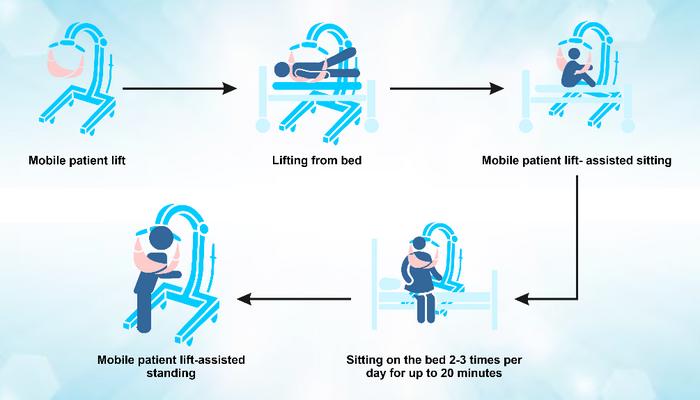
Mobilization of ICU patients using mobile patient lift

Credit: Dr. Ginga Suzuki

Tokyo, Japan – A recent randomized controlled trial in Tokyo, Japan, has unveiled the positive impact of early mobilization, assisted by mobile patient lifts, on the recovery of ventilated intensive care unit (ICU) patients. The debate surrounding the efficacy of early mobilization in ICU has persisted for an extended period.


The treatment of critically ill patients in ICUs, often involving prolonged limb immobilization or restricted mobility, is acknowledged as a risk factor for diminished physical strength and diminished quality of life post-recovery, commonly termed as post-intensive care syndrome (PICS) or ICU-acquired weakness (ICU-AW). While early mobilization, the initiation of physical activity in the early stages of ICU treatment, has been suggested as a preventive measure for ICU-AW, its impact on outcomes has been highly controversial. This new study aimed to investigate whether a more proactive approach to early mobilization, assisted by mobile patient lifts, could facilitate mobilization compared to usual rehabilitation.


The study enrolled 80 patients who received ventilation for a minimum of 48 hours. The intervention group underwent assistance in sitting, standing, transfers, and walking using a mobile patient lift. The researchers observed that the use of mobile lifts led to earlier standing (on day 1, compared to day 3 in the control group after the initiation of rehabilitation). Furthermore, the intervention group exhibited higher Functional Status Score for the Intensive Care Unit scores (FSS-ICU) at ICU discharge, physical function during ICU stay. This study underscores the benefits of early mobilization for mechanically ventilated ICU patients when combined with the use of mobile patient lifts. Given the historical controversy surrounding the effectiveness of early mobilization, these findings may contribute to our understanding of the recovery process in ICU patients.


“We anticipate that proactive early mobilization, with the assistance of mobile patient lifts, will play a pivotal role in preventing post-intensive care syndrome. To draw conclusive evidence for the advantages of early mobilization, further studies should accumulate supportive data,” remarked Dr. Ginga Suzuki, the lead author of the study.


Journal

Critical Care Medicine

DOI

10.1097/CCM.0000000000006219

Method of Research

Randomized controlled/clinical trial

Subject of Research

People

Article Title

Early mobilization using a mobile patient lift in the intensive care unit: A randomized controlled trial

Article Publication Date

6-Feb-2024

COI Statement

The authors declare they have no conflict of interest regarding the publication of this article.
Share12Tweet8Share2ShareShareShare2

Related Posts

Evaluating a Self-Care App for Chest Trauma Patients

February 8, 2026

Anesthesia Method’s Impact on Elderly Hip Fracture Recovery

February 8, 2026

Menopause Care: Insights from Workforce Review and Consultation

February 7, 2026

LRRK2R1627P Mutation Boosts Gut Inflammation, α-Synuclein

February 7, 2026

POPULAR NEWS

  • Robotic Ureteral Reconstruction: A Novel Approach

    Robotic Ureteral Reconstruction: A Novel Approach

    82 shares
    Share 33 Tweet 21
  • Digital Privacy: Health Data Control in Incarceration

    63 shares
    Share 25 Tweet 16
  • Breakthrough in RNA Research Accelerates Medical Innovations Timeline

    53 shares
    Share 21 Tweet 13
  • Mapping Tertiary Lymphoid Structures for Kidney Cancer Biomarkers

    50 shares
    Share 20 Tweet 13

About

We bring you the latest biotechnology news from best research centers and universities around the world. Check our website.

Follow us

Recent News

Evaluating a Self-Care App for Chest Trauma Patients

Anesthesia Method’s Impact on Elderly Hip Fracture Recovery

Menopause Care: Insights from Workforce Review and Consultation

Subscribe to Blog via Email

Enter your email address to subscribe to this blog and receive notifications of new posts by email.

Join 73 other subscribers
  • Contact Us

Bioengineer.org © Copyright 2023 All Rights Reserved.

Welcome Back!

Login to your account below

Forgotten Password?

Retrieve your password

Please enter your username or email address to reset your password.

Log In
No Result
View All Result
  • Homepages
    • Home Page 1
    • Home Page 2
  • News
  • National
  • Business
  • Health
  • Lifestyle
  • Science

Bioengineer.org © Copyright 2023 All Rights Reserved.