UNIVERSITY PARK, Pa. — The bacteria and microorganisms that live within the human body — the microbiota — can impact human health, disease risk and even how the body absorbs medications, but the details of these processes are unclear. To help understand how complex communities of microbes impact human health, the National Institutes of Health’s National Institute of General Medical Science has awarded a 5-year, $1.9 million Maximizing Investigator’s Research Award to Jordan Bisanz, assistant professor of biochemistry and molecular biology in the Penn State Eberly College of Science.
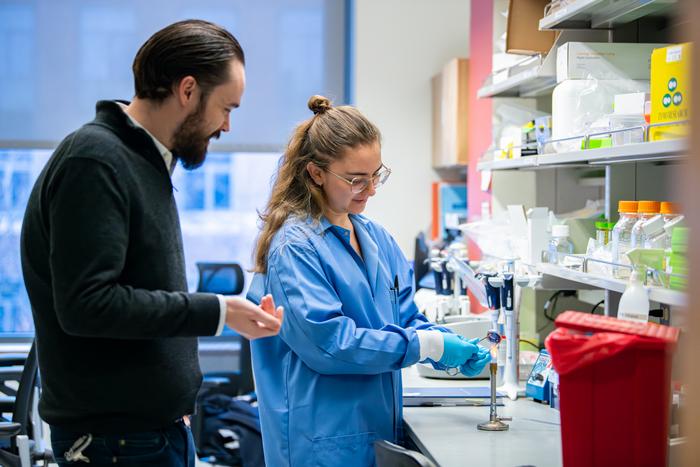
Credit: Michelle Bixby/Penn State
UNIVERSITY PARK, Pa. — The bacteria and microorganisms that live within the human body — the microbiota — can impact human health, disease risk and even how the body absorbs medications, but the details of these processes are unclear. To help understand how complex communities of microbes impact human health, the National Institutes of Health’s National Institute of General Medical Science has awarded a 5-year, $1.9 million Maximizing Investigator’s Research Award to Jordan Bisanz, assistant professor of biochemistry and molecular biology in the Penn State Eberly College of Science.
“It is clear that the diversity of microbes in the human body is important, but why that diversity is important gets much murkier,” Bisanz said. “We plan to use a combination of computational and experimental biology to better understand the different species that make up a healthy human microbiome as well as how they work together to impact human health.”
A single person’s microbiome might contain several hundred or thousand different species, for example living within the digestive tract or on the skin. Many microbiome studies focus on counting the number of different species present — the diversity — as well as identifying individual species and their abundance. Bisanz plans to use machine learning and other computational methods to analyze these kinds of publicly available data to better understand what defines a healthy microbial community.
“We plan to look at information from hundreds of people to identify the most common strains or combinations of strains in a healthy microbiome,” he said. “Then, we can essentially design a healthy microbiome and use that as a model system to understand how the community functions. This is a very different approach from how microbiology tends to be done.”
After identifying the key species in a typical healthy microbiome, Bisanz and his lab will experimentally build a laboratory model of a healthy microbiome, pulling from the several hundred microbial strains they maintain in the lab. Then, they can assess how that microbiome might respond in the context of a certain disease. They could also identify and build laboratory models microbiomes that reflect those of individuals with particular diseases.
“It’s kind of like a cookbook of microbial communities, and we can decide what is practical for us to use to explore different questions,” he said. “Ultimately, we hope to better identify the specific microbes and metabolic processes that are important for host-microbe interactions and how they impact disease risk.”
This work could help guide the development of targeted therapies, Bisanz said, that use specific microbes to treat bacterial infections or to improve gut health, rather than a more generic set of microbes, like those in probiotics and fecal transplant therapy.
Bisanz will also explore how the microbiome might impact a person’s response to medications. Most drugs taken orally pass through microbes before they are absorbed in the body, he said, so microbes — like host genetics — can impact how effectively and efficiently drugs are absorbed.
“One of the questions from a personalized medicine standpoint is how to select the right dosage of a drug,” he said. “You can imagine in a futuristic world, you might go to the doctor for a treatment and they could do a quick test. And maybe they would identify a genetic marker that indicates you absorb the drug more quickly than others and also identify that they have a microbe that is known to metabolize the drug, and that helps them set the dosage.”
Bisanz and colleagues will specifically investigate the role of the microbiome in the uptake of orally administered antimalarial drugs, which are notorious for their side effects that range from dizziness and vomiting to lucid dreams.
“There is a huge amount of unexplained variation in the amount and severity of these side-effects, and a lot of people stop taking the drugs because of those side effects,” Bisanz said. “Antimalarials are also a subject of concern because there is increasing resistance to the most common drugs in the parasites that cause malaria. If microbes can impact how much of a drug gets into the bloodstream, they may also influence the side effects, and it’s reasonable that they may also be playing a role in the development of resistance.”
Together, this grant will provide Bisanz the opportunity to improve understanding of how microbial communities shape human health and physiology.
“The microbiome is very responsive, and it can be modified quickly and easily using dietary manipulations, like probiotics,” he said. “It is a relatively young field, but it has promising and immediate translational applications.”