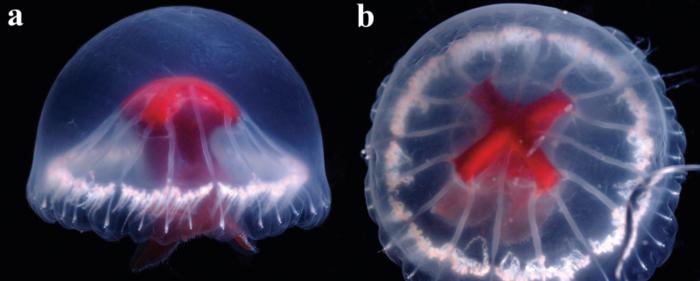
A gelatinous animal with a diameter of about 10 cm and a red stomach resembling the Cross of St George when seen from above. This is Santjordia pagesi, a newly described species of medusa. Medusae are a type of free-swimming, umbrella-shaped jellyfish with a reduced stalk.
Credit: Dhugal John Lindsay/JAMSTEC
A gelatinous animal with a diameter of about 10 cm and a red stomach resembling the Cross of St George when seen from above. This is Santjordia pagesi, a newly described species of medusa. Medusae are a type of free-swimming, umbrella-shaped jellyfish with a reduced stalk.
The new species is described in an article published in the journal Zootaxa. The study was conducted by an international group of researchers that included a Brazilian scientist supported by FAPESP.
The scientist in question is André Morandini, last author of the article. He is a professor of zoology at the University of São Paulo’s Institute of Biosciences (IB-USP) and Director of the Center for Marine Biology (CEBIMar) at the same university.
While he was conducting the research, Morandini was supported by FAPESP’s Research Program on Biodiversity Characterization, Conservation, Restoration and Sustainable Use (BIOTA-FAPESP) via three projects (10/50174-7, 11/50242-5 and 13/05510-7.
The other authors are researchers at the Japan Agency for Marine-Earth Science and Technology (JAMSTEC), in Japan, and the Okinawa Institute of Science and Technology (OIST), also in Japan.
The St George’s Cross Medusa, as it has been named, apparently lives only in the Sumisu Caldera in Ogasawara Islands, some 460 km south of Tokyo. The caldera is a hydrothermally active deep-sea volcanic structure with a diameter of about 10 km and a depth of 812 m.
“The species is very different from all the deep-sea medusae discovered to date. It’s relatively small, whereas others in this kind of environment are much larger. The bright red coloring of its stomach probably has to do with capturing food,” Morandini explained.
Like all jellyfish, S. pagesi is transparent, and the bright red stomach ensures that bioluminescent organisms cannot be seen by predators after they are swallowed. Bioluminescence (emission of light by living organisms) is common in the darkness of the deep sea.
The species epithet pagesi was chosen to honor Dr. Francesc Pagès, a jellyfish taxonomist from Barcelona who died recently. The authors determined that the medusa belongs to a new genus (Santjordia, St George in Catalan) and subfamily (Santjordiinae) in the jellyfish family Ulmaridae.
Rare and inaccessible
Discovery of a new species usually entails the collection of several specimens, but S. pagesi is very rare, and it was so hard to collect that the description was based on a single specimen, although the scientists did see another nearby and expect future surveys of the deep ocean to discover more members of the group.
The specimen was captured in 2002 by the Remotely Operated Vehicle (ROV) Hyperdolphin during a dive in the Sumisu Caldera, which can only be accessed by scientific expeditions with this type of special equipment. No other specimens were found until 2020, when the KM-ROV filmed, but was unable to collect, another individual of the same species.
“We opted to publish the description and call attention to the species that are present at the site, which has a substrate rich in minerals and the potential to be commercially developed. Unfortunately, research can’t be conducted in such places without partners who have interests of this kind,” Morandini said.
Because it is so different even from closely related species, the researchers believe S. pagesi may have an arsenal of venoms that are also unlike those discovered to date. “Who knows? Maybe it holds secrets more valuable than all the mineral wealth that could be extracted from that place. All this with the advantage of keeping the species and the site intact,” he stressed.
About São Paulo Research Foundation (FAPESP)
The São Paulo Research Foundation (FAPESP) is a public institution with the mission of supporting scientific research in all fields of knowledge by awarding scholarships, fellowships and grants to investigators linked with higher education and research institutions in the State of São Paulo, Brazil. FAPESP is aware that the very best research can only be done by working with the best researchers internationally. Therefore, it has established partnerships with funding agencies, higher education, private companies, and research organizations in other countries known for the quality of their research and has been encouraging scientists funded by its grants to further develop their international collaboration. You can learn more about FAPESP at www.fapesp.br/en and visit FAPESP news agency at www.agencia.fapesp.br/en to keep updated with the latest scientific breakthroughs FAPESP helps achieve through its many programs, awards and research centers. You may also subscribe to FAPESP news agency at http://agencia.fapesp.br/subscribe.
Journal
Zootaxa
DOI
10.11646/ZOOTAXA.5374.4.5
Article Title
A new subfamily of ulmarid scyphomedusae, the Santjordiinae, with a description of Santjordia pagesi gen. et sp. nov. (Cnidaria: Scyphozoa: Discomedusae: Semaeostomeae: Ulmaridae) from the Sumisu Caldera, Ogasawara Islands, Japan
Article Publication Date
20-Nov-2023