

• HOME
  • NEWS
  • EXPLORE
    • CAREER
      • Companies
      • Jobs
    • EVENTS
    • iGEM
      • News
      • Team
    • PHOTOS
    • VIDEO
    • WIKI
  • BLOG
  • COMMUNITY
    • FACEBOOK
    • INSTAGRAM
    • TWITTER
Wednesday, September 2, 2026
BIOENGINEER.ORG
No Result
View All Result
  • Login
  • HOME
  • NEWS
  • EXPLORE
    • CAREER
      • Companies
      • Jobs
        • Lecturer
        • PhD Studentship
        • Postdoc
        • Research Assistant
    • EVENTS
    • iGEM
      • News
      • Team
    • PHOTOS
    • VIDEO
    • WIKI
  • BLOG
  • COMMUNITY
    • FACEBOOK
    • INSTAGRAM
    • TWITTER
  • HOME
  • NEWS
  • EXPLORE
    • CAREER
      • Companies
      • Jobs
        • Lecturer
        • PhD Studentship
        • Postdoc
        • Research Assistant
    • EVENTS
    • iGEM
      • News
      • Team
    • PHOTOS
    • VIDEO
    • WIKI
  • BLOG
  • COMMUNITY
    • FACEBOOK
    • INSTAGRAM
    • TWITTER
No Result
View All Result
Bioengineer.org
No Result
View All Result
Home NEWS Science News Health

Unlocking precision medicine for inflammatory bowel disease

Bioengineer by Bioengineer
February 5, 2024
in Health
Reading Time: 2 mins read
0
An illustration of the future of precision medicine and informed selection of IBD therapy.
Share on FacebookShare on TwitterShare on LinkedinShare on RedditShare on Telegram

The prevalence of inflammatory bowel disease (IBD), encompassing ulcerative colitis (UC) and Crohn’s disease (CD), is rapidly increasing worldwide, affecting an estimated 6.8 million people. This surge brings significant economic burdens, with annual healthcare costs exceeding $12,000 and $7,000 for CD and UC patients, respectively. Tailored drug selection based on individual factors can potentially reduce these costs and improve patient outcomes.
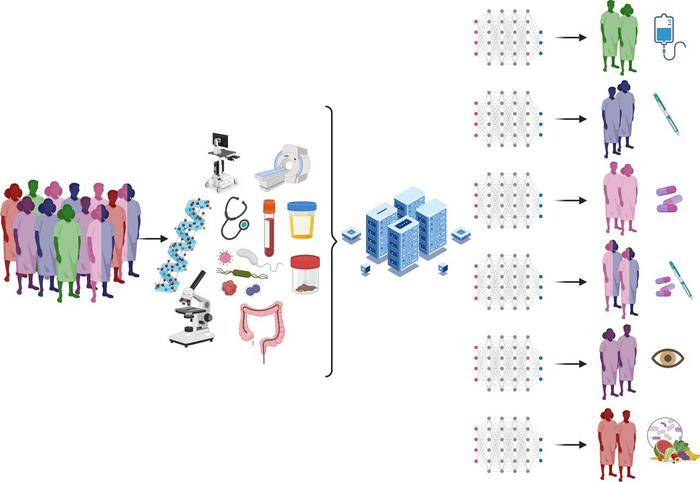
An illustration of the future of precision medicine and informed selection of IBD therapy.

Credit: By Little RD, Jayawardana T, Koentgen S, et al.

The prevalence of inflammatory bowel disease (IBD), encompassing ulcerative colitis (UC) and Crohn’s disease (CD), is rapidly increasing worldwide, affecting an estimated 6.8 million people. This surge brings significant economic burdens, with annual healthcare costs exceeding $12,000 and $7,000 for CD and UC patients, respectively. Tailored drug selection based on individual factors can potentially reduce these costs and improve patient outcomes.

Factors associated with a Western lifestyle such as urbanization, high animal protein intake, ultra-processed foods, and reduced fiber consumption are linked to IBD onset. Gut microbial diversity also plays a key role, with rural communities exhibiting greater microbial richness compared to urban populations. Understanding these environmental and microbial influences is crucial for developing preventive strategies.

Despite significant scientific advancements, the exact causes of UC and CD remain elusive. A complex interplay of genetics, immune dysregulation, gut microbiota alterations, and environmental factors contributes to disease development. Current immunosuppressive treatment options require more personalized approaches.

The field of precision medicine offers hope for personalized IBD treatment. We can potentially predict treatment response and optimize therapy selection by analyzing individual genetic, immunological, and microbial profiles. This “multiomics” approach, coupled with machine learning, holds the key to unlocking new therapeutic targets and improving patient outcomes.

This review dives deeper into IBD’s genetic, immunological, and microbial drivers, highlighting potential predictive markers of treatment response. We explore the principles of machine-learning-powered bioinformatics and collaborative research, paving the way for future precision medicine strategies in IBD. By embracing personalized approaches, we can unlock a brighter future for patients living with this chronic condition.

See the article: 

Little RD, Jayawardana T, Koentgen S, et al. Pathogenesis and precision medicine for predicting response in inflammatory bowel disease: advances and future directions. eGastroenterology 2024;2:e100006. doi:10.1136/egastro-2023-100006


About eGastroenterology

eGastroenterology is a new, open-access, and open peer-reviewed BMJ Journal, which focuses on basic, clinical, translational, and evidence-based medicine research in all areas of gastroenterology (including hepatology, pancreatology, esophagology, and gastrointestinal surgery).

For more information, please visit: egastroenterology.bmj.com and follow us on Twitter (@eGastro_BMJ).

Sign-up to Email Alerts for eGastroenterology: https://emails.bmj.com/k/Bmj/jausu/egastroenterology


Journal

eGastroenterology

DOI

10.1136/egastro-2023-100006

Article Title

Pathogenesis and precision medicine for predicting response in inflammatory bowel disease: advances and future directions


Share12Tweet8Share2ShareShareShare2

Related Posts

Wearable monitor improves diagnosis of heart rhythm disorders after fainting

August 31, 2026

Visualisation of magnetic field-induced nanoparticle clusters and mechanical property changes in a breast phantom for inductive moderate hyperthermia

August 31, 2026

Multidisciplinary intervention in frail elderly patients with cardiovascular diseases: a multicentre, single-blinded, randomised controlled trial

August 31, 2026

Machine Learning Model Development and Evaluation for Non-contact Lower Limb Injury Risk Prediction in Elite Male Rugby Union: A Multi-team, Multi-season Analysis

August 31, 2026

POPULAR NEWS

  • β-Sitosterol from Ipomoea carnea Jacq. As a promising anti-inflammatory agent: Evidence from in silico modeling and in vitro validation

    29 shares
    Share 12 Tweet 7
  • Design, fabrication and characterization of a wearable Fiber Bragg grating sensor for cardiorespiratory monitoring using finger plethysmography

    29 shares
    Share 12 Tweet 7
  • KAIST opens the era of industrial-scale microbial foods, proposing growth strategies for the next-generation protein market

    29 shares
    Share 12 Tweet 7
  • Virologist awarded $2 million NIH grant to investigate how virus-infected cells live and die

    29 shares
    Share 12 Tweet 7

About

We bring you the latest biotechnology news from best research centers and universities around the world. Check our website.

Follow us

Recent News

β-Sitosterol from Ipomoea carnea Jacq. As a promising anti-inflammatory agent: Evidence from in silico modeling and in vitro validation

Design, fabrication and characterization of a wearable Fiber Bragg grating sensor for cardiorespiratory monitoring using finger plethysmography

KAIST opens the era of industrial-scale microbial foods, proposing growth strategies for the next-generation protein market

Subscribe to Blog via Email

Success! An email was just sent to confirm your subscription. Please find the email now and click 'Confirm' to start subscribing.

Join 85 other subscribers
  • Contact Us

Bioengineer.org © Copyright 2023 All Rights Reserved.

Welcome Back!

Login to your account below

Forgotten Password?

Retrieve your password

Please enter your username or email address to reset your password.

Log In
No Result
View All Result
  • Homepages
    • Home Page 1
    • Home Page 2
  • News
  • National
  • Business
  • Health
  • Lifestyle
  • Science

Bioengineer.org © Copyright 2023 All Rights Reserved.