

• HOME
  • NEWS
  • EXPLORE
    • CAREER
      • Companies
      • Jobs
    • EVENTS
    • iGEM
      • News
      • Team
    • PHOTOS
    • VIDEO
    • WIKI
  • BLOG
  • COMMUNITY
    • FACEBOOK
    • INSTAGRAM
    • TWITTER
Wednesday, April 1, 2026
BIOENGINEER.ORG
No Result
View All Result
  • Login
  • HOME
  • NEWS
  • EXPLORE
    • CAREER
      • Companies
      • Jobs
        • Lecturer
        • PhD Studentship
        • Postdoc
        • Research Assistant
    • EVENTS
    • iGEM
      • News
      • Team
    • PHOTOS
    • VIDEO
    • WIKI
  • BLOG
  • COMMUNITY
    • FACEBOOK
    • INSTAGRAM
    • TWITTER
  • HOME
  • NEWS
  • EXPLORE
    • CAREER
      • Companies
      • Jobs
        • Lecturer
        • PhD Studentship
        • Postdoc
        • Research Assistant
    • EVENTS
    • iGEM
      • News
      • Team
    • PHOTOS
    • VIDEO
    • WIKI
  • BLOG
  • COMMUNITY
    • FACEBOOK
    • INSTAGRAM
    • TWITTER
No Result
View All Result
Bioengineer.org
No Result
View All Result
Home NEWS Science News Health

cfDNA sequencing enhances non-invasive early detection of gestational diabetes

Bioengineer by Bioengineer
February 1, 2024
in Health
Reading Time: 3 mins read
0
(A) The age distribution of the normal group and GDM group. (B) The weight distribution of the normal group and GDM group. (C) The sample time distribution of the normal and GDM group. (D) PCA scatter plot of normal and GDM samples
Share on FacebookShare on TwitterShare on LinkedinShare on RedditShare on Telegram

Gestational diabetes mellitus (GDM) is a prevalent pregnancy complication posing significant health risks to both mothers and their newborns. Early detection and treatment of GDM are crucial to prevent adverse outcomes. Current screening methods, like glucose tolerance tests, are in after 24 weeks of pregnancy and have limitations in patient compliance and accuracy.
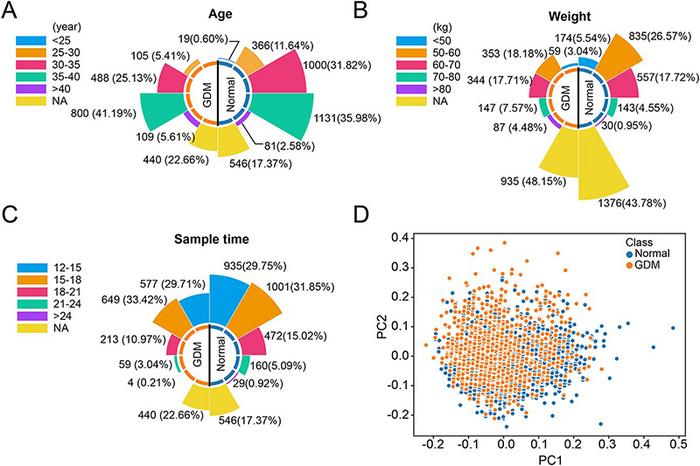
(A) The age distribution of the normal group and GDM group. (B) The weight distribution of the normal group and GDM group. (C) The sample time distribution of the normal and GDM group. (D) PCA scatter plot of normal and GDM samples

Credit: BGI Genomics

Gestational diabetes mellitus (GDM) is a prevalent pregnancy complication posing significant health risks to both mothers and their newborns. Early detection and treatment of GDM are crucial to prevent adverse outcomes. Current screening methods, like glucose tolerance tests, are in after 24 weeks of pregnancy and have limitations in patient compliance and accuracy.

A new study led by Lijian Zhao, Pei Sun, Hui Huang, Nan Li at BGI Genomics in collaboration with the Beijing Obstetrics and Gynecology Hospital, recently published on Briefings in Bioinformatics aimed to develop a non-invasive method for early detection of GDM using cell-free DNA (cfDNA) and deep learning models.

Methods and Findings:

A deep learning model was developed using circulating cell-free DNA samples from 5,085 pregnant women, including 1,942 GDM patients and 3,143 healthy controls, to predict GDM status.

The researchers built a Convolutional Neural Networks (CNN)-based deep neural network with a self-attention layer to analyze copy numbers of cfDNA sequencing data linked to gestational diabetes mellitus, focusing on identifying crucial genetic regions for accurate classification.

Key Points to Highlight:

1. The risk of gestational diabetes can be predicted non-invasively in the first trimester (12 weeks of pregnancy) which is earlier than the traditional method of glucose tolerance test performed late in pregnancy.

2. High accuracy of 93.5% in predicting GDM status, outperforming traditional methods.

3. Potential to improve patient compliance and accuracy in GDM screening, providing a promising approach for early detection of the gestational diabetes.

The study demonstrates the advantage of using cfDNA sequencing for early detection of GDM and highlights the importance of further investigating the use of deep learning models in precision medicine.

The analysis of cfDNA CNVs associated with diabetes genes and the use of a sophisticated model incorporating a self-attention layer to identify important genetic regions for accurate classification also allowed to identify:

•Essential genetic regions for accurate classification of GDM.

•CNV fragments covering 2190 genes, including known genes related to GDM like alpha- and beta-defensin genes (DEFA1, DEFA3, and DEFB1).

•Enriched biological processes and pathways linked to diabetes, such as glutamate signaling, forebrain development, and GTPase regulator activity.

Enhancing Research and Clinical Outcomes:

These findings provide a significant leap forward in understanding molecular mechanisms underlying GDM, offering insights for future research and therapeutic strategies.

About BGI Genomics:

BGI Genomics, headquartered in Shenzhen, China, is the world’s leading integrated solutions provider of precision medicine. Our services cover more than 100 countries and regions, involving more than 2,300 medical institutions. In July 2017, as a subsidiary of BGI Group, BGI Genomics (300676.SZ) was officially listed on the Shenzhen Stock Exchange.


Share12Tweet8Share2ShareShareShare2

Related Posts

Tracking Research on Adult Outcomes After Complex Perinatal History

April 1, 2026

Inequities in Family Engagement Within the NICU

April 1, 2026

Frailty, Malnutrition Link Falls to Daily Functioning

April 1, 2026

Dactylides D, E: Novel 22-Membered Polyol Macrolides

April 1, 2026

POPULAR NEWS

  • blank

    Revolutionary AI Model Enhances Precision in Detecting Food Contamination

    96 shares
    Share 38 Tweet 24
  • Imagine a Social Media Feed That Challenges Your Views Instead of Reinforcing Them

    1006 shares
    Share 398 Tweet 249
  • Promising Outcomes from First Clinical Trials of Gene Regulation in Epilepsy

    51 shares
    Share 20 Tweet 13
  • Popular Anti-Aging Compound Linked to Damage in Corpus Callosum, Study Finds

    43 shares
    Share 17 Tweet 11

About

We bring you the latest biotechnology news from best research centers and universities around the world. Check our website.

Follow us

Recent News

Tracking Research on Adult Outcomes After Complex Perinatal History

Unveiling the Biological Pathways Linking Pesticides to Cancer Risk: New Study Sheds Light on Environmental Health Impacts

Inequities in Family Engagement Within the NICU

Subscribe to Blog via Email

Success! An email was just sent to confirm your subscription. Please find the email now and click 'Confirm' to start subscribing.

Join 78 other subscribers
  • Contact Us

Bioengineer.org © Copyright 2023 All Rights Reserved.

Welcome Back!

Login to your account below

Forgotten Password?

Retrieve your password

Please enter your username or email address to reset your password.

Log In
No Result
View All Result
  • Homepages
    • Home Page 1
    • Home Page 2
  • News
  • National
  • Business
  • Health
  • Lifestyle
  • Science

Bioengineer.org © Copyright 2023 All Rights Reserved.