Plants are continuously evolving new immune receptors to ever-changing pathogens. Researchers at the RIKEN Center for Sustainable Resource Science (CSRS) have traced the origin and evolutionary trajectory of plant immune receptors. Their discovery will make it easier to identify immune receptor genes from genomic information and could help in the development of pathogen-resistant crops. This study was published in the scientific journal Nature Communications on February 1.
Credit: RIKEN
Plants are continuously evolving new immune receptors to ever-changing pathogens. Researchers at the RIKEN Center for Sustainable Resource Science (CSRS) have traced the origin and evolutionary trajectory of plant immune receptors. Their discovery will make it easier to identify immune receptor genes from genomic information and could help in the development of pathogen-resistant crops. This study was published in the scientific journal Nature Communications on February 1.
As in animals, plants have immune responses that help them defend against pathogens such as viruses, bacteria, fungi, and oomycetes. Before invaders can be stopped, they must first be detected, and this is accomplished by pattern recognition receptors located on the surface of plant cells. The ability of these receptors to detect molecular patterns associated with pathogens depends on two types of proteins, called RLPs and RLKs, both of which can contain leucine-rich repeats—sections in which the amino acid leucine appears multiple times.
To trace the evolution of plant immunity, the international research team led by Ken Shirasu and Yasuhiro Kadota at RIKEN CSRS examined the numbers and patterns of receptors. They analyzed over 170,000 genes encoding RLKs and about 40,000 genes encoding RLPs, which they obtained from publicly available data taken from 350 plant species. They discovered that RLKs and RLPs with leucine-rich repeats were the most abundant receptor types among all the plant species, making up nearly half of RLKs and 70% of RLPs.
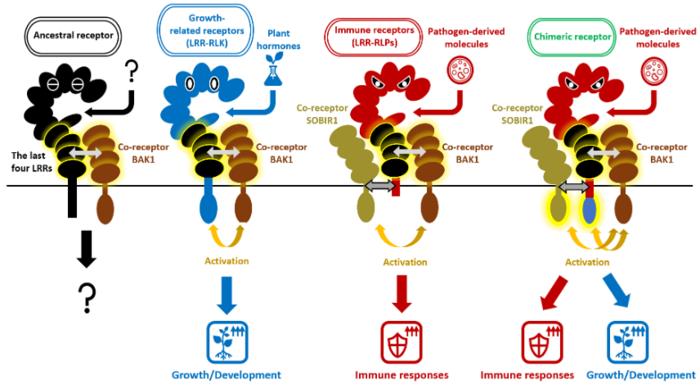
RLPs, and some RLKs, are known to contain a special island region that is crucial for recognizing parts of pathogens. Investigation by the RIKEN CSRS team revealed that among RLPs that contain the leucine-rich repeats, this special region was almost always located in the same place; between the 4th and 5th leucine-rich repeat. These RLPs were found to be associated with immune responses. They also discovered that the island region was located at the same position in some RLKs, nearly all of which belong to a functional group that regulates growth and development.
Comparative analysis showed that the sequence of the four repeats below the island region was very similar between the two types of protein detectors, suggesting that they have a common evolutionary ancestry. In particular, these four sets of leucine repeats contained sections needed for bonding to the same co-receptor, called BAK1. This means that immunity-related RLPs and growth-related RLKs inherited the ability to bind BAK1 from a common ancestor.
“Intriguingly, we found that exchanging the four regions of leucine-rich repeats among these receptors did not disrupt their functionality,” says Bruno Pok Man Ngou, who conducted the study. Creating a hybrid receptor by combining a growth-related RLK with an immunity-related RLP resulted in a hybrid receptor that recognized pathogens and induced both immune and growth-related responses. This means that scientists should be able to engineer receptors with new functions by swapping those modules.
This study addressed the origins of plant immunity at a molecular level, showing that simultaneously analyzing information from multiple plant genomes can allow straightforward and precise prediction of genes involved in plant immunity and growth. “We are currently isolating immune receptors from various plants using this information, aiming for practical applications such as developing disease-resistant crops in the future,” says Shirasu.
Journal
Nature Communications
DOI
10.1038/s41467-023-44408-3
Method of Research
Experimental study
Subject of Research
Not applicable
Article Title
Evolutionary Trajectory of Pattern Recognition Receptors in Plants.
Article Publication Date
1-Feb-2024