Recently, an international research team has successfully carried out a high precision x-ray spectroscopy measurement on helium-like uranium, the simplest and heaviest many-electron atomic system. The obtained results allow, for the first time in this regime, to disentangle and to test separately high-order (two-loop) one-electron and two-electron quantum electrodynamics (QED) effects and set a new important benchmark for QED in the strong field domain. Moreover, the achieved accuracy of 37 parts per million allows to discriminate between different theoretical approaches developed throughout the last decades for describing He-like systems. The measurement took place at the Experimental Storage Ring (ESR) at GSI/FAIR in Darmstadt within the FAIR Phase0 research program. The research team, led by the CNRS and Sorbonne University (Institut des nanosciences de Paris), France, and comprising (among others) scientists from GSI/FAIR, the Helmholtz Institute Jena, and the Friedrich Schiller University of Jena, presents the results in the scientific journal Nature.
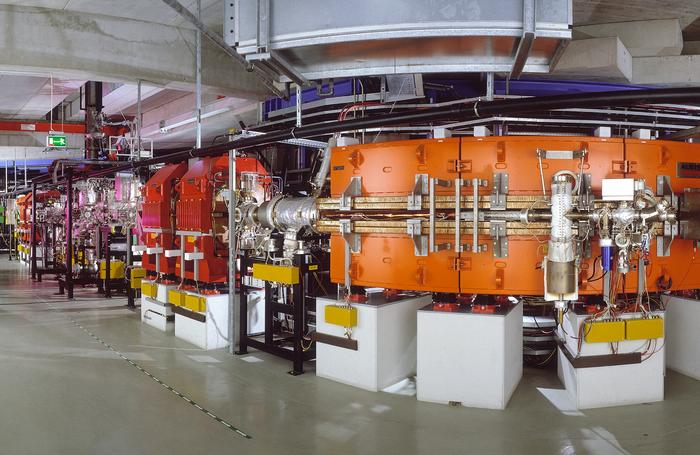
Credit: Photo: A. Zschau, GSI/FAIR
Recently, an international research team has successfully carried out a high precision x-ray spectroscopy measurement on helium-like uranium, the simplest and heaviest many-electron atomic system. The obtained results allow, for the first time in this regime, to disentangle and to test separately high-order (two-loop) one-electron and two-electron quantum electrodynamics (QED) effects and set a new important benchmark for QED in the strong field domain. Moreover, the achieved accuracy of 37 parts per million allows to discriminate between different theoretical approaches developed throughout the last decades for describing He-like systems. The measurement took place at the Experimental Storage Ring (ESR) at GSI/FAIR in Darmstadt within the FAIR Phase0 research program. The research team, led by the CNRS and Sorbonne University (Institut des nanosciences de Paris), France, and comprising (among others) scientists from GSI/FAIR, the Helmholtz Institute Jena, and the Friedrich Schiller University of Jena, presents the results in the scientific journal Nature.
Quantum electrodynamics (QED), the quantum field theory that describes the interaction between light and matter, is one of the important cornerstones of the Standard Model. QED is generally considered as the best tested quantum field theory. However, recent precision measurements of the gyromagnetic factor of the muon and the fine structure of positronium show significant disagreements with theoretical predictions, stressing the need for new complementary tests.
At present, most stringent tests of QED are based on extremely precise studies performed in the domain of relatively low electromagnetic field strengths and light atoms and ions, where perturbation methods can be efficiently implemented in the QED calculations. In the regime of extreme fields of heavy ions, the QED calculations enter a qualitatively different non-perturbative regime (with respect to the nuclear charge), making accurate theoretical predictions challenging. Experiments in this domain are equally challenging and thus QED tests in strong fields currently lack the high precision reached for light atoms. New tests are required, in particular in the regime of extreme fields of heavy ions, where QED effects are greatly enhanced due to the extremely strong electromagnetic field of the heavy nucleus, reaching several orders of magnitude higher than the most intense laser fields available nowadays.
GSI/FAIR is at present the unique place worldwide where the heaviest ions in any desired charge-state can be produced with subsequent acceleration and stripping, followed by cooling and storage in the dedicated storage ring ESR. The international research team used the ESR to perform a new stringent test based on precision x-ray spectroscopy of helium-like uranium (with two bound electrons), the simplest and heaviest many-electron atomic system, and compared its transition energy to the energy of similar transitions in lithium-like (three electrons) and beryllium-like uranium ions (four electrons).
For the measurement, dedicated Bragg crystal spectrometers have been constructed and mounted at the gas-jet interaction chamber of the ESR. Differently from past experiments, a new calibration method based on a combination of moving and stationary energy references is implemented. This new method (along with other improvements) provided a gain in accuracy of almost one order of magnitude on the absolute transition energy. The obtained accuracy of 37 parts per million allows, for the first time for high-Z helium-like ions, to test high-order QED effects and sets a new important benchmark for QED in the strong field domain. In addition, such an accuracy enables the discrimination between different theoretical models and approximations developed throughout the last decades. Moreover, by comparing the transition energies for the different uranium ions, one-electron and many-electron QED contributions could be clearly disentangled for the first time in such a high-field regime.
Journal
Nature
DOI
10.1038/s41586-023-06910-y
Method of Research
Experimental study
Subject of Research
Not applicable
Article Title
Testing quantum electrodynamics in extreme fields using helium-like uranium
Article Publication Date
24-Jan-2024