Emerging research suggests it may be easier to use fusion as a power source if liquid lithium is applied to the internal walls of the device housing the fusion plasma.
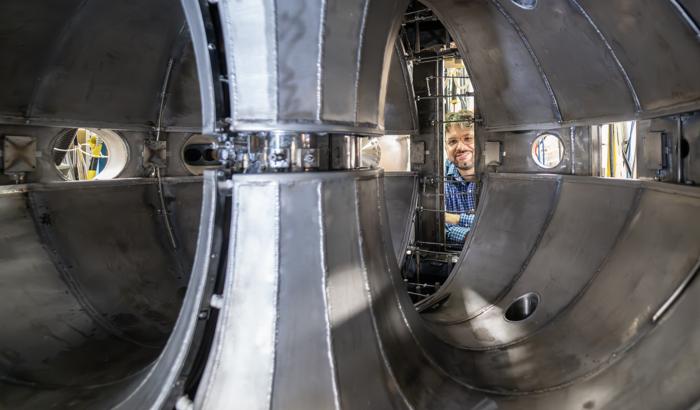
Credit: Elle Starkman/PPPL Office of Communications
Emerging research suggests it may be easier to use fusion as a power source if liquid lithium is applied to the internal walls of the device housing the fusion plasma.
Plasma, the fourth state of matter, is a hot gas made of electrically charged particles. Scientists at the Department of Energy’s Princeton Plasma Physics Laboratory (PPPL) are working on solutions to efficiently harness the power of fusion to offer a cleaner alternative to fossil fuels, often using devices called tokamaks, which confine plasma using magnetic fields.
“The purpose of these devices is to confine the energy,” said Dennis Boyle, a staff research physicist at PPPL. “If you had much better energy confinement, you could make the machines smaller and less expensive. That would make the whole thing a lot more practical, and cost-effective so that governments and industry want to invest more in it.”
The new findings, which were highlighted in a recent invited presentation by Boyle at an American Physical Society Division of Plasma Physics meeting, are part of the Lab’s Lithium Tokamak Experiment-Beta (LTX-β). In recent experiments, a coating of liquid lithium added to the inside of the tokamak wall helped the plasma stay hot at its edge. Maintaining a hot edge is key to their unique approach, which the scientists hope will one day contribute to designs for a fusion power plant. Past LTX-β experiments studied solid lithium coatings and found they could enhance a plasma. The researchers were pleased they could yield similar results with liquid lithium, as it’s better suited for use in a large-scale tokamak.
Richard Majeski, a managing principal research physicist at PPPL and head of LTX-β, noted that one of the greatest challenges in developing fusion energy is to build a viable wall for the device confining the plasma. PPPL is dedicated to finding solutions to this and other challenges to help bridge the gaps in bringing fusion energy to the power grid. “Although LTX-β is a very modest-sized spherical tokamak, it is the first and still the only plasma confinement device in the world with a core plasma completely contained by a liquid lithium wall,” said Majeski. “The results from LTX-β have been very promising — liquid lithium not only provides a wall that can withstand contact with a 2-million-degree plasma, it actually improves the performance of the plasma.”
The liquid lithium could reduce the need for repairs, acting as a shield to the inner walls of the device as they are exposed to the extreme heat of the plasma.
The liquid lithium absorbed around 40% of hydrogen ions escaping from the plasma so that fewer of these particles were recycled back into the plasma as a relatively cold neutral gas. Scientists refer to this as a low-recycling environment because much of the hydrogen ions expelled from the plasma aren’t recycled back into it in a way that would cool the plasma edge.
Ultimately, this low-recycling environment meant the temperature at the edge of the plasma was closer to the temperature at the core of the plasma. That uniformity of temperature should allow the plasma to confine heat better than it likely would have without the liquid lithium by avoiding a variety of instabilities.
The liquid lithium also allowed for an increase in the density of the plasma when a beam of high-energy neutral particles was injected to heat and fuel the plasma. With solid lithium, only a small density increase was demonstrated. When the neutral beam was used, the added hydrogen ions pushed out hydrogen ions already in the plasma in a process known as charge exchange.
The researchers believe the key difference is due to a small amount of lithium that evaporated off the liquid walls of the reactor and entered the plasma. This lithium impurity in the plasma changed the dynamics of the charge exchange and allowed the plasma to retain hydrogen ions added by the neutral beam without booting out other hydrogen ions, resulting in an overall increase in plasma density.
“Implementing liquid lithium walls in a much larger tokamak will be difficult and expensive. In order to move confidently ahead with liquid lithium walls in a future phase of NSTX-U, exploratory experiments at a smaller scale are essential. LTX-β is just that experiment,” Majeski said.
The research was funded with grants from the U.S. Department of Energy contract DE-AC02-09CH11466.