At the National Museum in Copenhagen, Denmark, there is a marble head that was once part of the ancient Greek Parthenon temple on the Acropolis in Athens. The head originally belonged to a centaur figure and was part of a scene depicting the Greek mythological Lapiths’ battle against the centaurs (mythical creatures that were half-horse, half-human).
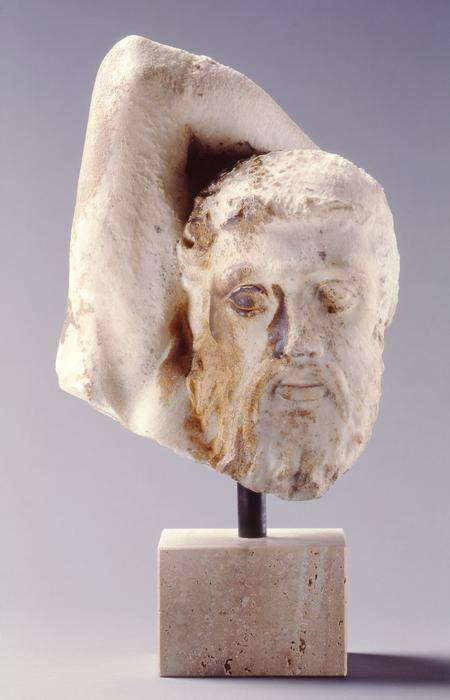
Credit: John Lee, National Museum of Denmark
At the National Museum in Copenhagen, Denmark, there is a marble head that was once part of the ancient Greek Parthenon temple on the Acropolis in Athens. The head originally belonged to a centaur figure and was part of a scene depicting the Greek mythological Lapiths’ battle against the centaurs (mythical creatures that were half-horse, half-human).
For reasons that have yet to be explained, parts of the centaur head are coated with a thin brown film, as are several other marble fragments from the Parthenon. The mysterious brown film was first examined by the British Museum in 1830.
Back then, attempts were made to determine if the color originated from ancient paint, but it was eventually concluded that it might be a result of a chemical reaction between the marble and the air, or that the marble contained iron particles that had migrated to the surface, coloring it brown.
Oxalic acid, algae and fungi
“There have been many attempts to explain the peculiar brown film. In 1851, German chemist, Justus von Liebig, performed the first actual scientific investigation and determined that the brown film contained oxalates – salts of oxalic acid. This has been confirmed by later analyses, but the origin of the oxalates has remained a mystery,” says Professor emeritus Kaare Lund Rasmussen, an expert in chemical analyses of historical and archaeological artifacts, Department of Physics, Chemistry and Pharmacy, University of Southern Denmark.
Along with University of Southern Denmark colleagues Frank Kjeldsen and Vladimir Gorshkov from the Department of Biochemistry and Molecular Biology, Bodil Bundgaard Rasmussen, former head of the Antiquities Collection at the National Museum of Denmark, Thomas Delbey from Cranfield University in England, and Ilaria Bonaduce from the University of Pisa, Italy, he has published a scientific article describing the results of their investigations into the brown-colored centaur head from the National Museum. The article is published in Heritage Science, and you can find it here.
“We especially wanted to examine whether the brown film could have been formed by some biological organism, such as lichen, bacteria, algae, or fungi. This theory had been suggested before, but no specific organism had been identified. The same goes for the theory that it could be remnants of applied paint – perhaps to protect or tone the marble surface,” says Kaare Lund Rasmussen.
For their investigations, the research team was allowed to take five small samples from the back of the centaur head. These samples underwent various analyses in SDU’s laboratories, including protein analysis and so-called Laser Ablation Inductively Coupled Plasma Mass Spectrometry.
“We found no traces of biological matter in the brown layers – only from our own fingerprints and perhaps a bird egg that broke on the marble in ancient times. This doesn’t prove that there never was a biological substance, but it significantly reduces the probability, making the theory of a biological organism less probable now,” says Kaare Lund Rasmussen.
Similarly, it is now less probably that the marble surface was painted or preserved, according to the researchers, who also specifically searched for traces of paint. Ancient paints were typically based on natural products such as eggs, milk, and bones, and no traces of such ingredients were found in the brown stain alone.
The mystery remains
Through their investigations, the research team also discovered that the brown film consists of two separate layers. These two layers are approximately equally thick, around 50 micrometers each, and they differ in terms of trace element composition. However, both layers contain a mixture of the oxalate minerals weddellite and whewellite. The fact that there are two distinct layers argues against the theory that they were created by the migration of material, such as iron particles, from the interior of the marble. It also contradicts the theory that they resulted from a reaction with the air.
Air pollution is also unlikely for another reason; the centaur head has been indoors in Copenhagen since before the modern industrialization began in the 18th century. In fact, this makes the heads at the National Museum particularly valuable compared to the marble pieces on the Acropolis, of which some have only recently been brought indoors.
“As there are two different brown layers with different chemical compositions, it is likely that they have different origins. This could suggest that someone applied paint or a conservation treatment, but since we haven’t found traces of such substances, the brown color remains a mystery,” concludes Kaare Lund Rasmussen.
How the centaur head came to Denmark
The centaur head, along with another head from the Parthenon temple, came to Denmark in 1688 as a gift to King Christian V. It was brought by the Danish captain Moritz Hartmand, who served in the Venetian fleet and was present during the bombardment of the Acropolis in Athens in 1687. A significant part of the Parthenon temple was destroyed. The Centaur Head was placed in the Royal Kunstkammer, which later became the National Museum, where it has been exhibited ever since.
Professor Kaare Lund Rasmussen
Kaare Lund Rasmussen is professor emeritus in archaeometry, specializing in chemical investigations of cultural heritage materials. He leads the research group CHART (Cultural Heritage and Archaeometric Research Team) at the Department of Physics, Chemistry, and Pharmacy. Among his notable analyses are Tycho Brahe’s grave, the Dead Sea Scrolls, the tomb of Knud the Holy, and the skeletons of Jesus’ apostles. https://www.sdu.dk/en/forskning/kemi-farmaci/forskere/analytisk/kaare-lund-rasmussen
Journal
Heritage Science
DOI
10.1186/s40494-023-01126-9
Subject of Research
Not applicable
Article Title
Analyses of the brown stain on the Parthenon Centaur head in Denmark
Article Publication Date
16-Jan-2024