Researchers at Columbia University have successfully synthesized the first 2D heavy fermion material. They introduce the new material, a layered intermetallic crystal composed of cerium, silicon, and iodine (CeSiI), in a research article published today in Nature.
Credit: Nicoletta Barolini, Columbia University
Researchers at Columbia University have successfully synthesized the first 2D heavy fermion material. They introduce the new material, a layered intermetallic crystal composed of cerium, silicon, and iodine (CeSiI), in a research article published today in Nature.
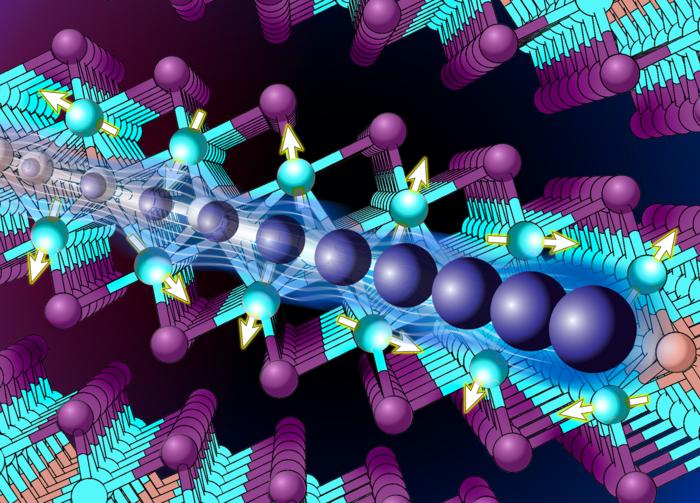
Heavy fermion compounds are a class of materials with electrons that are up to 1000x heavier than usual. In these materials, electrons get tangled up with magnetic spins that slow them down and increase their effective mass. Such interactions are thought to play important roles in a number of enigmatic quantum phenomena, including superconductivity, the movement of electrical current with zero resistance.
Researchers have been exploring heavy fermions for decades, but in the form of bulky, 3D crystals. The new material synthesized by PhD student Victoria Posey in the lab of Columbia chemist Xavier Roy will allow researchers to drop a dimension.
“We’ve laid a new foundation to explore fundamental physics and to probe unique quantum phases,” said Posey.
One of the latest materials to come out of the Roy lab, CeSiI is a van der Waals crystal that can be peeled into layers that are just a few atoms thick. That makes it easier to manipulate and combine with other materials than a bulk crystal, in addition to possessing potential quantum properties that occur in 2D. “It’s amazing that Posey and the Roy lab could make a heavy fermion so small and thin,” said senior author Abhay Pasupathy, a physicist at Columbia and Brookhaven National Laboratory. “Just like we saw with the recent Nobel Prize to quantum dots, you can do many interesting things when you shrink dimensions.”
With its middle sheet of silicon sandwiched between magnetic cerium atoms, Posey and her colleagues suspected that CeSiI, first described in a paper in 1998, might have some interesting electronic properties. Its first stop (after Posey figured out how to prepare the extremely air-sensitive crystal for transport) was a Scanning Tunneling Microscope (STM) in Abhay Pasupathy’s physics lab at Columbia. With the STM, they observed a particular spectrum shape characteristic of heavy fermions. Posey then synthesized a non-magnetic equivalent to CeSiI and weighed the electrons of both materials via their heat capacities. CeSiI’s were heavier. “By comparing the two—one with magnetic spins and one without—we can confirm we’ve created a heavy fermion,” said Posey.
Samples then made their way across campus and the country for additional analyses, including to Pasupathy’s lab at Brookhaven National Laboratory for photoemission spectroscopy; to Philip Kim’s lab at Harvard for electron transport measurements; and to the National High Magnetic Field Laboratory in Florida to study its magnetic properties. Along the way, theorists Andrew Millis at Columbia and Angel Rubio at Max Planck helped explain the teams’ observations.
From here, Columbia’s researchers will do what they do best with 2D materials: stack, strain, poke, and prod them to see what unique quantum behaviors can be coaxed out of them. Pasupathy plans to add CeSiI to his arsenal of materials in the search for quantum criticality, the point where a material shifts from one unique phase to another. At the crossover, interesting phenomena like superconductivity may await.
“Manipulating CeSiI at the 2D limit will let us explore new pathways to achieve quantum criticality,” said Michael Ziebel, a postdoc in the Roy group and co-corresponding author, “and this can guide us in the design of new materials.”
Back in the chemistry department, Posey, who has perfected the air-free synthesis techniques needed, is systematically replacing the atoms in the crystal—for example, swapping silicon for other metals, like aluminum or gallium—to create related heavy fermions with their own unique properties to study. “We initially thought CeSiI was a one-off,” said Roy. “But this project has blossomed into a new kind of chemistry in my group.”
Journal
Nature
DOI
10.1038/s41586-023-06868-x
Article Title
Two-dimensional heavy fermions in the van der Waals metal CeSiI
Article Publication Date
17-Jan-2024