As the threat of global warming looms, researchers are racing to understand how complex, interconnected weather systems affect one another. Unprecedented changes to weather patterns, sometimes in defiance of models and predictions, point to the need for a global perspective.
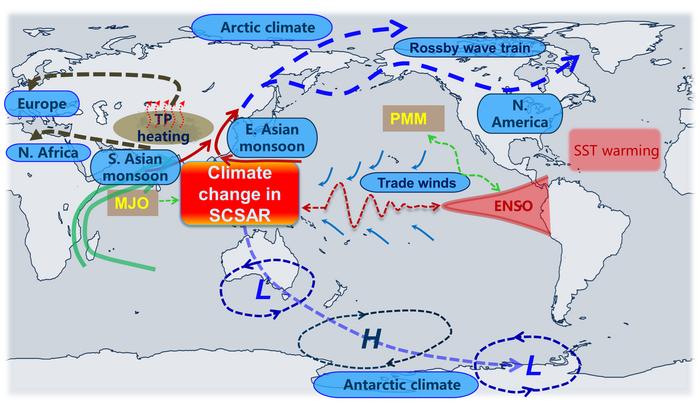
Credit: Yang et al. (2023)
As the threat of global warming looms, researchers are racing to understand how complex, interconnected weather systems affect one another. Unprecedented changes to weather patterns, sometimes in defiance of models and predictions, point to the need for a global perspective.
A paper published in Ocean-Land-Atmosphere Research on December 20, highlights how one region, the South China Sea and its surrounding areas, have global impacts on weather patterns.
Complex climate interactions between the ocean, land, and atmosphere in these regions, which include the Indo-Pacific Oceans, Southeast Asia, and the Tibetan Plateau, mean that the climate is changing more rapidly in this area. However, this rapid warming affects weather patterns all over the globe, not just in the South China Sea and the surrounding regions. “This paper contributes to a deeper understanding of the complex interactions and consequences of climate change in the South China Sea and its surrounding areas, which is crucial for predicting weather extremes in extratropical regions and for mitigating the broader impacts of climate change on a global scale,” said Song Yang, a professor at Sun Yat-sen University in Zhuhai, China.
Researchers sought to study the distinctive features of climate change in this region and how they impact regional and global climate patterns, including how air-sea interactions across tropical and subtropical factors drive climate change. With a deeper understanding of warming patterns in the region, the researchers also make projections for the future of climate change in the area and its far-reaching global implications.
One defining feature of this region are the three overlapping, large-scale atmospheric overturning circulations: the regional Hadley circulation, the Walker circulation, and the Asian monsoon circulation. Air moves across the globe in predictable patterns. These patterns are called circulations or cells. Circulations are important on a regional and global scale because they connect the region with the wider globe. For example, heating experienced in the western Pacific and South Asian monsoon region can make droughts worse on the other side of the globe thanks to air movement between the Pacific and North Africa. Changes in the South China Sea and the surrounding areas can even impact weather in the Arctic.
“Climate change in the South China Sea and its surrounding areas is very complex. It has a significant impact on shaping not only regional climates, but also exerting far-reaching impacts on weather and climate patterns across the globe,” said Yang.
The researchers studying these regions also wanted to understand future projections, both for the South China Sea and its surrounding areas and how changes in these areas will come to impact climate change globally. The three overlapping circulations are already shifting thanks to climate change. Researchers point to the predicted changes in the Hadley circulation as an example, which is a cell that connects tropics and extratropics. In a warmer climate, the ascending branch of the Hadley circulation would become stronger and narrower, while the descending branch will shift poleward. These changes are expected to increase dry weather and decrease humidity in the extratropical regions. As the climate gets warmer, current climate models project increasing precipitation over South Asia, East Asia, and northern Australia, due to the warmer sea surface temperature, increased water vapour supply, and these strengthened overlapping circulations over the South China Sea and surrounding regions.
Looking ahead, researchers will continue to explore the interconnectedness of weather patterns across the globe on different time scales. “This paper seeks to catalyze further research, provide valuable contributions to the understanding of climate dynamics in this region and its global implications, and ultimately improve predictions for weather extremes,” said Yang.
Other contributors include Deliang Chen of the University of Gothenburg in Gothenburg, Sweden and Kaiqiang Deng at Sun Yat-sen University in Zhuhai, China.
The National Natural Sciences Foundation of China, the Guangdong Major Project of Basic and Applied Basic Research, the Guangdong Province Key Laboratory for Climate Change and Natural Disaster Studies, and the Innovation Group Project of Southern Marine Science and Engineering Guangdong Laboratory supported this research.
Journal
Ocean-Land-Atmosphere Research
DOI
10.34133/olar.0038
Method of Research
Content analysis
Subject of Research
Not applicable
Article Title
Global Effects of Climate Change in the South China Sea and Its Surrounding Areas
Article Publication Date
20-Dec-2023
COI Statement
The authors declare that they have no competing interest.