When light goes through a material, it often behaves in unpredictable ways. This phenomenon is the subject of an entire field of study called “nonlinear optics”, which is now integral to technological and scientific advances from laser development and optical frequency metrology, to gravitational wave astronomy and quantum information science.
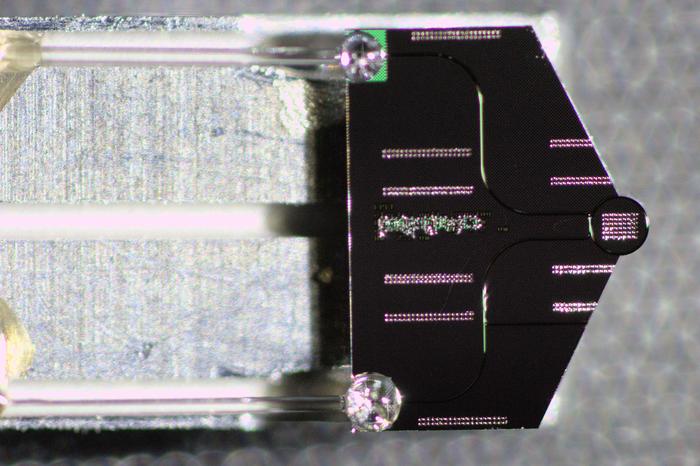
Credit: Yang et al. DOI: 10.1126/science.adk2489
When light goes through a material, it often behaves in unpredictable ways. This phenomenon is the subject of an entire field of study called “nonlinear optics”, which is now integral to technological and scientific advances from laser development and optical frequency metrology, to gravitational wave astronomy and quantum information science.
In addition, recent years have seen nonlinear optics applied in optical signal processing, telecommunications, sensing, spectroscopy, light detection and ranging. All these applications involve the miniaturization of devices that manipulate light in nonlinear ways onto a small chip, enabling complex light interactions chip-scale.
Now, a team of scientists at EPFL and the Max Plank Institute has brought nonlinear optical phenomena into a transmission electron microscope (TEM), a type of microscope that uses electrons for imaging instead of light. The study was led by Professor Tobias J. Kippenberg at EPFL and Professor Claus Ropers, Director of the Max Planck Institute for Multidisciplinary Sciences. It is now published in Science.
At the heart of the study are “Kerr solitons”, waves of light that hold their shape and energy as they move through a material, like a perfectly formed surf wave traveling across the ocean. This study used a particular type of Kerr solitons called “dissipative”, which are stable, localized pulses of light that last tens of femtoseconds (a quadrillionth of a second) and form spontaneously in the microresonator. Dissipative Kerr solitons can also interact with electrons, which made them crucial for this study.
The researchers formed dissipative Kerr solitons inside a photonic microresonator, a tiny chip that traps and circulates light inside a reflective cavity, creating the perfect conditions for these waves. “We generated various nonlinear spatiotemporal light patterns in the microresonator driven by a continuous-wave laser,” explains EPFL researcher Yujia Yang, who led the study. “These light patterns interacted with a beam of electrons passing by the photonic chip, and left fingerprints in the electron spectrum.”
Specifically, the approach demonstrated the coupling between free electrons and dissipative Kerr solitons, which allowed the researchers to probe soliton dynamics in the microresonator cavity and perform ultrafast modulation of electron beams.
“Our ability to generate dissipative Kerr solitons [DKS] in a TEM extends the use of microresonator-base frequency combs to unexplored territories,” says Kippenberg. “The electron-DKS interaction could enable high repetition-rate ultrafast electron microscopy and particle accelerators empowered by a small photonic chip.”
Ropers adds: “Our results show electron microscopy could be a powerful technique for probing nonlinear optical dynamics at the nanoscale. This technique is non-invasive and able to directly access the intracavity field, key to understanding nonlinear optical physics and developing nonlinear photonic devices.”
The photonic chips were fabricated in the Center of MicroNanoTechnology (CMi) and the Institute of Physics cleanroom at EPFL. The experiments were conducted at the Göttingen Ultrafast Transmission Electron Microscopy (UTEM) Lab.
Other contributors
EPFL Center for Quantum Science and Engineering
Reference
Yujia Yang, Jan-Wilke Henke, Arslan S. Raja, F. Jasmin Kappert, Guanhao Huang, Germaine Arend, Zheru Qiu, Armin Feist, Rui Ning Wang, Aleksandr Tusnin, Alexey Tikan, Claus Ropers, Tobias J. Kippenberg. Free-electron interaction with nonlinear optical states in microresonators. Science, 12 January 2024. DOI: 10.1126/science.adk2489
Journal
Science
DOI
10.1126/science.adk2489
Article Title
Free-electron interaction with nonlinear optical states in microresonators
Article Publication Date
12-Jan-2024