• HOME
  • NEWS
  • EXPLORE
    • CAREER
      • Companies
      • Jobs
    • EVENTS
    • iGEM
      • News
      • Team
    • PHOTOS
    • VIDEO
    • WIKI
  • BLOG
  • COMMUNITY
    • FACEBOOK
    • INSTAGRAM
    • TWITTER
Saturday, February 7, 2026
BIOENGINEER.ORG
No Result
View All Result
  • Login
  • HOME
  • NEWS
  • EXPLORE
    • CAREER
      • Companies
      • Jobs
        • Lecturer
        • PhD Studentship
        • Postdoc
        • Research Assistant
    • EVENTS
    • iGEM
      • News
      • Team
    • PHOTOS
    • VIDEO
    • WIKI
  • BLOG
  • COMMUNITY
    • FACEBOOK
    • INSTAGRAM
    • TWITTER
  • HOME
  • NEWS
  • EXPLORE
    • CAREER
      • Companies
      • Jobs
        • Lecturer
        • PhD Studentship
        • Postdoc
        • Research Assistant
    • EVENTS
    • iGEM
      • News
      • Team
    • PHOTOS
    • VIDEO
    • WIKI
  • BLOG
  • COMMUNITY
    • FACEBOOK
    • INSTAGRAM
    • TWITTER
No Result
View All Result
Bioengineer.org
No Result
View All Result
Home NEWS Science News Biology

Artificial intelligence helps unlock advances in wireless communications

Bioengineer by Bioengineer
January 10, 2024
in Biology
Reading Time: 3 mins read
0
UBCO researchers are clearing the way for the next generation of wireless technology
Share on FacebookShare on TwitterShare on LinkedinShare on RedditShare on Telegram

A new wave of communication technology is quickly approaching and researchers at UBC Okanagan are investigating ways to configure next-generation mobile networks.
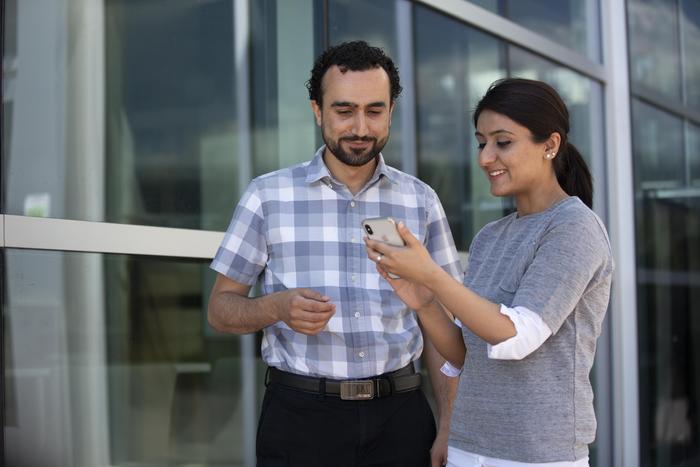
UBCO researchers are clearing the way for the next generation of wireless technology

Credit: UBC Okanagan

A new wave of communication technology is quickly approaching and researchers at UBC Okanagan are investigating ways to configure next-generation mobile networks.

Dr. Anas Chaaban works in the UBCO Communication Theory Lab where researchers are busy analyzing a theoretical wireless communication architecture that will be optimized to handle increasing data loads while sending and receiving data faster.

Next-generation mobile networks are expected to outperform 5G on many fronts such as reliability, coverage and intelligence, explains Dr. Chaaban, an Assistant Professor in UBCO’s School of Engineering.

And the benefits go far beyond speed. The next generation of technology is expected to be a fully integrated system that allows for instantaneous communications between devices, consumers and the surrounding environment, he says.

These new networks will call for intelligent architectures that support massive connectivity, ultra-low latency, ultra-high reliability, high-quality experience, energy efficiency and lower deployment costs.

“One way to meet these stringent requirements is to rethink traditional communication techniques by exploiting recent advances in artificial intelligence,” he says. “Traditionally, functions such as waveform design, channel estimation, interference mitigation and error detection and correction are developed based on theoretical models and assumptions. This traditional approach is not capable of adapting to new challenges introduced by emerging technologies.”

Using a technology called transformer masked autoencoders, the researchers are developing techniques that enhance efficiency, adaptability and robustness. Dr. Chaaban says while there are many challenges in this research, it is expected it will play an important role in next-generation communication networks.

“We are working on ways to take content like images or video files and break them down into smaller packets in order to transport them to a recipient,” he says “The interesting thing is that we can throw away a number of packets and rely on AI to recover them at the recipient, which then links them back together to recreate the image or video.”

The experience, even today, is something users take for granted but next-generation technology—where virtual reality will be a part of everyday communications including cell phone calls—is positioned to improve wireless systems substantially, he adds. The potential is unparalleled.

“AI provides us with the power to develop complex architectures that propel communications technologies forward to cope with the proliferation of advanced technologies such as virtual reality,” says Chaaban. “By collectively tackling these intricacies, the next generation of wireless technology can usher in a new era of adaptive, efficient and secure communication networks.”

The research is published in the latest issue of IEEE Communications Magazine.


Journal

IEEE Communications Magazine

DOI

10.1109/MCOM.002.2300257

Method of Research

Meta-analysis

Subject of Research

Not applicable

Article Title

ransformer Masked Autoencoders for Next-Generation Wireless Communications: Architecture and Opportunities

Article Publication Date

13-Nov-2023

Share12Tweet8Share2ShareShareShare2

Related Posts

Florida Cane Toad: Complex Spread and Selective Evolution

Florida Cane Toad: Complex Spread and Selective Evolution

February 7, 2026
New Study Uncovers Mechanism Behind Burn Pit Particulate Matter–Induced Lung Inflammation

New Study Uncovers Mechanism Behind Burn Pit Particulate Matter–Induced Lung Inflammation

February 6, 2026

DeepBlastoid: Advancing Automated and Efficient Evaluation of Human Blastoids with Deep Learning

February 6, 2026

Navigating the Gut: The Role of Formic Acid in the Microbiome

February 6, 2026

POPULAR NEWS

  • Robotic Ureteral Reconstruction: A Novel Approach

    Robotic Ureteral Reconstruction: A Novel Approach

    82 shares
    Share 33 Tweet 21
  • Digital Privacy: Health Data Control in Incarceration

    63 shares
    Share 25 Tweet 16
  • Study Reveals Lipid Accumulation in ME/CFS Cells

    57 shares
    Share 23 Tweet 14
  • Breakthrough in RNA Research Accelerates Medical Innovations Timeline

    53 shares
    Share 21 Tweet 13

About

We bring you the latest biotechnology news from best research centers and universities around the world. Check our website.

Follow us

Recent News

Evaluating Pediatric Emergency Care Quality in Ethiopia

TPMT Expression Predictions Linked to Azathioprine Side Effects

Improving Dementia Care with Enhanced Activity Kits

Subscribe to Blog via Email

Enter your email address to subscribe to this blog and receive notifications of new posts by email.

Join 73 other subscribers
  • Contact Us

Bioengineer.org © Copyright 2023 All Rights Reserved.

Welcome Back!

Login to your account below

Forgotten Password?

Retrieve your password

Please enter your username or email address to reset your password.

Log In
No Result
View All Result
  • Homepages
    • Home Page 1
    • Home Page 2
  • News
  • National
  • Business
  • Health
  • Lifestyle
  • Science

Bioengineer.org © Copyright 2023 All Rights Reserved.