“Identifying plasma proteins that regenerate aged or damaged ovaries could lead to more effective, targeted and/or preventive therapies for patients.”
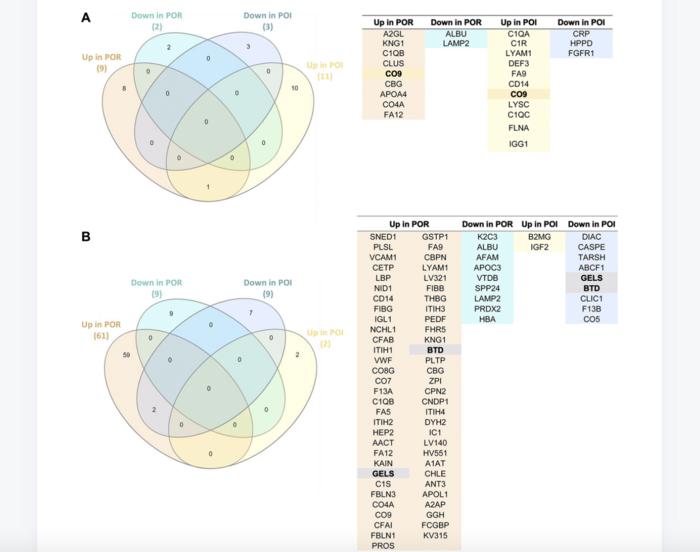
Credit: 2023 Buigues et al.
“Identifying plasma proteins that regenerate aged or damaged ovaries could lead to more effective, targeted and/or preventive therapies for patients.”
BUFFALO, NY- January 9, 2024 – A new research paper was published in Aging (listed by MEDLINE/PubMed as “Aging (Albany NY)” and “Aging-US” by Web of Science) Volume 15, Issue 24, entitled, “Systemic changes induced by autologous stem cell ovarian transplant in plasma proteome of women with impaired ovarian reserves.”
Patients with poor ovarian response (POR) and premature ovarian insufficiency (POI) are challenging to treat, with oocyte donation remaining as the only feasible option to achieve pregnancy in some cases. The Autologous stem cell ovarian transplantation (ASCOT) technique allows follicle development, enabling pregnancies and births of healthy babies in these patients. Previous research suggests that growth factors and cytokines secreted by stem cells are partially responsible for their regenerative properties. Indeed, ASCOT beneficial effects are associated with the presence of different bone marrow derived stem cell- secreted factors in plasma.
In this new study, researchers Anna Buigues, Noelia Ramírez-Martin, Jessica Martínez, Nuria Pellicer, Marcos Meseguer, Antonio Pellicer, and Sonia Herraiz from IVI Foundation – Instituto de Investigación Sanitaria La Fe (IIS La Fe) and IVIRMA Global aimed to assess whether ASCOT induces any modifications in the plasma proteomic profile of patients with impaired ovarian reserves.
“In this study, we aimed to assess if the ASCOT technique modifies the signature of the human plasma proteome, reveal the mechanisms underlying its beneficial effects on the ovary, and identify key regulators of ovarian aging.”
Discriminant analysis highlighted clear distinctions between the plasma proteome before (PRE), during stem cell mobilization and collection (APHERESIS) and three months after ASCOT (POST) in patients with POR and POI. Both the stem cell mobilization and ASCOT technique induced statistically significant modifications in the plasma composition, reversing some age-related protein expression changes. In the POR group, functional analysis revealed an enrichment in processes related to the complement cascade, immune system, and platelet degranulation, while in the POI group, enriched processes were also associated with responses to oxygen-containing compounds and growth hormones, and blood vessel maturation.
“In conclusion, our findings highlight the potential proteins and biological processes that may promote the follicle activation and growth observed after ASCOT.”
Read the full paper: DOI: https://doi.org/10.18632/aging.205400
Corresponding Author: Sonia Herraiz
Corresponding Email: [email protected]
Keywords: plasma, proteomic profile, autologous stem cell ovarian transplantation, poor ovarian response, premature ovarian insufficiency, aging
Sign up for free Altmetric alerts about this article: https://aging.altmetric.com/details/email_updates?id=10.18632%2Faging.https://doi.org/10.18632/aging.205400
About Aging:
Launched in 2009, Aging publishes papers of general interest and biological significance in all fields of aging research and age-related diseases, including cancer—and now, with a special focus on COVID-19 vulnerability as an age-dependent syndrome. Topics in Aging go beyond traditional gerontology, including, but not limited to, cellular and molecular biology, human age-related diseases, pathology in model organisms, signal transduction pathways (e.g., p53, sirtuins, and PI-3K/AKT/mTOR, among others), and approaches to modulating these signaling pathways.
Please visit our website at www.Aging-US.com and connect with us:
- SoundCloud
- X, formerly known as Twitter
- YouTube
- LabTube
Click here to subscribe to Aging publication updates.
For media inquiries, please contact [email protected].
Aging (Aging-US) Journal Office
6666 E. Quaker Str., Suite 1B
Orchard Park, NY 14127
Phone: 1-800-922-0957, option 1
###
Journal
Aging-US
DOI
10.18632/aging.205400
Method of Research
Experimental study
Subject of Research
People
Article Title
Systemic changes induced by autologous stem cell ovarian transplant in plasma proteome of women with impaired ovarian reserves
Article Publication Date
26-Dec-2023