• HOME
  • NEWS
  • EXPLORE
    • CAREER
      • Companies
      • Jobs
    • EVENTS
    • iGEM
      • News
      • Team
    • PHOTOS
    • VIDEO
    • WIKI
  • BLOG
  • COMMUNITY
    • FACEBOOK
    • INSTAGRAM
    • TWITTER
Saturday, February 7, 2026
BIOENGINEER.ORG
No Result
View All Result
  • Login
  • HOME
  • NEWS
  • EXPLORE
    • CAREER
      • Companies
      • Jobs
        • Lecturer
        • PhD Studentship
        • Postdoc
        • Research Assistant
    • EVENTS
    • iGEM
      • News
      • Team
    • PHOTOS
    • VIDEO
    • WIKI
  • BLOG
  • COMMUNITY
    • FACEBOOK
    • INSTAGRAM
    • TWITTER
  • HOME
  • NEWS
  • EXPLORE
    • CAREER
      • Companies
      • Jobs
        • Lecturer
        • PhD Studentship
        • Postdoc
        • Research Assistant
    • EVENTS
    • iGEM
      • News
      • Team
    • PHOTOS
    • VIDEO
    • WIKI
  • BLOG
  • COMMUNITY
    • FACEBOOK
    • INSTAGRAM
    • TWITTER
No Result
View All Result
Bioengineer.org
No Result
View All Result
Home NEWS Science News Chemistry

Asbestos: the size and shape of inhaled nanofibers could be exclusively responsible for the development of pulmonary fibrosis

Bioengineer by Bioengineer
January 5, 2024
in Chemistry
Reading Time: 2 mins read
0
Pseudo-coloured scanning electron microscopy image
Share on FacebookShare on TwitterShare on LinkedinShare on RedditShare on Telegram

The pathogenic potential of inhaling the inert fibrous nanomaterials used in thermal insulation (such as asbestos or fibreglass) is actually connected not to their chemical composition, but instead to their geometrical characteristics and size. This was revealed by a study, published on 3 January 2024 in the journal Nature Nanotechnology, conducted on glass nanofibers by a French-Chinese team including a CNRS chemist.1
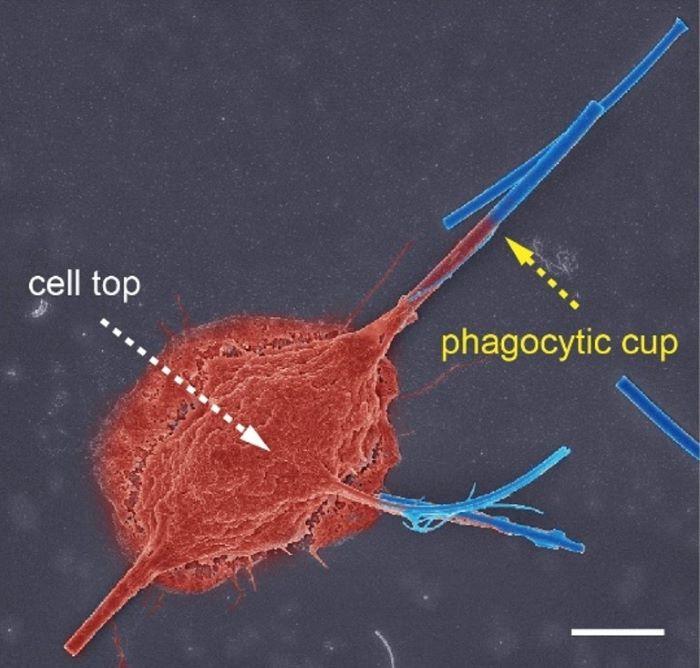
Pseudo-coloured scanning electron microscopy image

Credit: ©Yu-Ting Qi et al., 2023, Nature Nanotechnology.

The pathogenic potential of inhaling the inert fibrous nanomaterials used in thermal insulation (such as asbestos or fibreglass) is actually connected not to their chemical composition, but instead to their geometrical characteristics and size. This was revealed by a study, published on 3 January 2024 in the journal Nature Nanotechnology, conducted on glass nanofibers by a French-Chinese team including a CNRS chemist.1

The reason for this is the inability of the macrophages2 naturally present in pulmonary alveolar tissue to eliminate foreign bodies that are too large. The study was initially conducted in vitro with electrochemical nanosensors, and revealed that when confronted with inert nanofibers over 15 microns in length,3 the cells are unable to distend enough to entirely encapsulate them within their “digestive” vesicle. This results in leaked secretions that are very harmful for the alveolar walls, which this study detected, characterised, and quantified for the first time.4 An experiment on rats subsequently showed that regular unprotected inhalation of similar inert fibrous nanometerials, whatever they may be, causes repeated pulmonary lesions that can eventually lead to the development of fibroma.

This discovery poses a challenge for the use of inert nanofibre felts in construction, which had heretofore been deemed to be less harmful than the asbestos it replaced, but that in reality could present the same health risks for those handling it.


Notes : 

1 From the Selective Activation Processes via Uni-Electronic or Radiative Energy Transfer Laboratory (CNRS/ École normale supérieure – PSL/Sorbonne Université), in collaboration with Wuhan University.

2 “Big eater” cells belonging to groups of white blood cells whose primary role is to eliminate cell debris and pathogenic biological agents throughout the body.

3 Or 0.015mm, a micron measuring 10-3 mm.

4 The ROS and RNS species (species reactive to oxygen and nitrogen) secreted by macrophages are known for attacking the bioorganic components of healthy cells, and cause inflammation and mutations that are often cancerous. While the phenomenon of “frustrated phagocytosis” had already been observed, its role in the pathogenesis of the concerned diseases had not yet been clearly established.


Journal

Nature Nanotechnology

DOI

10.1038/s41565-023-01575-0

Article Title

Nanosensor detection of reactive oxygen and nitrogen species leakage in frustrated phagocytosis of nanofibres

Article Publication Date

3-Jan-2024

Share12Tweet8Share2ShareShareShare2

Related Posts

blank

Breakthrough in Environmental Cleanup: Scientists Develop Solar-Activated Biochar for Faster Remediation

February 7, 2026
blank

Cutting Costs: Making Hydrogen Fuel Cells More Affordable

February 6, 2026

Scientists Develop Hand-Held “Levitating” Time Crystals

February 6, 2026

Observing a Key Green-Energy Catalyst Dissolve Atom by Atom

February 6, 2026

POPULAR NEWS

  • Robotic Ureteral Reconstruction: A Novel Approach

    Robotic Ureteral Reconstruction: A Novel Approach

    82 shares
    Share 33 Tweet 21
  • Digital Privacy: Health Data Control in Incarceration

    63 shares
    Share 25 Tweet 16
  • Study Reveals Lipid Accumulation in ME/CFS Cells

    57 shares
    Share 23 Tweet 14
  • Breakthrough in RNA Research Accelerates Medical Innovations Timeline

    53 shares
    Share 21 Tweet 13

About

We bring you the latest biotechnology news from best research centers and universities around the world. Check our website.

Follow us

Recent News

Barriers and Boosters of Seniors’ Physical Activity in Karachi

Evaluating Pediatric Emergency Care Quality in Ethiopia

TPMT Expression Predictions Linked to Azathioprine Side Effects

Subscribe to Blog via Email

Enter your email address to subscribe to this blog and receive notifications of new posts by email.

Join 73 other subscribers
  • Contact Us

Bioengineer.org © Copyright 2023 All Rights Reserved.

Welcome Back!

Login to your account below

Forgotten Password?

Retrieve your password

Please enter your username or email address to reset your password.

Log In
No Result
View All Result
  • Homepages
    • Home Page 1
    • Home Page 2
  • News
  • National
  • Business
  • Health
  • Lifestyle
  • Science

Bioengineer.org © Copyright 2023 All Rights Reserved.