Synthetic biology offers the opportunity to build biochemical pathways for the capture and conversion of carbon dioxide (CO2). Researchers at the Max-Planck-Institute for Terrestrial Microbiology have developed a synthetic biochemical cycle that directly converts CO2 into the central building block Acetyl-CoA. The researchers were able to implement each of the three cycle modules in the bacterium E.coli, which represents a major step towards realizing synthetic CO2 fixing pathways within the context of living cells.
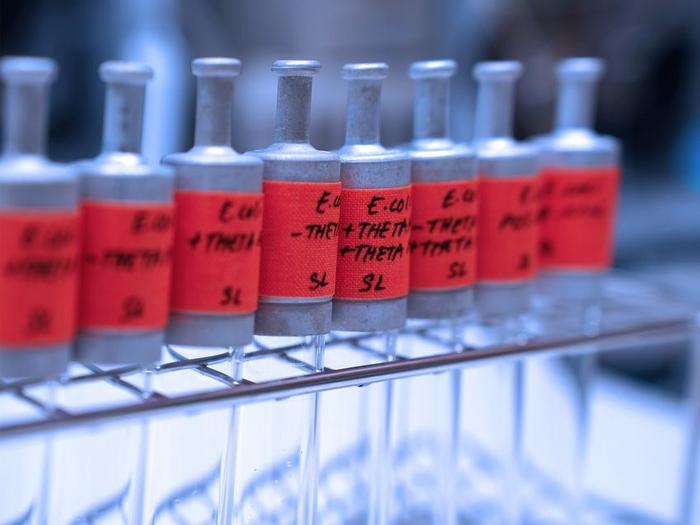
Credit: Max Planck Institute for Terrestrial Microbiology/Geisel
Synthetic biology offers the opportunity to build biochemical pathways for the capture and conversion of carbon dioxide (CO2). Researchers at the Max-Planck-Institute for Terrestrial Microbiology have developed a synthetic biochemical cycle that directly converts CO2 into the central building block Acetyl-CoA. The researchers were able to implement each of the three cycle modules in the bacterium E.coli, which represents a major step towards realizing synthetic CO2 fixing pathways within the context of living cells.
Developing new ways for the capture and conversion of CO2 is key to tackle the climate emergency. Synthetic biology opens avenues for designing new-to-nature CO2-fixation pathways that capture CO2 more efficiently than those developed by nature. However, realizing those new-to-nature pathways in different in vitro and in vivo systems is still a fundamental challenge. Now, researchers in Tobias Erb’s group have designed and constructed a new synthetic CO2-fixation pathway, the so-called THETA cycle. It contains several central metabolites as intermediates, and with the central building block, acetyl-CoA, as its output. This characteristic makes it possible to be divided into modules and integrated into the central metabolism of E. coli.
The entire THETA cycle involves 17 biocatalysts, and was designed around the two fastest CO2-fixing enzymes known to date: crotonyl-CoA carboxylase/reductase and phosphoenolpyruvate carboxylase. The researchers found these powerful biocatalysts in bacteria. Although each of the carboxylases can capture CO2 more than 10 times faster than RubisCO, the CO2-fixing enzyme in chloroplasts, evolution itself has not brought these capable enzymes together in natural photosynthesis.
The THETA cycle converts two CO2 molecules into one acetyl-CoA in one cycle. Acetyl-CoA is a central metabolite in almost all cellular metabolism and serves as the building block for a wide array of vital biomolecules, including biofuels, biomaterials, and pharmaceuticals, making it a compound of great interest in biotechnological applications. Upon constructing the cycle in test tubes, the researchers could confirm its functionality. Then the training began: through rational and machine learning-guided optimization over several rounds of experiments, the team was able to improve the acetyl-CoA yield by a factor of 100. In order to test its in vivo feasibility, incorporation into the living cell should be carried out step by step. To this end, the researchers divided the THETA cycle into three modules, each of which was successfully implemented into the bacterium E. coli. The functionality of these modules was verified through growth-coupled selection and/or isotopic labelling.
“What is special about this cycle is that it contains several intermediates that serve as central metabolites in the bacterium’s metabolism. This overlap offers the opportunity to develop a modular approach for its implementation.” explains Shanshan Luo, lead author of the study. “We were able to demonstrate the functionality of the three individual modules in E. coli. However, we have not yet succeeded in closing the entire cycle so that E. coli can grow completely with CO2,” she adds. Closing the THETA cycle is still a major challenge, as all of the 17 reactions need to be synchronized with the natural metabolism of E. coli, which naturally involves hundreds to thousands of reactions. However, demonstrating the whole cycle in vivo is not the only goal, the researcher emphasizes. “Our cycle has the potential to become a versatile platform for producing valuable compounds directly from CO2 through extending its output molecule, acetyl-CoA.” says Shanshan Luo.
“Bringing parts of the THETA cycle into living cells is an important proof-of-principle for synthetic biology”, adds Tobias Erb. “Such modular implementation of this cycle in E. coli paves the way to the realization of highly complex, orthogonal new-to-nature CO2-fixation pathways in cell factories. We are learning to completely reprogram the cellular metabolism to create a synthetic autotrophic operating system for the cell.”
Journal
Nature Catalysis
DOI
10.1038/s41929-023-01079-z
Subject of Research
Cells
Article Title
Construction and modular implementation of the THETA cycle for synthetic CO2 fixation. Nature Catalysis, 6(12), 1228-1240.
Article Publication Date
20-Dec-2023