Metal organic frameworks (MOFs) are advanced porous materials with multifunctional tunable properties. Discovered approximately 20 years ago, these sponge-like molecule structures are being improved today by scientists determinately to make positive change in the world. For example, these frameworks can capture water molecules in the desert or store and distribute energy sources more efficiently. They even can trap carbon dioxide before it’s released into the atmosphere. Indeed, one of their biggest potentials today lies in decelerating global warming.
Credit: Koç University
Metal organic frameworks (MOFs) are advanced porous materials with multifunctional tunable properties. Discovered approximately 20 years ago, these sponge-like molecule structures are being improved today by scientists determinately to make positive change in the world. For example, these frameworks can capture water molecules in the desert or store and distribute energy sources more efficiently. They even can trap carbon dioxide before it’s released into the atmosphere. Indeed, one of their biggest potentials today lies in decelerating global warming.
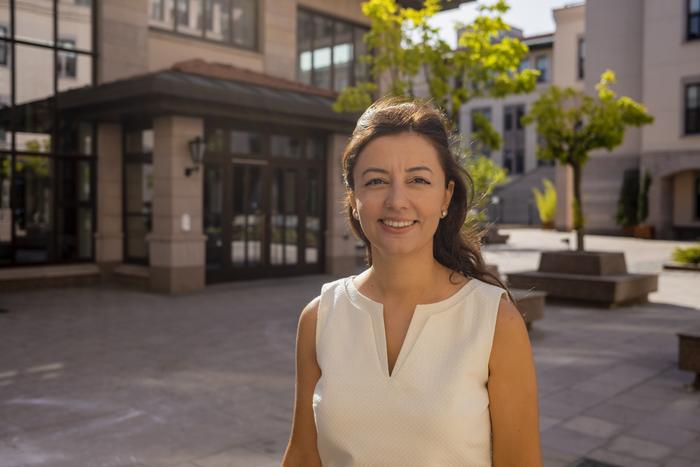
Researchers from Koç University are discovering the potential of the next-generation nano-porous materials. Prof. Dr. Seda Keskin Avcı from the Department of Chemical and Biological Engineering is known for her work on MOFs. Her recent project promises hope in critical areas such as cancer treatment and global warming. Titled “STARLET: Atomistic Modeling of Advanced Porous Materials for Energy, Environmental, and Biomedical Applications,” the project was recently awarded a 2 million Euro grant from the European Research Council (ERC). She holds the distinction of being the first researcher in Turkey to receive ERC’s Consolidator Grant support from the Products and Processes Engineering Panel (PE8).
In 2017, with her first ERC project COSMOS, Prof. Dr. Seda Keskin Avcı developed computer simulations that enabled testing these materials faster – a process otherwise bound to take years in the laboratory. Her new project STARLET aims to discover the most suitable materials for cancer treatments, clean energy storage, capturing toxic gases, and combating global warming through MOFs. The project aims to determine the performance of MOFs in different applications by combining atomic calculations, molecular simulations, data science methods, and experimental studies. This process will hopefully find ways to use MOFs even more efficiently. This improvement will enhance the application of MOFs in energy, environment, and biomedicine.
Prof. Dr. Seda Keskin Avcı shared the following details about her project: “In this project, we will focus on 10 critical molecules to address the world’s fundamental social problems: hydrogen and methane for the use of MOFs in clean energy storage; ammonia, carbon monoxide, carbon dioxide, and nitrogen oxides for effectively capturing toxic gases and combating global warming; fluorouracil, and methotrexate to use MOFs as nanocarriers in anti-cancer drug treatments; and nitrogen and oxygen to investigate the storage and distribution properties of MOFs for biomedical applications.
“One of the biggest achievements of the project will be the establishment of the world’s first database in this field. This database will include the storage and transportation properties of millions of MOFs for guest molecules. Within the scope of STARLET, design guides will also be created for high-performance MOFs to encourage the discovery of new materials.”
STARLET is one of the 308 projects selected from 2130 applications this year. The study will continue at Koç University for five years. Of the 50 ERC grants awarded to Turkey, 28 are led by Koç University faculty members.