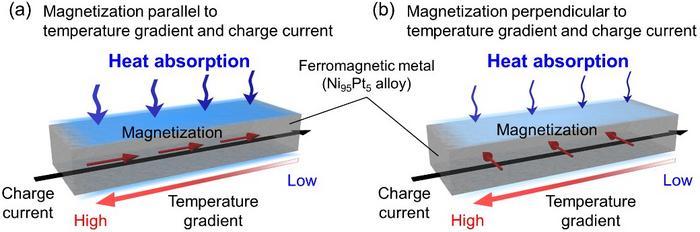
1. NIMS has succeeded in directly observing the “anisotropic magneto-Thomson effect,” a phenomenon in which the heat absorption/release proportional to an applied temperature difference and charge current (i.e., Thomson effect) changes anisotropically depending on the magnetization direction in magnetic materials. This research is expected to lead to further development of basic physics and materials science related to the fusion area of thermoelectrics and spintronics, as well as to development of new functionalities to control thermal energy with magnetism.
Credit: Ken-ichi Uchida
National Institute for Materials Science
1. NIMS has succeeded in directly observing the “anisotropic magneto-Thomson effect,” a phenomenon in which the heat absorption/release proportional to an applied temperature difference and charge current (i.e., Thomson effect) changes anisotropically depending on the magnetization direction in magnetic materials. This research is expected to lead to further development of basic physics and materials science related to the fusion area of thermoelectrics and spintronics, as well as to development of new functionalities to control thermal energy with magnetism.
2. The Thomson effect has long been known as one of the fundamental thermoelectric effects in metals and semiconductors, along with the Seebeck and Peltier effects, which are driving principles of thermoelectric conversion technologies. Although the influence of magnetism on the Seebeck and Peltier effects has been studied for many years, it has not been clarified how the Thomson effect is affected by magnetic fields and magnetism because the thermoelectric conversion of the Thomson effect is generally small and its measurement and quantitative estimation methods have not been fully established. Under such circumstances, NIMS reported in 2020 an experimental result in which the Thomson effect in nonmagnetic conductors was observed to change with a magnetic field (i.e., the magneto-Thomson effect). This time, we succeeded in observing the anisotropic magneto-Thomson effect in magnetic materials through more precise thermal measurements. The anisotropic magneto-Thomson effect in magnetic materials differs from the conventional magneto-Thomson effect in nonmagnetic materials, and this is the first direct observation of the unexplored phenomenon.
3. The NIMS research team used a thermal measurement technique called lock-in thermography to precisely measure the temperature distribution generated when a charge current is applied to a ferromagnetic alloy Ni95Pt5 while applying a temperature difference, and verified how the Thomson effect changes depending on the magnetization direction. As a result, it was found that the amount of heat absorption (or heat release) generated in the Ni95Pt5 alloy is larger when the temperature gradient and charge current are parallel to the magnetization than when they are perpendicular to the magnetization. This result is consistent with the behavior expected from measurements of the Seebeck and Peltier effects in magnetic materials.
4. This research has clarified the fundamental properties of the anisotropic magneto-Thomson effect and established techniques for its quantitative measurement. In the future, we will continue to explore the physics, materials, and functionalities of the anisotropic magneto-Thomson effect to investigate new physics caused by the interaction of heat, electricity, and magnetism, and to develop applications for thermal management technologies that will contribute to improved efficiency and energy conservation in electronic devices.
***
5. This project was carried out by Rajkumar Modak (Special Researcher, Research Center for Magnetic and Spintronic Materials (CMSM), NIMS), Takamasa Hirai (Researcher, CMSM, NIMS), Seiji Mitani (Director, CMSM, NIMS), and Ken-ichi Uchida (Distinguished Group Leader, CMSM, NIMS). This work was supported mainly by funding from the Japan Society for the Promotion of Science (JSPS): Grant-in-Aid for Scientific Research (B) (grant no. 19H02585), Grant-in-Aid for Scientific Research (S) (grant no. 22H04965), and JSPS Postdoctoral Fellowship for Research in Japan (Standard) (grant no. P21064).
6. This research was published in Physical Review Letters (vol. 131, p. 206701), a journal of the American Physical Society, on November 17, 2023.
Journal
Physical Review Letters
DOI
10.1103/PhysRevLett.131.206701
Method of Research
Experimental study
Subject of Research
Not applicable
Article Title
Observation of the Anisotropic Magneto-Thomson Effect
Article Publication Date
17-Nov-2023