Researchers at Uppsala University, together with colleagues at the Swedish Museum of Natural History, the University of Gothenburg, and institutions in seven other countries, have studied the relationships between five closely related species of larks that occur in Africa south of the Sahara. Two of these have not been observed for decades, so the researchers analysed DNA from museum specimens, some of which were over 100 years old.
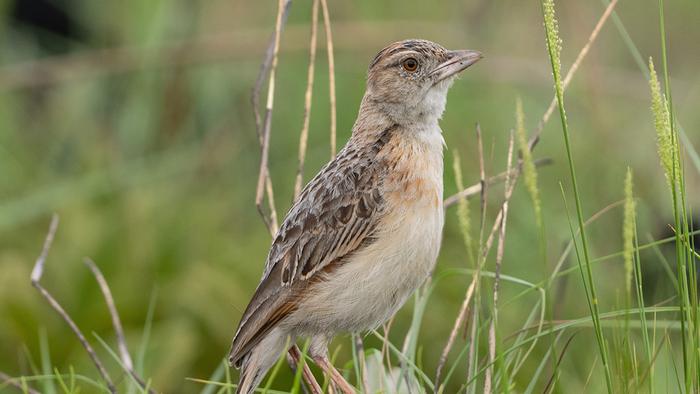
Credit: Per Alström
Researchers at Uppsala University, together with colleagues at the Swedish Museum of Natural History, the University of Gothenburg, and institutions in seven other countries, have studied the relationships between five closely related species of larks that occur in Africa south of the Sahara. Two of these have not been observed for decades, so the researchers analysed DNA from museum specimens, some of which were over 100 years old.
The DNA analyses revealed nine distinct evolutionary lines, which were estimated to have been separated for up to at least five million years – which is about as long as humans and chimpanzees have been separated. Five of these branches on the tree of life are normally classified as different subspecies of Rufous-naped Lark Corypha africana and two of them as subspecies of Red-winged Lark Corypha hypermetra. Based on the genetic results, combined with extensive analyses of plumage, size/structure, vocalisations and behaviours, the researchers demonstrated that the relationships are considerably more complex and that the branches were previously missorted. They propose that the two species be split into seven. Conversely, the analyses showed that Ash’s Lark Corypha ashi, which is only known from a few specimens collected in Somalia, is the same species as the slightly better-known Somali Lark Corypha somalica.
Most of the ‘new’ species are extremely poorly known, and the paper describes songs and behaviours for the first time for several of them. After the article was accepted for publication, the lead author, Per Alström at Uppsala University, had the opportunity to study one of the least known ‘new’ species in north-western Zambia, on the border with Angola, in November 2023.
“This species, which we propose be called Plains Lark Corypha kabalii, but which does not yet have a Swedish name, is even more distinct than we concluded based on the data we analysed earlier,” Alström comments. “Among other things, it has a unique display behaviour, which is probably used both for defending a territory and attracting females. The Plains Lark male rapidly ascends to a height of a few metres, where it claps its wings to produce a rather strong sound before descending to the ground again on spread wings.”
Another recently published paper by largely the same research group presented the family tree for all but one of the more than 100 lark species of the world. That study confirmed that many species that are similar in appearance are not closely related at all, but likely developed similarities due to similar living conditions – so-called convergent evolution. Conversely, some close relatives have diverged so much in appearance that their close relationship can no longer be traced in their external characteristics.
Journal
Zoological Journal of the Linnean Society
DOI
10.1093/zoolinnean/zlad107
Method of Research
Observational study
Subject of Research
Animals
Article Title
Integrative taxonomy reveals unrecognised species diversity in African Corypha larks (Aves: Alaudidae)
Article Publication Date
28-Sep-2023