“[…] the biological mechanisms linking aging and osteoarthritis prevalence remain largely unknown.”
Credit: 2023 Copp et al.
“[…] the biological mechanisms linking aging and osteoarthritis prevalence remain largely unknown.”
BUFFALO, NY- December 19, 2023 – A new research paper was published in Aging (listed by MEDLINE/PubMed as “Aging (Albany NY)” and “Aging-US” by Web of Science) Volume 15, Issue 23, entitled, “Sirtuin 6 activation rescues the age-related decline in DNA damage repair in primary human chondrocytes.”
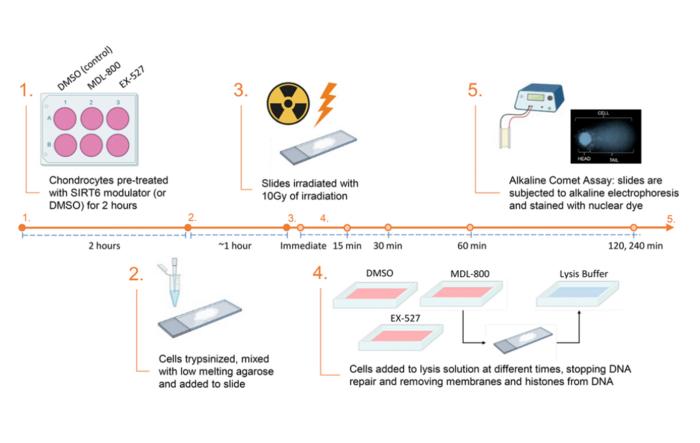
While advanced age is widely recognized as the greatest risk factor for osteoarthritis (OA), the biological mechanisms behind this connection remain unclear. Previous work has demonstrated that chondrocytes from older cadaveric donors have elevated levels of DNA damage as compared to chondrocytes from younger donors. In this new study, researchers Michaela E. Copp, Jacqueline Shine, Hannon L. Brown, Kirti R. Nimmala, Oliver B. Hansen, Susan Chubinskaya, John A. Collins, Richard F. Loeser, and Brian O. Diekman from University of North Carolina at Chapel Hill, North Carolina State University, Rush University Medical Center, and Thomas Jefferson University aimed to determine whether a decline in DNA repair efficiency is one explanation for the accumulation of DNA damage with age, and to quantify the improvement in repair with activation of Sirtuin 6 (SIRT6).
“In this study, we use irradiation as an acute model of DNA damage to bring the level of damage to equivalent levels across chondrocytes from donors of various ages.”
After acute damage with irradiation, DNA repair was shown to be more efficient in chondrocytes from young (≤45 years old) as compared to middle-aged (50–65 years old) or older (>70 years old) cadaveric donors. Activation of SIRT6 with MDL-800 improved the repair efficiency, while inhibition with EX-527 reduced the rate of repair and increased the percentage of cells that retain high levels of damage.
In addition to affecting repair after acute damage, treating chondrocytes from older donors with MDL-800 for 48 hours significantly reduced the amount of baseline DNA damage. Chondrocytes isolated from the knees of mice between 4 months and 22 months of age revealed both an increase in DNA damage with aging, and a decrease in DNA damage following MDL-800 treatment. Lastly, treating murine cartilage explants with MDL-800 lowered the percentage of chondrocytes with high p16 promoter activity, which supports the concept that using SIRT6 activation to maintain low levels of DNA damage may prevent the initiation of senescence.
“In conclusion, the findings presented here support the hypothesis that the efficiency of DNA damage repair declines with age in chondrocytes and that SIRT6 activation improves repair both in response to an acute irradiation challenge and in the context of age-related damage accumulation. These results emphasize the critical role of SIRT6 in DNA repair and support further studies investigating the use of MDL-800 (or alternative SIRT6 activators) in mitigating senescence induction and ameliorating OA development.”
Read the full paper: DOI: https://doi.org/10.18632/aging.205394
Corresponding Author: Brian O. Diekman
Corresponding Email: [email protected]
Keywords: SIRT6, MDL-800, cartilage, aging, comet assay
Sign up for free Altmetric alerts about this article: https://aging.altmetric.com/details/email_updates?id=10.18632%2Faging.https://doi.org/10.18632/aging.205394
About Aging:
Launched in 2009, Aging publishes papers of general interest and biological significance in all fields of aging research and age-related diseases, including cancer—and now, with a special focus on COVID-19 vulnerability as an age-dependent syndrome. Topics in Aging go beyond traditional gerontology, including, but not limited to, cellular and molecular biology, human age-related diseases, pathology in model organisms, signal transduction pathways (e.g., p53, sirtuins, and PI-3K/AKT/mTOR, among others), and approaches to modulating these signaling pathways.
Please visit our website at www.Aging-US.com and connect with us:
- SoundCloud
- X, formerly known as Twitter
- YouTube
- LabTube
Click here to subscribe to Aging publication updates.
For media inquiries, please contact [email protected].
Aging (Aging-US) Journal Office
6666 E. Quaker Str., Suite 1B
Orchard Park, NY 14127
Phone: 1-800-922-0957, option 1
###
Journal
Aging-US
DOI
10.18632/aging.205394
Method of Research
Observational study
Subject of Research
People
Article Title
Sirtuin 6 activation rescues the age-related decline in DNA damage repair in primary human chondrocytes
Article Publication Date
9-Dec-2023