WASHINGTON, Dec. 19, 2023 – A winter wonderland calls to mind piles of fluffy, glistening snow. But to reach the ground, snowflakes are swept into the turbulent atmosphere, swirling through the air instead of plummeting directly to the ground.
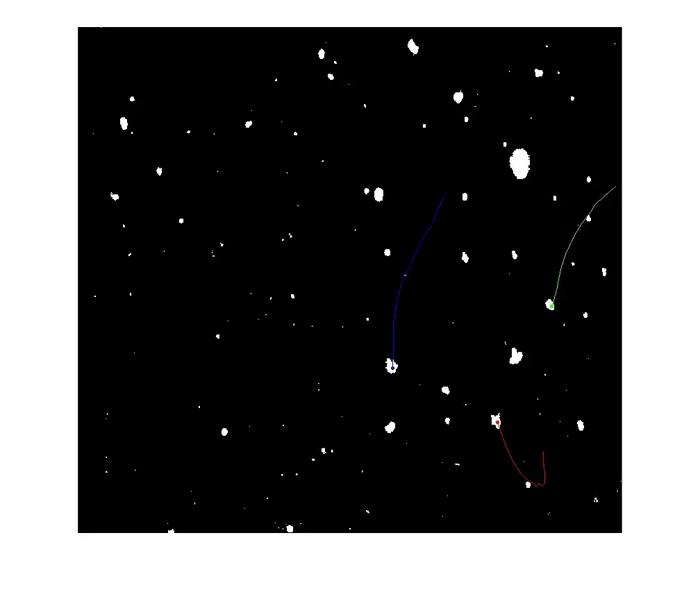
Credit: Singh et al.
WASHINGTON, Dec. 19, 2023 – A winter wonderland calls to mind piles of fluffy, glistening snow. But to reach the ground, snowflakes are swept into the turbulent atmosphere, swirling through the air instead of plummeting directly to the ground.
The path of precipitation is complex but important to more than just skiers assessing the potential powder on their alpine vacation or school children hoping for a snow day. Determining snowflake fall speed is crucial for predicting weather patterns and measuring climate change.
In Physics of Fluids, from AIP Publishing, researchers from the University of Utah report snowflake accelerations in atmospheric turbulence. They found that regardless of turbulence or snowflake type, acceleration follows a universal statistical pattern that can be described as an exponential distribution.
“Even in the tropics, precipitation often starts its lifetime as snow,” said author Timothy Garrett. “How fast precipitation falls greatly affects storm lifetimes and trajectories and the extent of cloud cover that may amplify or diminish climate change. Just small tweaks in model representations of snowflake fall speed can have important impacts on both storm forecasting and how fast climate can be expected to warm for a given level of elevated greenhouse gas concentrations.”
Set up in a ski area near Salt Lake City, the team battled an unprecedented 900 inches of snow. They simultaneously filmed snowfall and measured atmospheric turbulence. Using a device they invented that employs a laser light sheet, they gathered information about snowflake mass, size, and density.
“Generally, as expected, we find that low-density ‘fluffy’ snowflakes are most responsive to surrounding turbulent eddies,” said Garrett.
Despite the system’s complexity, the team found that snowflake accelerations follow an exponential frequency distribution with an exponent of three halves. In analyzing their data, they also discovered that fluctuations in the terminal velocity frequency distribution followed the same pattern.
“Snowflakes are complicated, and turbulence is irregular. The simplicity of the problem is actually quite mysterious, particularly given there is this correspondence between the variability of terminal velocities – something ostensibly independent of turbulence – and accelerations of the snowflakes as they are locally buffeted by turbulence,” said Garrett.
Because size determines terminal velocity, a possible explanation is that the turbulence in clouds that influences snowflake size is related to the turbulence measured at the ground. Yet the factor of three halves remains a mystery.
The researchers will revisit their experiment this winter, using a mist of oil droplets to obtain a closer look at turbulence and its impact on snowflakes.
###
The article “A universal scaling law for Lagrangian snowflake accelerations in atmospheric turbulence” is authored by Dhiraj Kumar Singh, Eric R. Pardyjak, and Timothy Garrett. It will appear in Physics of Fluids on Dec. 19, 2023 (DOI: 10.1063/5.0173359). After that date, it can be accessed at https://doi.org/10.1063/5.0173359.
ABOUT THE JOURNAL
Physics of Fluids is devoted to the publication of original theoretical, computational, and experimental contributions to the dynamics of gases, liquids, and complex fluids. See https://pubs.aip.org/aip/pof.
###
Journal
Physics of Fluids
DOI
10.1063/5.0173359
Article Title
A universal scaling law for Lagrangian snowflake accelerations in atmospheric turbulence
Article Publication Date
19-Dec-2023