Since 2009, the Cambridge Conservation Initiative has coordinated an annual horizon scan, a well-established method for predicting which threats, changes, and technologies will have the biggest impact on biological conservation in the following year. This year, the 15th horizon scan included 31 scientists, practitioners, and policymakers who developed a list of 96 issues, which they eventually narrowed down to the fifteen most novel and impactful. Their findings, publishing in the journal Trends in Evolution & Ecology on December 18, include topics related to sustainable energy, declining invertebrate populations, and changing marine ecosystems.
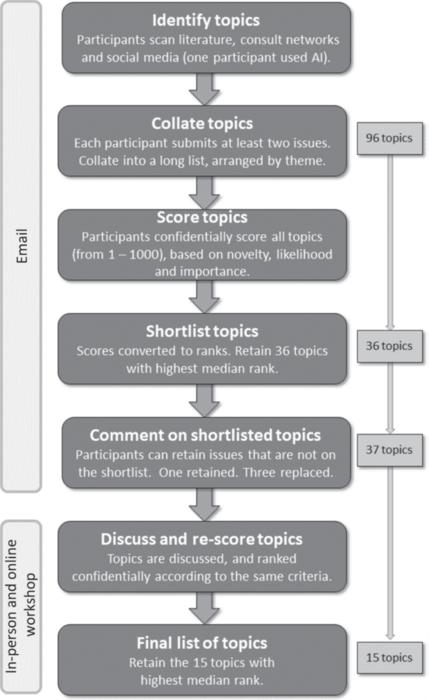
Credit: Current Biology, Sutherland et al.
Since 2009, the Cambridge Conservation Initiative has coordinated an annual horizon scan, a well-established method for predicting which threats, changes, and technologies will have the biggest impact on biological conservation in the following year. This year, the 15th horizon scan included 31 scientists, practitioners, and policymakers who developed a list of 96 issues, which they eventually narrowed down to the fifteen most novel and impactful. Their findings, publishing in the journal Trends in Evolution & Ecology on December 18, include topics related to sustainable energy, declining invertebrate populations, and changing marine ecosystems.
The fifteen topics identified by the scan include:
- New sources of hydrogen for energy production, including seawater electrolysis
- Decarbonized ammonia production for fertilizer and fuel using water microdroplets, graphite mesh, and nitrogen
- Making food and animal feed with fish-like nutrients from autotrophic hydrogen-oxidizing bacteria
- Indoor agriculture in urban environments using light-free artificial photosynthesis
- Excessive usage of rock dusts to remineralize large amounts of carbon and put ecosystems at risk for heavy metal contamination
- Earthworm populations to continue declining, especially in farmland and broadleaved woodland area ecosystems, potentially due to pesticides
- Soil ecoacoustics, which project sounds like water moving through soil, poised to help monitor soil ecology and invertebrate populations
- Wildfires to change climate patterns like El Niño by releasing trapped aerosols
- Benchtop DNA printers, which can produce double-stranded DNA sequences on demand, to become increasingly advanced, widespread, and in need of regulation
- New methods to measure a chemical’s toxicity before adverse impacts surface
- Saudia Arabia’s planned “sustainable” ultra-tall skyscraper city to impact migratory birds
- Sea urchins to continue dying off rapidly worldwide, potentially due to a protist pathogen, which could threaten tropical ecosystems
- Testing methods to remove carbon dioxide from the ocean including using ocean fertilization, macroalgae, and rock injections
- Rising temperatures in the twilight zone to disturb the ocean’s biological carbon pump
- Melting Antarctic ice to alter deep sea ocean currents, reducing abyssal overturning by 40% by 2050
“The issues identified in this scan continue to reflect the juxtaposition between anthropogenic impacts on biodiversity and increasing technological capacity to mitigate those impacts,” write the researchers, led by conservationist William Sutherland (@Bill_Sutherland) of Cambridge University. “In some cases, new issues arise directly from efforts to mitigate other issues.”
The authors identify several common threads in the list of issues, including threats to marine ecosystems. They underscore the importance of recent marine policy initiatives to help address these threats while noting that these efforts will not help resolve the climate-related issues identified. They also discuss the continued importance of innovation in carbon capture and sustainable energy technologies.
“We anticipate continuing to highlight novel emerging impacts of climate change and technologies aiming to mitigate climate change and transition to more sustainable pathways in future horizon scans,” write the researchers.
###
This research was supported by funding from The Pew Charitable Trusts, the Natural Environment Research Council, and the Royal Society for the Protection of Birds.
Trends in Ecology & Evolution, Chang et al. “A horizon scan of global biological conservation
4 issues for 2024” https://www.cell.com/trends/ecology-evolution/fulltext/S0169-5347(23)00295-1
Trends in Ecology & Evolution (@Trends_Ecol_Evo), published by Cell Press, is a monthly review journal that contains polished, concise, and readable reviews and opinion pieces in all areas of ecology and evolutionary science. It aims to keep scientists informed of new developments and ideas across the full range of ecology and evolutionary biology—from the pure to the applied, and from molecular to global. Visit http://www.cell.com/trends/ecology-evolution. To receive Cell Press media alerts, please contact [email protected].
Journal
Trends in Ecology & Evolution
DOI
10.1016/j.tree.2023.11.001
Method of Research
Systematic review
Subject of Research
Not applicable
Article Title
A horizon scan of global biological conservation issues for 2024
Article Publication Date
18-Dec-2023